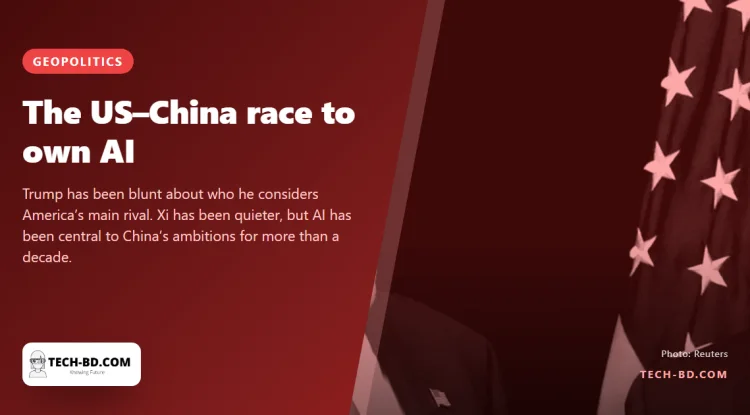
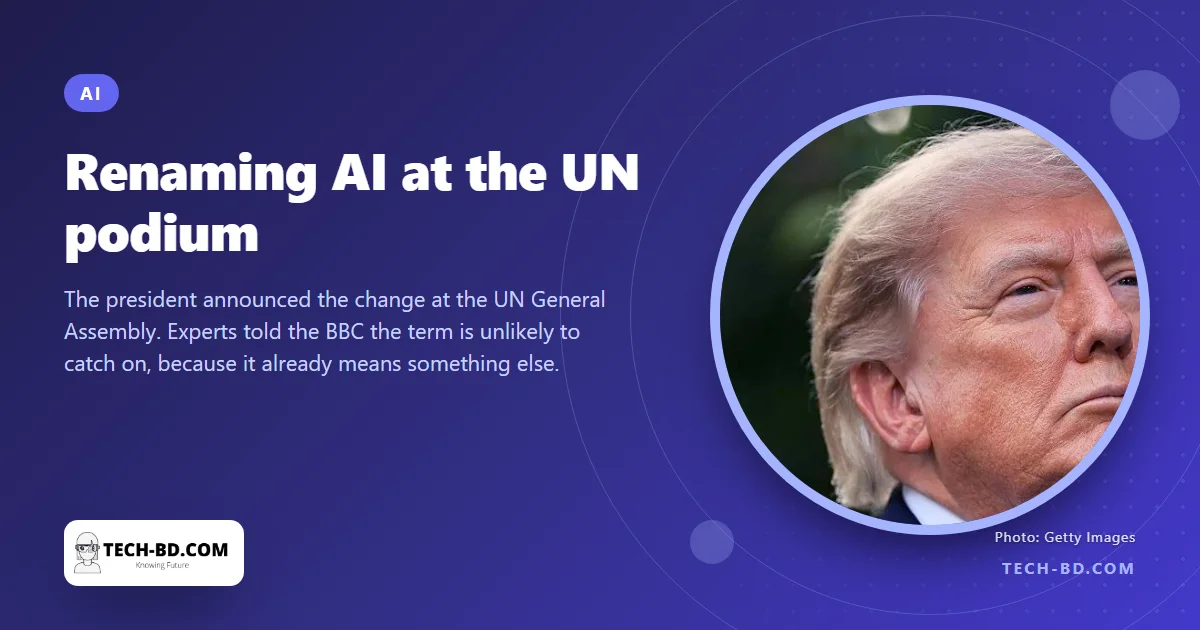
US President Donald Trump says the term artificial intelligence makes the technology "sound fake", and wants it called "super intelligence" instead.
The announcement
"Welcome to the new world of super intelligence — SI," he said during a wide-ranging speech to the United Nations General Assembly in New York.
"From this point forward, all of United States' documents, and hopefully the world's, will be changed to use the more accurate term 'super' as opposed to 'artificial'. So it's 'super intelligence'," he said. In the preceding week he had asked his social media followers to vote on other candidates, including superior intelligence, extreme intelligence and supreme intelligence.
It is his latest rebranding, after the names of Lake Ontario and the Gulf of Mexico were changed on US maps and federal communications.
Some people close to the president began using the term immediately. Experts told the BBC it is unlikely to gain traction in the industry, because superintelligence already has a meaning — it refers to systems far more advanced than anything now in use. The speech was reported by AFP, Euronews, The Independent and the South China Morning Post.
What it means in Bangladesh
It would be easy to file this as a curiosity. There is a real cost buried in it, and Bangladesh is well placed to pay it.
The word "artificial" is doing useful work. It marks the thing as made, and therefore as having makers who chose what it does and who are answerable for it. "Super" marks it as better. One of those words invites a citizen to ask who built this and on what data; the other invites deference.
That matters most where public understanding is thinnest and where the technology is arriving through marketing rather than through institutions. In Bangladesh, AI is currently reaching most people as a claim in an advertisement — an "AI-powered" loan app, an "AI" tutoring service, an "AI" diagnostic. The already-common problem is that the label is treated as evidence of quality. A term that literally means "better intelligence" makes that problem worse, not better.
There is also a narrower drafting point worth flagging now, while it is cheap. Bangladesh is at the stage of writing its first rules touching this technology — in data protection, in financial services, in education. Legal texts should use defined terms, not political ones. A statute that says "super intelligence" inherits a definitional fight with the research field, where the word already denotes something that does not yet exist. A statute that says "automated decision-making system" describes what is actually being regulated and survives the next rebrand.
The more useful question for a Bangladeshi reader is not what to call it. We set out the version that affects people's pay in whether promotion should depend on AI use.