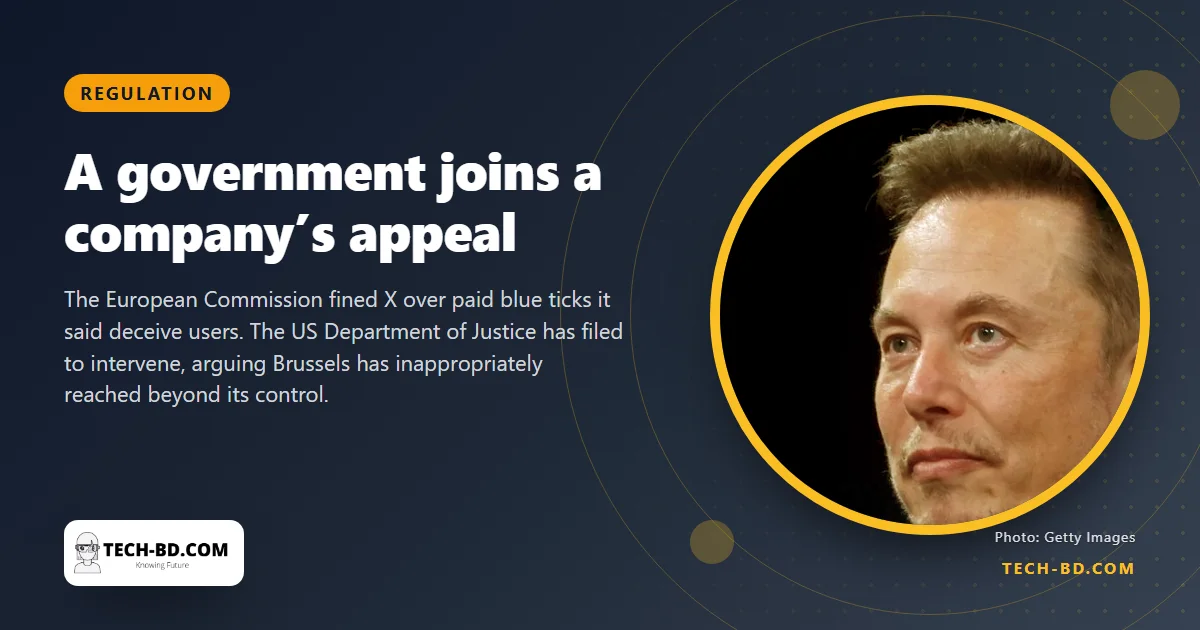
The US government is seeking to join Elon Musk's legal challenge to overturn a €120m (£105m) EU fine against X over its blue tick badges.
What the fine was for
In December 2025 the European Commission said the platform "deceives users" by letting people pay for a blue verified check mark, because it is not "meaningfully verifying" who is behind the account. The reasoning matters: the blue tick originally signified that a platform had checked an identity, and selling it turned a verification signal into a subscription feature while leaving the old meaning in users' heads.
US Assistant Attorney General Brett A. Shumate said the Commission had "inappropriately attempted" to extend its reach to American companies outside its control. The Department of Justice has filed an application with the EU's General Court supporting the attempt to dismiss the case, citing a provision under which a state may intervene where it can establish an interest in the result.
Musk, who spent millions helping elect Donald Trump and other Republicans, has previously said EU tech regulation "inhibits progress". The filing was reported by outlets including The Next Web and NDTV Profit, which put the fine at about $137m.
What it means in Bangladesh
Strip out the personalities and this is a case about whether a country can set conditions on a foreign platform operating inside it. That question matters far more to Bangladesh than to the EU, because the EU can enforce an answer and Bangladesh largely cannot.
Bangladesh has tens of millions of users on platforms with no local establishment, no local tax presence in most cases, and no obligation that can be practically enforced against them. When a Bangladeshi regulator asks for something, compliance is voluntary. The EU's leverage comes from a market large enough that leaving it is unthinkable; Bangladesh's leverage is the ability to block, which is a blunt instrument that mostly harms its own users and businesses.
The second point is the one worth watching. If the argument that regulating a US company is itself improper gains ground, it weakens every country's ability to impose local rules — not only the EU's. A precedent built to protect an American firm from Brussels is available to protect it from Dhaka, and Dhaka has no comparable counterweight.
The third is directly practical. The underlying complaint — that a paid badge means something different from what users think it means — describes a live harm in Bangladesh. Verification badges are widely read here as proof that a page is genuine, and impersonation of banks, mobile financial services, government offices and well-known individuals is a routine route to fraud. Whatever the court decides about the fine, the consumer point stands: a blue tick now means someone paid, not that anyone checked.
The reverse case — a European court successfully protecting a design against a large retailer — is in the court that priced a copy.