
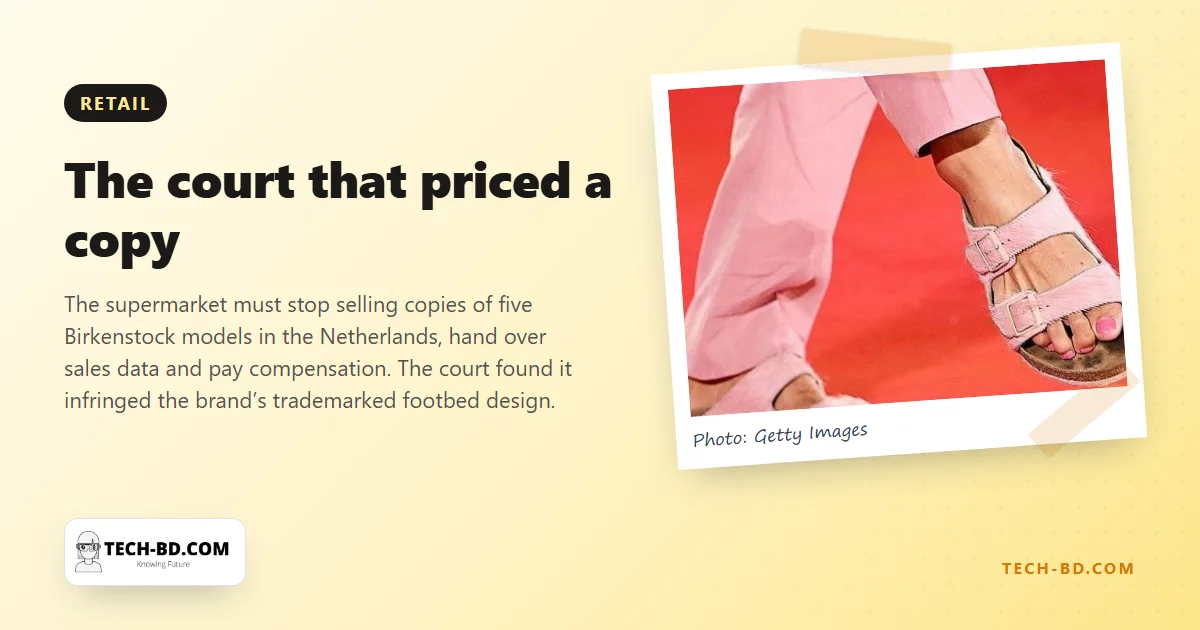
Lidl must stop selling copycat versions of Birkenstock's sandals in the Netherlands, a Dutch court has ruled.
The terms
The discount supermarket chain faces a fine of €5,000 (£4,200) per day if it fails to comply, and must hand over sales data to Birkenstock. It must also compensate the company and pay its legal fees, with the amounts to be decided separately.
The ruling — which can still be appealed — covers Lidl's copies of the Arizona, Madrid, Gizeh, Boston and Florida models, after the court found the grocer infringed the brand's trademarked "footbed design". It is the latest in a string of court decisions on Birkenstock designs.
Birkenstock said the judgement sent a clear message that "copycats must not be allowed to free-ride on [our] creativity and innovation". The BBC contacted Lidl for comment. The ruling was reported by NL Times and other outlets the same week.
What it means in Bangladesh
This is a story Bangladeshi manufacturers should read closely, because the country sits on both sides of it.
On one side, Bangladesh is a large producer of footwear and leather goods, and a share of that output is explicitly derivative — "same as" versions of European designs, made for domestic sale and for export to markets where enforcement is weak. That is a real business today and a liability tomorrow: as Bangladeshi firms move toward selling directly into Europe rather than through buying houses, they inherit the legal exposure that buying houses used to absorb.
On the other side is the part that gets less attention. Bangladeshi design is copied constantly, domestically and abroad, with no practical remedy. Jamdani has a geographical indication; the vast majority of contemporary Bangladeshi fashion, leather and craft design has nothing. A designer whose print appears on a competitor's shelf three weeks later has, in practice, no route that is faster or cheaper than giving up.
The instructive detail in the Dutch ruling is what was actually protected: not a logo, but a functional shape — the contoured footbed. That is a hard right to obtain and an extremely valuable one, because it protects the product rather than the label. It is also the category of protection Bangladeshi producers almost never apply for, largely because the design registration system here is slow, little-used and poorly understood.
For an exporting firm, the practical takeaways are narrow and cheap. Check whether what you are producing infringes a registered design before shipping it to a jurisdiction that enforces. Register your own designs where you sell them, not only where you make them. And treat a buyer's instruction to copy as the transfer of risk it is — get the indemnity in writing, because the court that issues the injunction will not be interested in whose idea it was.
The brand economics underneath all of this are the ones we set out in wearing your favourite tech firm.