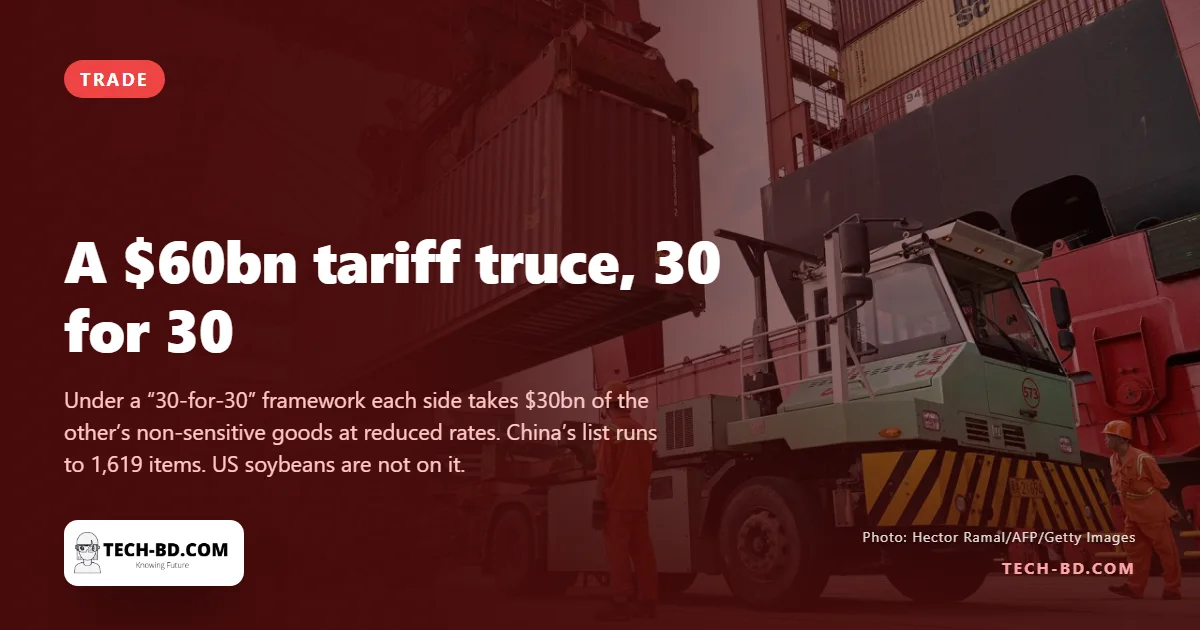
The United States and China have agreed to slash tariffs on $60bn worth of goods, extending relief across products from US coal and agricultural goods to Chinese-made toys, car seats and holiday decorations.
The shape of it
The White House announcement followed last week's meeting between Donald Trump and Xi Jinping in Washington. Under a "30-for-30" framework, each country may import "non-sensitive" goods worth $30bn from the other at reduced rates. US trade representative Jamieson Greer said it would improve market access for about 30% of US exports to China.
China's list covers 1,619 items — corn, wheat, frozen meat, seafood, wood products, cosmetics, medical devices. The US list covers 77, including toys, tableware, kitchen accessories, curtains, electric shavers and inflatable balls. China will also import at least 10 million metric tons of US coal in 2027 and again in 2028.
US soybeans were not included — a blow to American farmers who have been collateral damage in the trade war. Existing truce levels stay at 30% on Chinese goods and 10% on US goods, paused until 10 January.
There is a technology footnote with real weight: the two sides agreed to establish a bilateral channel for AI-related "incidents", and to use the term "super intelligence" rather than artificial intelligence. A US-China Super Intelligence Dialogue will next meet by November 2026.
What it means in Bangladesh
Bangladesh is not at this table and is affected by it anyway, in two opposite directions.
The first is competitive. Every tariff line the US lowers for Chinese goods narrows the price gap that has been sending buyers towards Bangladesh, Vietnam and Cambodia. The 77 items on the US list are mostly not garments, so the immediate effect on Bangladesh's core export is small — but the direction of travel is the thing to watch. Bangladesh's recent order growth has been substantially a by-product of US-China friction. A durable thaw removes part of that tailwind.
The second is input costs, and it points the other way. Bangladesh imports a great deal of Chinese machinery, fabric, accessories and intermediate goods. Anything that stabilises Chinese export pricing and shipping is broadly good for a Bangladeshi factory's cost base.
The soybean exclusion is worth noticing for a different reason. It shows these deals are decided item by item, by who has leverage on that item — not by principle. A country that wants a line item protected has to be in the room when the list is written. Bangladesh's trade diplomacy is overwhelmingly focused on preferences it receives; this is a reminder that the consequential negotiations are the ones between other people.
And the rebranding is not a footnote either. Two governments have now agreed on the vocabulary before agreeing on the rules — we set out why the word matters in renaming AI at the UN podium, and the rivalry underneath it in the race to own AI.