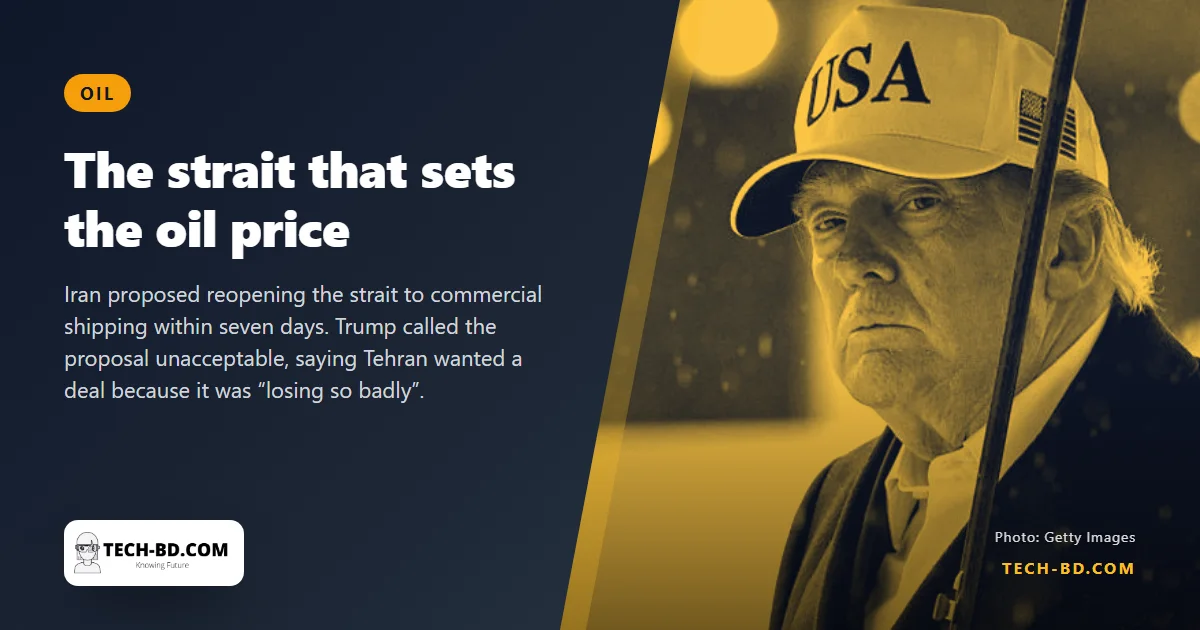
Only a "negotiated solution" can end the conflict between the US and Iran, Tehran's foreign minister has said, after President Donald Trump publicly rejected a proposal to reopen the Strait of Hormuz.
What was proposed and refused
Trump told reporters at the White House that Iran's proposal was not "acceptable", and that Tehran wanted a deal to open the strait to commercial shipping within seven days because "they're losing so badly".
In a post on Telegram, Iranian Foreign Minister Abbas Araghchi acknowledged the rejection but said Iran would wait for a "definitive" official US response, noting the president had made contradictory statements in the past. Araghchi said the conditions for opening the strait were the same as those in a memorandum of understanding signed in June. Iran said it had raised reopening the strait during talks on the sidelines of the UN General Assembly. The rejection was reported by the Financial Times, The Times and The Guardian, among others.
The strait is a technology chokepoint as much as a geographic one
Hormuz is narrow — the shipping lanes within it narrower still, a few kilometres wide in each direction. A tanker the length of three football pitches, drawing twenty metres, has very little room to be approximate about where it is. That has consequences people outside shipping rarely consider.
Position comes from satellites. Modern merchant navigation runs on satellite positioning feeding an electronic chart display, with radar as the cross-check. Those satellite signals arrive from twenty thousand kilometres away at a power lower than background noise, which makes them trivial to overwhelm with a local transmitter. Jamming — drowning the signal so the receiver has nothing — is detectable: the display says it has lost position and the crew falls back to radar and visual bearings. Spoofing is the serious one: broadcasting a counterfeit signal so the receiver confidently reports a position that is wrong, sometimes by miles. A ship that believes it is in the lane when it is not, in a channel this tight, is a grounding or a boarding waiting to happen. Persistent interference around the Gulf has been reported for years, and it is the reason mariners are repeatedly reminded to keep traditional position-fixing current rather than treating the chart display as truth.
Identity is self-declared. The system the world watches shipping through — the one behind every live tanker-tracking map — is AIS, a transponder that broadcasts a vessel's identity, position, course and speed to anyone in range, originally for collision avoidance and now received by satellite. It is not surveillance imposed on ships. It is a radio each ship switches on itself.
Which means it can be switched off, and routinely is. A vessel that goes dark disappears from the public picture entirely. The same transponder can also be made to lie, broadcasting a false identity or position. The "dark fleet" that moves sanctioned cargo depends on exactly this, and it is why satellite imagery and radar have become the check on AIS rather than the other way round: a transponder reports what its operator wants reported, while a radar return is a hull.
So a disruption at Hormuz does not begin with a blockade. It begins with insurance rates, with navigation becoming unreliable, and with the public tracking picture degrading at the moment everybody most wants to know where the cargo is.
Why a gas-fired grid is exposed to a shipping lane
Bangladesh is more exposed to this than most countries of its size, and the reason is the generation mix rather than the oil price.
A very large share of the world's seaborne crude and, critically, liquefied natural gas passes through the strait. The import basket runs directly through it: crude and refined products for the refinery and the diesel market come predominantly from the Gulf, and so does LNG, on long-term contracts with Qatar and Oman. Qatari LNG has no alternative route out — there is no pipeline bypass.
The effects stack rather than substitute. A constrained strait raises the delivered price of crude, diesel and LNG at the same time. That appears as a higher import bill, pressure on the taka, a larger subsidy requirement and — because a significant share of electricity is gas-fired — a direct constraint on generation. The industrial version of that constraint is gas rationing to factories, which the country has already experienced.
Three things to watch rather than guess at
Whether the June memorandum is revived, since both sides describe the same conditions. Whether Gulf producers can route more volume through alternatives such as the East-West pipeline across Saudi Arabia, which has limited capacity and cannot carry Qatari LNG at all. And whether spot LNG purchases continue at prices set in this environment, since spot is where volatility lands first.
What a fuel importer can do about any of it is limited. What it can do is hold larger strategic reserves, contract further ahead, and accelerate the domestic generation that does not depend on an imported molecule — the case for which is made, in its solar form, in how oil country took to solar.