
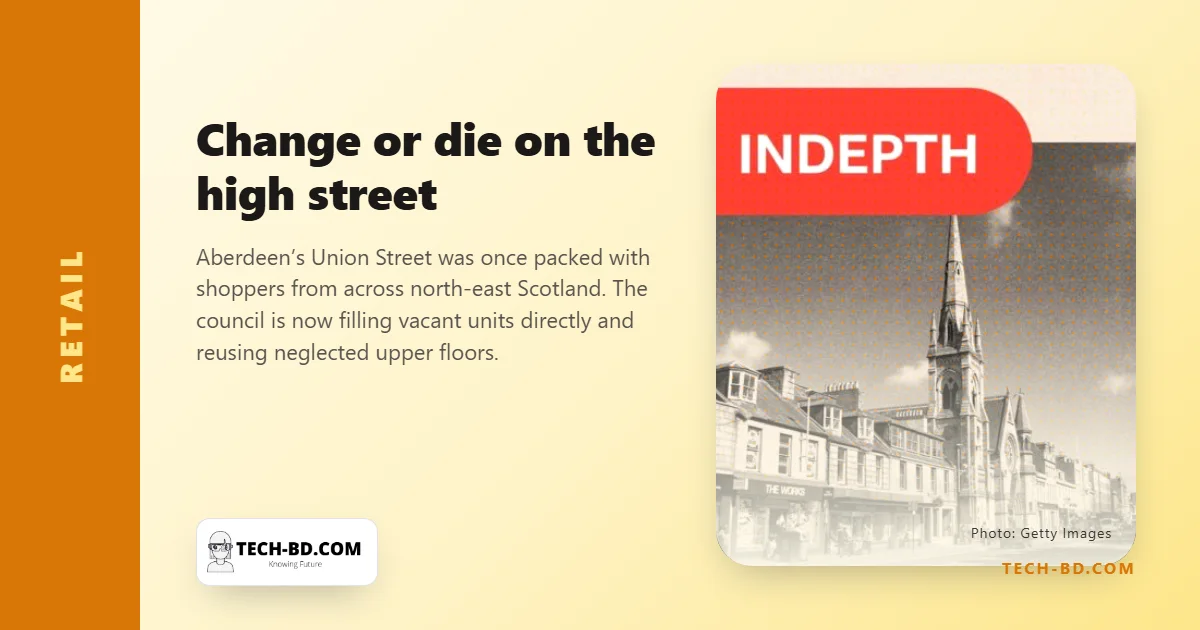
Union Street — Aberdeen's main thoroughfare, nicknamed the Granite Mile after the local silver-grey stone — was once packed with shoppers from across the north-east of Scotland.
What happened to it
"I come to Union Street to take a bus somewhere else... there's nothing to shop for now… it's horrendous," says Marie Sim, a lifelong Aberdeen resident.
It is a similar story across the country: high streets once bursting with shops, hit first by the rise of out-of-town retail centres and then by online commerce.
But Aberdeen is in the middle of an ambitious turnaround. The port city has essentially declared war on its empty shop problem, taking an unusually hands-on approach to filling vacant units and bringing long-neglected upper floors of buildings back into use. The council is also pouring tens of millions into making the city centre a destination again — leaning, like many other places, into the "experience economy", with a new indoor food and drink market and a major seafront redevelopment.
The same sequence, running faster in Dhaka
The sequence that emptied Union Street — out-of-town retail first, then online — is running in Bangladesh right now, compressed into a much shorter period.
Dhaka's traditional retail streets and older markets are losing footfall to two things at once: air-conditioned shopping complexes with parking, and e-commerce. New Market, Gulistan, Islampur and the older sections of Chattogram's Terri Bazar are not declining because the shopkeepers got worse. They are competing with a format that offers comfort and a format that requires no travel at all.
The Aberdeen response is worth studying because it is not nostalgia. Two elements are directly transferable.
The first is the upper floors. Almost every commercial street in urban Bangladesh has substantial vacant or semi-derelict space above the ground-floor shops, held by owners with no incentive to bring it into use. That space is the cheapest available urban housing and office stock in the country, and it already has services connected. The obstacles are ownership fragmentation, absent fire access, and a tax structure that does not penalise leaving it empty.
The second is the recognition that a shopping street now has to be somewhere people want to be, not merely somewhere they need to go. What kills a Bangladeshi market street is the thing the shopkeepers themselves complain about — no footpath left to walk on, no parking, no shade, nowhere to sit, and traffic that makes crossing dangerous. Those are municipal decisions, not retail ones, and they determine whether a customer comes at all.
The honest caveat is that Aberdeen's plan costs tens of millions of pounds of public money, and no Bangladeshi city corporation has that. But the cheapest interventions in this story — clearing footpaths, reusing upper floors, deciding a street is for people rather than for parked cars — are the ones that do not require it.
Why a customer pays for belonging rather than for an object is the other half of the "experience economy", and it is in wearing your favourite tech firm.