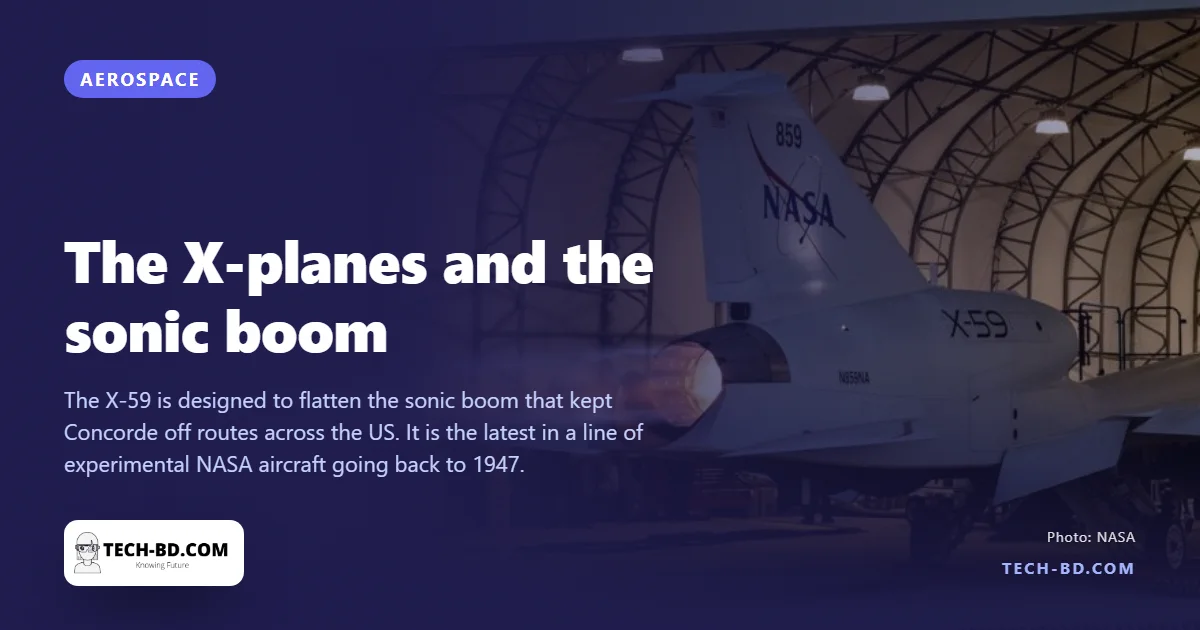
There is a weird and wonderful jet flying over the United States. It has the nose of an anteater, parts cannibalised from other planes, and a cockpit set so far back that the pilot depends on a camera to see where he is going.
What the shape is for
The X-59 owes its eccentric design to the problem of sonic booms. The shockwave created by a jet breaking the sound barrier restricted Concorde to flights over the sea and barred it from lucrative routes across the US. NASA is working around that with the X-59's elongated snout, which is intended to flatten supersonic booms into tolerable bumps in the background.
It carries a remarkable lineage: the latest in a series of experimental NASA aircraft dating back to 1947 and the Bell X-1, the first plane to break the sound barrier.
Peter Coen, a 43-year NASA veteran who manages the programme, explains the philosophy behind eighty years of X-planes: "Our approach is to pick small goals we aim to prove with flight data and we construct an airframe for that one task."
What it means in Bangladesh
Supersonic transport is not a Bangladeshi question. Coen's sentence is, and it is the most portable piece of engineering management advice in this month's reporting.
Pick one small goal, prove it with data, build the minimum thing that tests it. That is the opposite of how most publicly funded technical projects in Bangladesh are structured. The pattern here is the ambitious integrated programme — a smart city, a national platform, a flagship centre — announced complete, budgeted complete, and evaluated on whether it was delivered rather than on what was learned.
The X-plane model is cheaper and more honest. Each aircraft answers one question. Several were failures in the ordinary sense — they crashed, or they proved the idea did not work — and that outcome still counted as a result, because the programme was designed to produce knowledge rather than a product.
Bangladesh has a real need for that structure in the areas where it actually has problems worth solving: flood-resilient construction, low-cost water treatment, solar irrigation at smallholder scale, cold chain for agriculture, saline-tolerant crops. These are fields where a small prototype tested against measured criteria would teach more than a large programme delivered to specification.
The institutional barrier is not money. It is that a Bangladeshi research grant or public project that produces a negative result is treated as a failure to be buried rather than a finding to be published — which guarantees the same idea is funded again five years later by someone who never heard it had been tried.
The one-purpose airframe has an industrial cousin in the fragility behind aircraft windows: extreme specialisation buys capability and costs resilience.