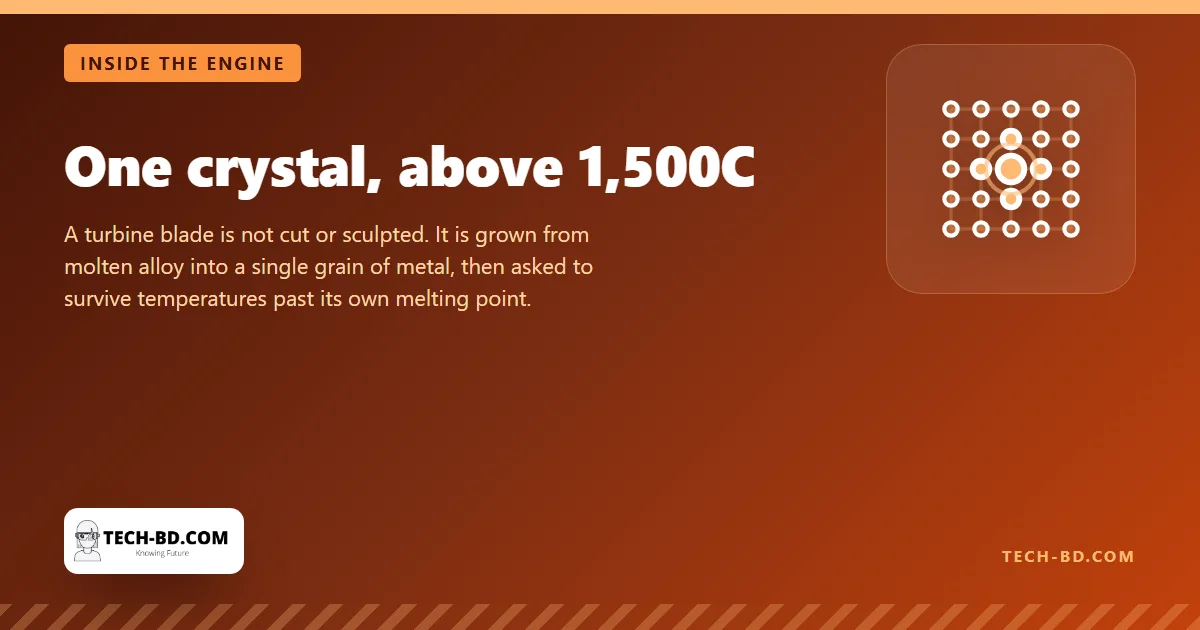
Inside every jet engine, hidden behind the smooth outer casing, are hundreds of small turbine blades that endure enormous mechanical stress at temperatures above 1,500C.
They are not cut, machined or sculpted from a block of metal. They are grown.
How you grow a piece of metal
The technique dates from the 1960s. Engineers take a molten metal alloy, cast it into the shape of a blade, and then cool it extremely slowly from one end to the other over a matter of hours.
Done precisely, a single crystal — one continuous grain of metal alloy — forms across the whole component as it solidifies. The BBC's description is the clearest one available: it is like turning a cup of water into one big snowflake of your own design, rather than a blizzard of many small ones.
The reason this matters is where metal fails. An ordinary casting is a mass of small grains locked together, and the boundaries between those grains are the weak points — where cracks start and where the metal slowly deforms under sustained heat and load. Remove the boundaries entirely and you remove the failure mode.
"About as complicated as manufacturing gets"
That is Ben Fifoot, a manufacturing engineer at Rolls-Royce, which makes turbine blades in the UK. He added that it is "a real motivator to get out of bed in the morning".
The difficulty shows in who can do it. Only a handful of companies worldwide produce single crystal turbine blades, and the process has been perfected end to end in just five countries, including the United States and the United Kingdom. Rolls-Royce, GE and France's Safran are among the few firms that have mastered it.
The money has become conspicuous
In September, GE Aerospace announced it would acquire its turbine blade supplier for $11.75bn (£8.78bn). Neither company responded to the BBC's requests for comment, but the move has been read as securing the supply of a critical component.
In March, Rolls-Royce said it would invest more than £19m in its blade casting facility at Rotherham.
Bill Sweetman, an aviation industry writer and consultant, puts the demand plainly: "Demand for [turbine blades] is huge. So few companies have managed to do it, which does give it this kind of magical aura." He suspects GE's acquisition is about securing reliability and predictability in an aircraft manufacturing supply chain that is notoriously volatile.
Why a component you will never see is strategic
China is working to prove its engineers can produce blades matching Western quality — and that effort is the clearest signal of what these objects represent.
An aero engine is the part of an aircraft that cannot be reverse-engineered from the outside. A country that cannot make single crystal blades cannot make a competitive large jet engine, and must buy them from someone who can, on terms that other country sets.
Paying $11.75bn for a supplier is not an unusual price for a component business. It is an ordinary price for removing the possibility that somebody else buys it first.