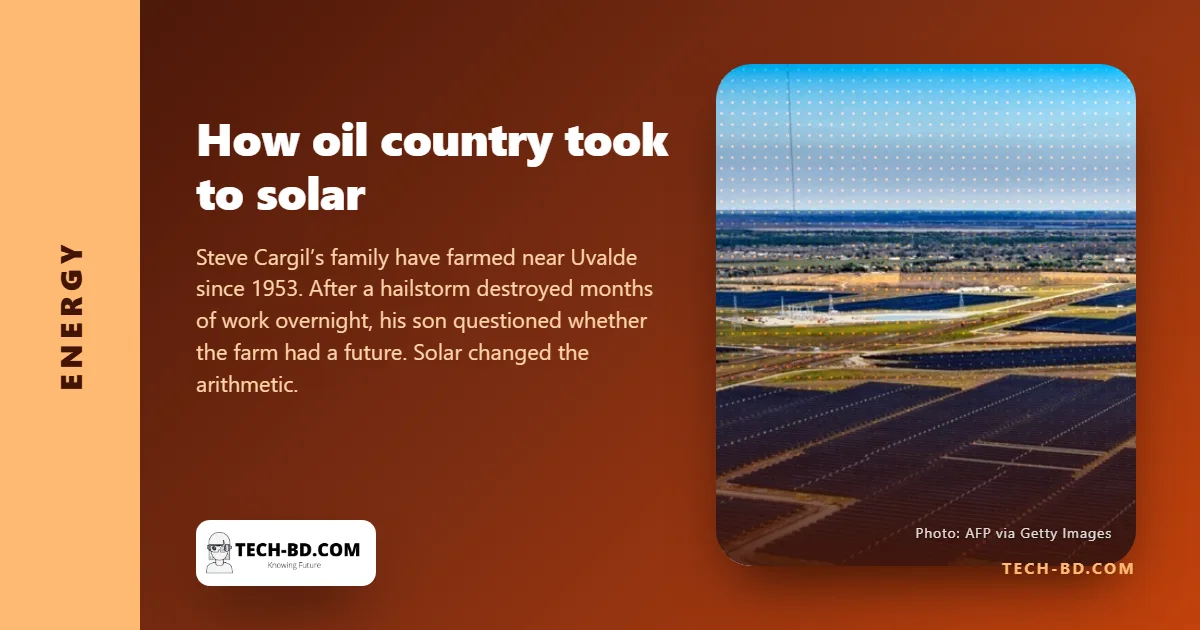
Steve Cargil's family has farmed the flat, dry land around Uvalde, a small city in southwest Texas, since 1953. Cargil, 67, had always assumed one of his three children would take it over, the way he had from his father.
The night that changed it
That assumption took a hit in 2018. Cargil and his son Ryan had spent months nursing crops of cabbage and onions to harvest. A violent hailstorm rolled through and destroyed them overnight.
"I remember my son saying, 'Dad, I just don't know if I can do this. You do everything right, and we work so hard, and you come out one morning and it's all gone'," Cargil says.
That is the economics that drove the change. Farming income in a region like this is volatile in a way that no amount of skill controls. Solar income is not. A lease pays the same whether or not it hails, and it pays for decades — which is why Texas, the oil capital of the United States, has become one of its largest solar producers.
What it means in Bangladesh
The lesson usually drawn from Texas solar is about scale and sunshine. The more useful one for Bangladesh is about income volatility, because that is the actual problem being solved.
A Bangladeshi smallholder faces the same uncertainty in a more severe form — flood, cyclone, hail, a pest outbreak, or simply a collapse in the price of whatever everyone planted that year. What is absent is any income stream on the same land that does not depend on the weather.
The obvious objection is land, and it is the right objection. Bangladesh has around 1,100 people per square kilometre and cannot take farmland out of production to build solar farms. Texas has the opposite problem. Copying the model directly is not available.
What is available is the version that does not compete for land. Rooftop solar on factories and warehouses is the largest untapped resource in the country — the garment industry alone has an enormous area of unused industrial roof, already connected to the grid, and already paying for expensive daytime power. Floating solar on the country's ponds, canals and reservoir surfaces is a genuine fit for a delta. And solar irrigation replaces diesel pumps at precisely the point where the farmer's cash cost is highest.
The financing structure is the part worth importing exactly. Cargil did not buy a solar plant; a developer leases his land and pays him. The Bangladeshi equivalent — a developer installing on a factory roof and selling the power back to the factory under a long contract, with no capital outlay by the owner — removes the barrier that actually stops rooftop solar here, which is not sunlight or technology but the upfront cost.
What happens after sunset remains the binding constraint, and we looked at it in Europe's second run at batteries.