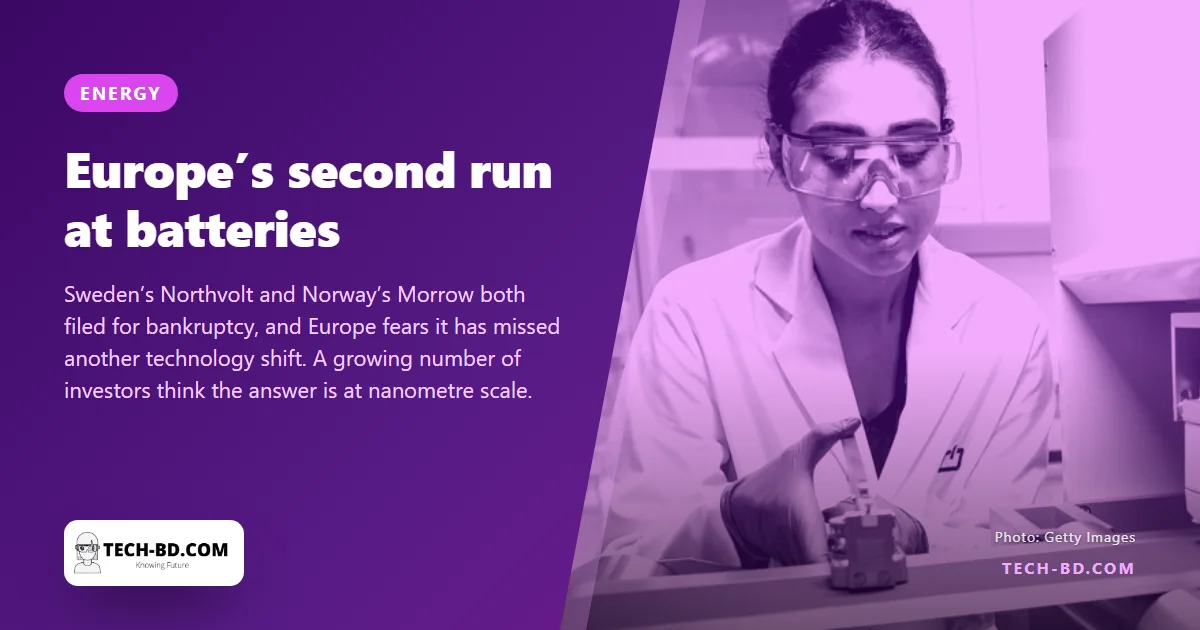
Europe has taken some big swings in the battery industry in recent years, and missed twice in public. Sweden's Northvolt and Norway's Morrow both filed for bankruptcy, and there are fears across the continent that it has missed another technology shift.
Why it is hard, not just unlucky
With more transport and industry switching from fossil fuels to electricity, batteries are likely to be a growth business. But the time required to bring new products to market, combined with brutal competition — especially from China — means entering it is a substantial risk.
That is the part worth holding on to. Northvolt did not fail because the idea was wrong. It failed because manufacturing cells at scale, reliably and cheaply, is an industrial competence that takes years to build and that China spent those years building.
The next attempt is being made at a different scale. A nanometre is one-billionth of a metre, and an increasing number of investors and researchers believe the most consequential work is now being done at that level — in the materials themselves rather than in bigger factories.
What it means in Bangladesh
Bangladesh will not manufacture lithium cells, and there is no useful version of this story that pretends otherwise. The relevant part is that the country is on the buying end of exactly this industry, at scale, right now.
Three fronts matter. The first is electric two- and three-wheelers. Bangladesh already has a very large fleet of battery-powered easy-bikes and rickshaws, running mostly on lead-acid batteries that are cheap, heavy, short-lived and recycled informally. Informal lead recycling is one of the worst environmental health problems in the country, and it exists because the battery is the single most expensive part of the vehicle.
The second is grid storage. Bangladesh's solar ambitions are limited less by panels, which are now cheap, than by what happens after sunset. Storage cost is the variable that decides whether daytime solar displaces imported fuel or merely supplements it.
The third is the trade lesson in Northvolt's failure. A government looking at this story might conclude that Bangladesh should build a battery plant. The more accurate conclusion is the opposite: if a well-funded Swedish company with European subsidies could not compete with Chinese cell manufacturing, a Bangladeshi assembly plant will not either. The realistic industrial opportunity is not making cells. It is pack assembly, battery management electronics, and formal recycling — lower-glamour, genuinely achievable, and the part where the environmental damage currently is.