"I think we're at the end of copper," says Chris Sharp, chief technology officer at the data centre operator Digital Realty.
What he means
He is not saying the world is running out of copper. He and many others in the industry are betting it will be used less.
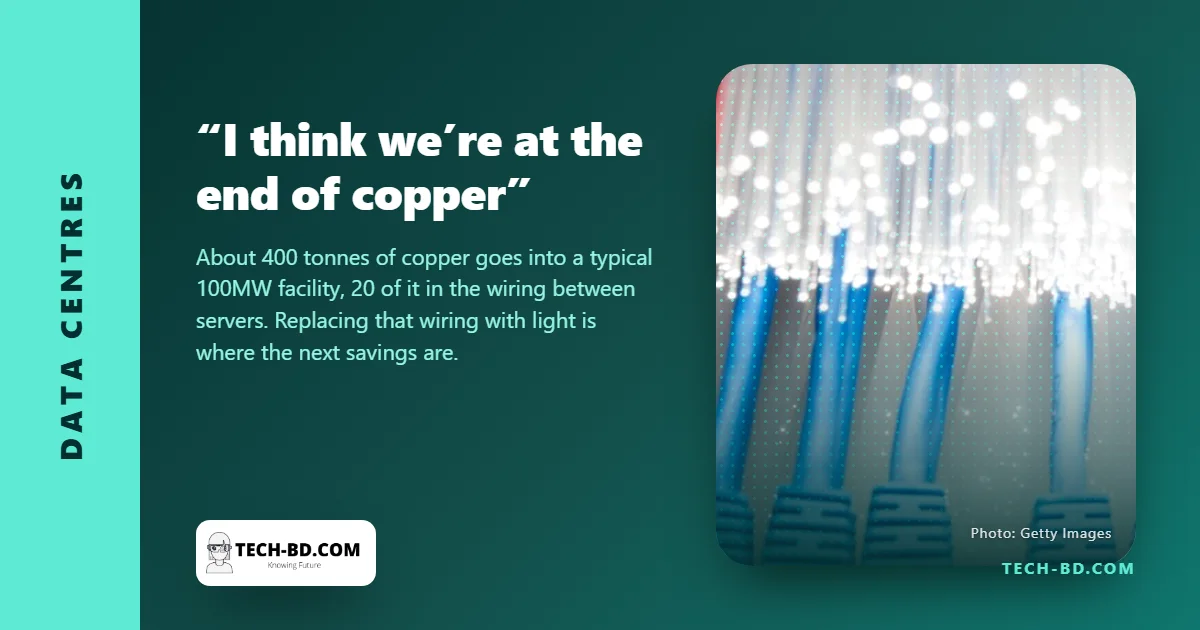
Data centres consume a great deal of the metal: around 400 tonnes goes into a typical facility of about 100MW — data centre size is measured in megawatts, a unit of electrical power. Most of that copper sits in the electrical infrastructure that powers the site and in the cooling systems. Up to 70 tonnes is used by the servers themselves, and up to 20 tonnes in the network wiring connecting those servers.
It is that spaghetti of wiring, snaking through the building, that is now targeted for replacement — with optical links, which move data as light rather than as current, and lose far less energy as heat over distance.
What it means in Bangladesh
Bangladesh is building data centres — at Kaliakoir, in bank and telecom facilities, and in the government's own consolidation projects — and the constraint here is not land or capital. It is power and cooling.
That makes this story more relevant here than in temperate countries, for a reason of physics. Every watt a server draws becomes heat, and in a Dhaka summer that heat has to be removed against an ambient temperature far higher than in Dublin or Stockholm. Cooling is therefore a larger share of the total load in Bangladesh than in the places where these designs are engineered. Anything that reduces the heat generated in the first place — which is exactly what replacing electrical interconnects with optical ones does — is worth more here than its headline figure suggests.
The second point is about what "sovereign data" actually costs. There is a strong and legitimate push for Bangladeshi data to be hosted in Bangladesh. The honest accounting is that a domestic data centre runs on a grid that is fuel-import-dependent and not always reliable, which means diesel backup, which means the fuel exposure discussed elsewhere in this section. Hosting locally is a defensible policy choice; it is not a free one, and the bill arrives as electricity.
The third is narrower and commercial. Copper is expensive, and copper theft from telecom and power infrastructure is a persistent problem in Bangladesh. An industry shift away from copper interconnects toward fibre, already under way in the country's own backbone, reduces both the cost and the target.
The wider pattern — that the decisive advances are now in materials rather than in scale — is the same one we looked at in Europe's second run at batteries.