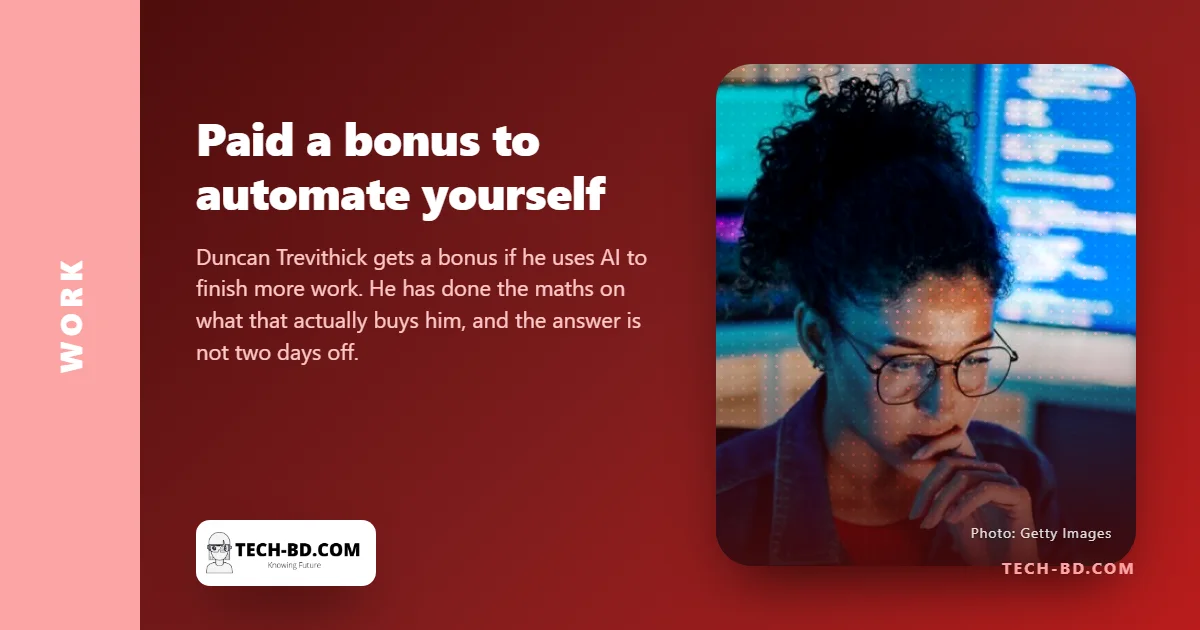
It is in Duncan Trevithick's interest to be good at using AI at work. If he can get more done, faster, he qualifies for a bonus at the end of the year. On the surface, a good incentive. He is not sure what is really in it for him.
The uncomfortable reading
"The uncomfortable interpretation is that employees are being assessed on how effectively they can participate in their own redundancy," says Trevithick, 34, who is based in Spain and works in marketing for an AI training data company.
If he uses AI to absorb two days of work each week, he says, the rewards do not add up. "I do not receive two days off or a 40% pay rise. The higher output simply becomes the new baseline. In the short term, that may help me get promoted. In the longer term, I have helped prove how much of my job no longer requires me."
That is the structural point, and it does not depend on any view about whether AI is good or bad. Productivity gains accrue to whoever has the bargaining power to claim them. An individual employee demonstrating that their role can be done in less time is, in the ordinary case, handing over information rather than banking a gain.
What it means in Bangladesh
This argument lands differently in a country whose largest services export is selling other people's time.
Bangladesh has several hundred thousand freelancers and a sizeable IT-enabled services sector, and much of that work — content writing, basic design, data entry, transcription, first-line support, simple web development — sits squarely in the band that current AI tools do adequately. The country's competitive advantage in those tasks was price. That advantage erodes fastest where the task is most routine.
The response being pushed in most Bangladeshi commentary is "learn AI tools", and it is not wrong, but it is incomplete in exactly the way Trevithick identifies. If your value to a client is that you can operate a tool the client could also operate, you have not moved up; you have made yourself faster at a job that is being repriced.
What holds value is the part a tool cannot supply: judgement about what the client actually needs, accountability when it is wrong, domain knowledge, and the relationship. A freelancer who can say "your brief is wrong and here is why" is not competing with a model. One who delivers exactly what was asked, quickly, is.
For employers here, there is a narrower warning. Tying bonuses to AI use measures the wrong thing — it rewards tool adoption rather than results, and it tells your best people that the organisation's plan for them is to be automated. In a labour market where good developers already leave for foreign remote work, that is an expensive message to send.