
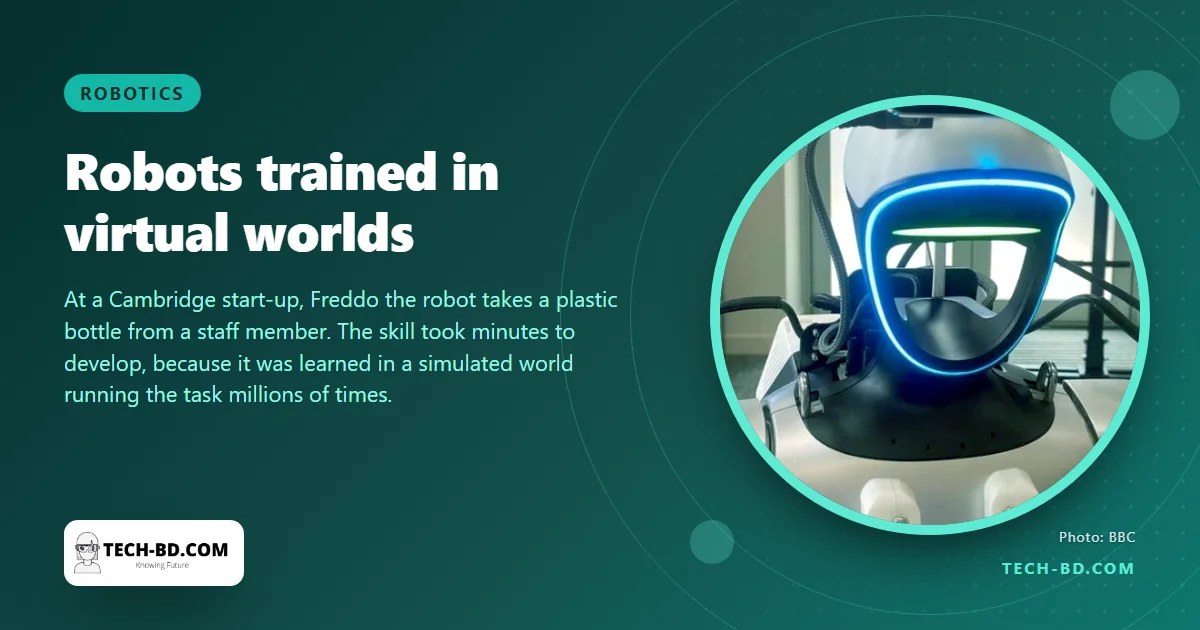
Freddo the robot walks across the office and takes a plastic bottle offered by a member of staff. Given that a robot recently beat Usain Bolt's 100m record, that is not the most startling achievement in the field.
The speed is the story
What is impressive is how quickly Freddo was trained to walk, recognise the bottle and grasp it. It took a few minutes to develop those skills and upload them. Rival systems, his developers say, could take days.
This is Vsim, a British start-up in Cambridge. Founders Michelle Lu and Kier Storey hope their software will one day control robots that can navigate and do useful tasks in homes and workplaces.
"It's a weird situation with robotics because actually the stuff that we find as humans to be incredibly difficult, like gymnastics, you can get robots to do reasonably well," Storey says. "The stuff that humans are really good at, like fine dexterity, is really hard in robots."
Freddo's skills were honed in a virtual environment, where a task can be performed in simulation millions of times. Once the best solution — known as a policy — is found, it is uploaded and used by the hardware.
What it means in Bangladesh
The important word in this story is simulation, and it is the part that travels.
The reason robotics research has been out of reach for most Bangladeshi universities is capital: a research-grade humanoid costs more than an entire departmental budget, and a damaged one ends the project. Simulation removes that barrier for the part of the work that is intellectually hardest. Training a control policy requires computing, not a robot. The physical machine is needed only at the end, to prove the policy works.
That has a direct implication for how engineering is taught here. A Bangladeshi undergraduate can do genuine, publishable work in reinforcement learning and robot control on a laptop with a GPU and open-source physics engines, and can do it now. Several Bangladeshi teams already compete internationally in robotics — this is the cheapest available route to being good enough to keep doing so.
Storey's observation about dexterity is also the most useful corrective to the automation anxiety that surrounds Bangladesh's export industries. The tasks robots find hard are precisely the ones that dominate garment assembly: handling limp, deformable fabric, judging tension by feel, adjusting to a piece that is slightly off. Cutting, spreading and warehouse movement automate readily. Sewing a curved seam in soft cloth does not, and has resisted serious investment for decades.
That is not a reason for complacency. It is a reason to know which jobs are actually exposed and which are not, rather than treating "robots are coming" as a single undifferentiated threat.