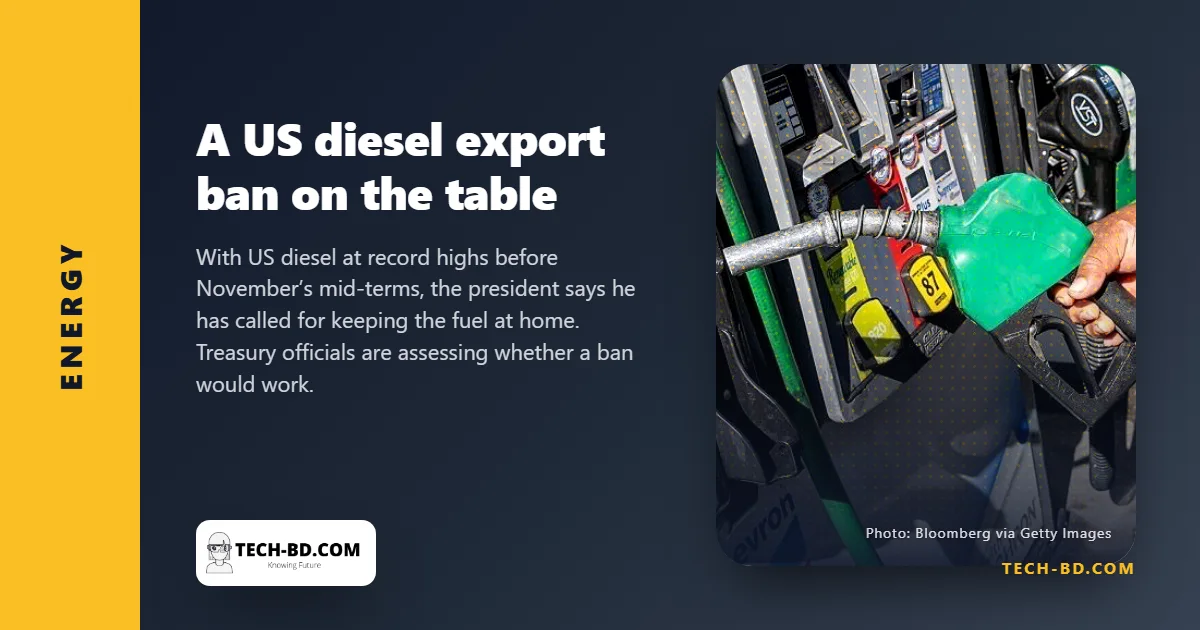
US President Donald Trump has said he would back proposals to halt American diesel exports, in a bid to ease prices for drivers at the pumps.
What was said
His comments followed pressure from Republican lawmakers ahead of November's mid-term elections to curb exports, as US diesel prices climb to record highs.
Speaking on the sidelines of the United Nations General Assembly, Trump suggested keeping domestic supplies inside the US could also ease petrol prices. "I've called for that too. I've said let's not send out the diesel. We make a lot of diesel. That could have a little bit of an effect on regular automobile gasoline," he said.
US Treasury Secretary Scott Bessent confirmed that officials were assessing "whether a full or partial ban would work" without disrupting refinery capabilities — a caveat that matters, because US refineries are configured to produce more diesel than the domestic market consumes.
The story was carried the same day by Reuters, CNBC, Axios and The Hill, and El País reported that Mexico — the largest single buyer of US refined fuel — had gone on alert.
What it means in Bangladesh
Bangladesh does not buy much diesel from the United States. That is not the same as being unaffected, and the distinction is the whole point of this story.
Diesel is a globally traded commodity with one price. If the largest exporter withdraws volume from the seaborne market, buyers who lose that supply — Mexico, Europe, Latin America — bid for the same cargoes Bangladesh buys from the Gulf and Singapore. The price rises everywhere, including for a country that never bought an American barrel.
That matters here more than in most places, because Bangladesh is unusually diesel-dependent. Diesel is the single largest petroleum product the country imports. It runs the irrigation pumps that make boro rice possible, the trucks that move every domestic good, the buses, the fishing boats, and a large share of standby generation. A diesel price shock is therefore not a transport story here. It is a food price story with a lag of one season.
The fiscal channel is the second half. When world prices rise, the government either passes the increase through — which moves straight into transport fares and food — or absorbs it through the Bangladesh Petroleum Corporation, which moves it into the budget instead. The formula-based pricing introduced to make that adjustment automatic works in both directions, which is the argument for it; the political difficulty always arrives on the upward leg.
The one useful piece of foresight: the irrigation season for boro runs roughly December to March, and it is the period when Bangladeshi diesel demand is least compressible. A supply squeeze that develops through the northern winter arrives precisely then.