
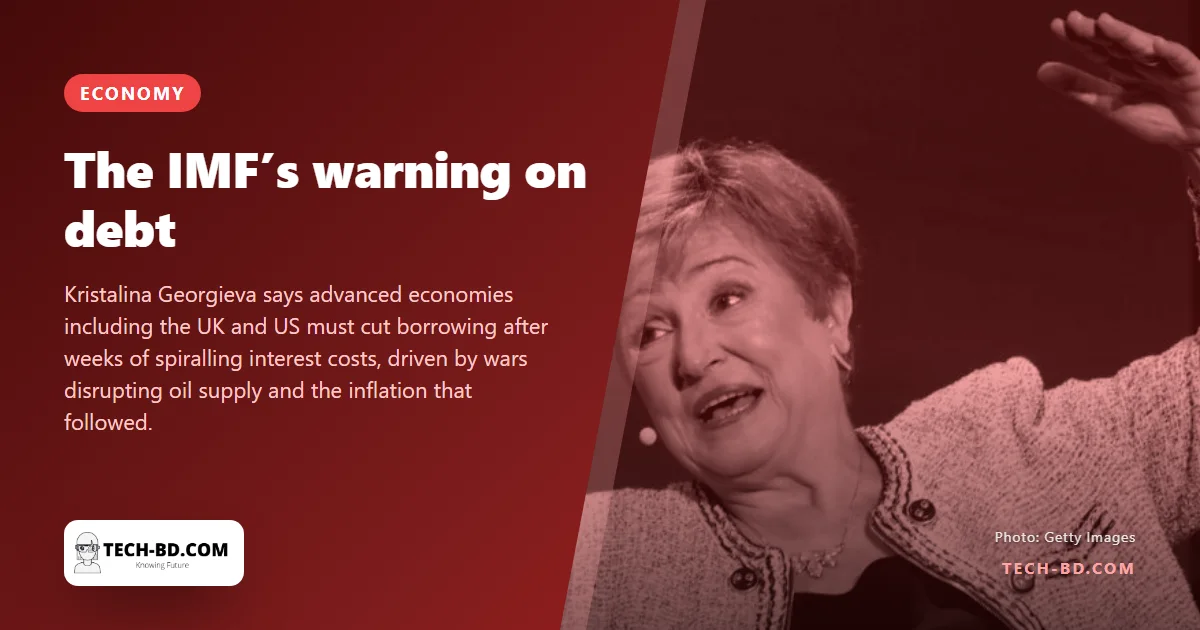
The world's advanced economies, including the UK and US, need to cut borrowing and reduce debt levels after weeks of spiralling government interest costs, the head of the International Monetary Fund has warned.
What she said
In an interview with the BBC, Kristalina Georgieva said global economic shocks had been "pushing debt levels up like a staircase not to heaven", but that governments had taken "no action to contain that service cost". "[It's] time to take that action," she said, adding that "courage" was needed from politicians.
The intervention comes as government borrowing costs have surged in response to wars disrupting the supply of oil, which has fuelled inflation. UK borrowing — the gap between tax receipts and spending — was £18.3bn ($24.4bn) in August, almost a fifth higher than a year earlier and above official forecasts. Investment Week put it at £3.5bn above the Office for Budget Responsibility's projection, and the figures were reported the same week by the Guardian and the Financial Times. The Guardian also noted that three international bodies issued warnings on debt within days of each other.
What it means in Bangladesh
An IMF warning aimed at rich countries is not a story about rich countries. When advanced-economy borrowing costs rise, the price of money rises for everyone, and it rises furthest for the borrowers with the least room.
The mechanism is straightforward. Investors who can earn a high, safe return on US or UK government debt require a bigger premium to hold anything riskier. Emerging-market bonds reprice, currencies weaken against the dollar, and the cost of rolling over existing external debt goes up without any change in the borrower's own behaviour.
For Bangladesh that shows up in three places. Debt service on external loans rises, and it is already the fastest-growing line in the budget. The taka comes under pressure, because a stronger dollar makes every import — fuel, food grain, capital machinery, industrial raw material — cost more in local currency. And new project financing gets more expensive, which is felt most in the infrastructure pipeline financed on commercial rather than concessional terms.
The one genuinely favourable channel is remittances, which tend to hold up when the dollar is strong because each dollar sent home buys more taka. That is a real cushion and it is the reason Bangladesh has weathered previous dollar cycles better than several comparable economies. It is also, being entirely dependent on conditions in the Gulf and Malaysia, the least controllable part of the picture.
Georgieva's actual argument deserves to be separated from the headline. She is not warning about the size of the debt so much as about the cost of servicing it — the point being that a government can run the same debt for years and then find the interest bill doubling without borrowing an extra taka. That is a warning Bangladesh should read as addressed to it, not overheard. The younger generation's scepticism about whether states will keep their promises, which we looked at in Gen Z and the state pension, starts from exactly this arithmetic.