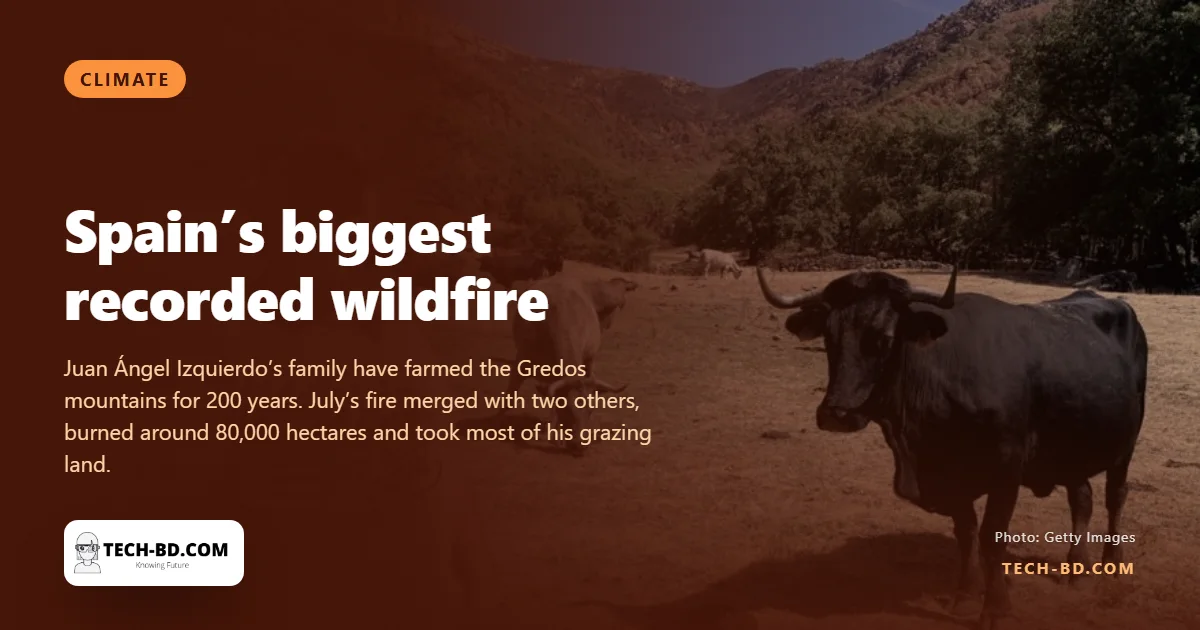
In a small green meadow in the Gredos mountains, west of Madrid, a couple of dozen cows belonging to Juan Ángel Izquierdo and his family are grazing. The only sound is the clang of the bells around their necks.
What is left
It would be idyllic were it not for the blackened pine and oak all around — the legacy of a recent wildfire. "It was immense, I've never seen anything like it," says Izquierdo, whose family have farmed here for 200 years.
The fire, in late July, merged with two others and burned around 80,000 hectares (200,000 acres), making it the biggest blaze Spain has ever registered.
It consumed more than two-thirds of Izquierdo's land and killed 12 of his 85 cows. Another eight had to be put down because of their injuries. All the hay he had gathered to feed the herd through winter burned with it.
"For us farmers, the summers are becoming more and more worrying, because they are getting hotter," he says. "It rains less, the wet season ends earlier and the autumn starts much later."
What it means in Bangladesh
Bangladesh does not burn. It floods, salts and erodes. But Izquierdo's last sentence is the transferable part, and it describes something Bangladeshi farmers say in almost identical words: the seasons have stopped arriving when they used to.
The agricultural calendar here was built on a monsoon that started and ended within a predictable window. What farmers now report is a shorter, more violent wet season, a delayed onset that pushes transplanting late, and dry spells in the middle of what should be the rains. Aman rice is the crop most exposed, because its timing is least flexible.
The second parallel is the one the Spanish story makes vivid: the loss is not only the crop. Izquierdo lost his winter fodder as well as his grazing, which means the fire will still be costing him in February. A Bangladeshi farmer flooded in Kurigram loses the standing aman, the seed stored for the next season, and often the cattle that are the family's actual savings account. Each of those is a separate blow, and relief that replaces only the first leaves the household further behind than it looks.
Which points at the practical gap. Spain has agricultural insurance, and Izquierdo will recover something. Bangladesh has almost none — crop insurance has been piloted repeatedly and has never reached scale, defeated by the cost of verifying claims across millions of tiny holdings. That is precisely the problem index-based insurance was designed for: paying out on a measured trigger such as rainfall or river level rather than on an inspected field. The technology to run it — satellite rainfall data, mobile money, the existing agent network — is all present in Bangladesh already.
The risk is not new. The absence of any mechanism for spreading it is the part that is now hard to justify. We looked at a different industry facing the same instability in aviation's hotter, stormier skies.