Megaspeed, the Singapore-based company that is the largest buyer of Nvidia chips in South East Asia, says Alice Huang left her executive role there in August last year.
Alice Huang is the woman at the centre of the Nvidia scandal — a suspected China spy, of no relation to Jensen Huang, who resigned as Nvidia's chief executive after it emerged he had allegedly had affairs with her and with one of his employees.
The dates, laid out
Three dates matter here, and they have been reported separately rather than together.
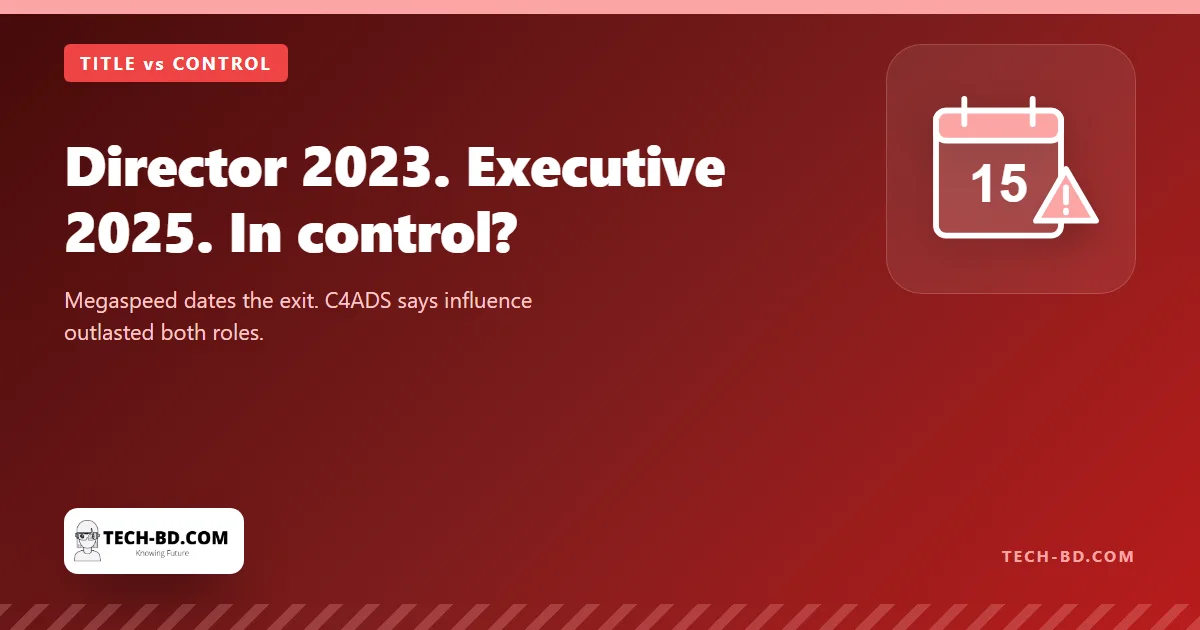
She is said to have stepped down as a Megaspeed director near the end of 2023. Singapore authorities investigated her in February 2025 as part of a probe into Megaspeed and other companies. And the company now says she left her executive role in August last year.
Against that, the Washington-based security analysis group C4ADS says she was still "practically in control" of Megaspeed after handing over the reins.
That is the whole dispute in one line. One side is describing titles. The other is describing control. Both can be accurate at the same time, which is exactly why the company's statement settles less than it appears to.
What Megaspeed is saying now
The company announced on Sunday that it has launched an internal investigation and retained external legal counsel to run it.
It said it was aware of reports "containing assertions about our business, supply chain and global operations that are not supported by verifiable evidence", and that it "conducts legitimate and lawful business".
On export rules it says it designs its control frameworks to comply with "all applicable laws and regulatory regimes", including US export control requirements and local rules in every market where it operates.
Megaspeed is suspected of giving Chinese companies backdoor access to Nvidia chips through its data centres in Malaysia, Indonesia and Thailand. Nvidia is banned from selling its advanced semiconductors to China.
Singapore's position is narrower than it sounds
Singapore does not prohibit transferring advanced AI chips to companies abroad. It has said it does not enforce "unilateral export controls imposed by other countries", but expects companies in its jurisdiction to respect such regulations.
Read carefully, that is a statement about who does the enforcing, not about whether the rules apply. A transfer that is legal in Singapore can still breach US export controls, and the consequences for that fall on the company, not the state.
Congress will hear it in private
US Congressman John Moolenaar said Jensen Huang has agreed to testify before the Select Committee on China, which Moolenaar chairs, as well as the House Foreign Affairs and House Intelligence committees.
The committee heads had threatened subpoenas. In the end none were issued. The testimony is expected to take place behind closed doors, with dates still being finalised.
Moolenaar told CBS that the meeting would examine "to what degree privileged information was accessed, and to what degree this potential alleged Chinese spy influenced Nvidia's philosophy".
Commerce Secretary Howard Lutnick has separately been called before the Senate Banking Committee next month over his department's role in allowing the chip exports, and committees have asked his department to retain all records relating to Nvidia and Jensen Huang.
And a campaign that is unlikely to work
A group of technology leaders including Elon Musk has been trying to rally support to have Huang reinstated. A representative declined to comment on a Financial Times report that he was discussing a return.
The BBC understands the likelihood is very low while the internal investigations run. Treasury Secretary Scott Bessent has called for Nvidia to hire its next chief executive from outside the company.
China has denied that Alice Huang is a spy and warned the US not to use the scandal as a "pretext for imposing a technological blockade".