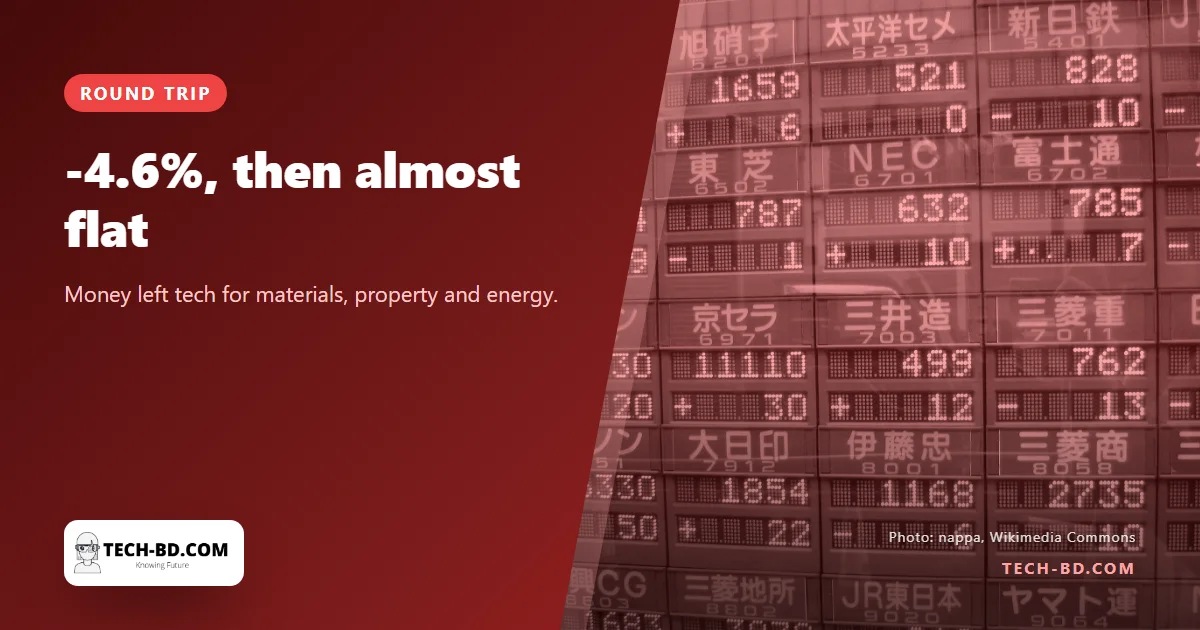
Wall Street spent Wednesday falling and then climbing back. The Dow dropped 1,100 points after the opening bell and ended the day up 164 points. The Nasdaq fell as much as 4.6% and closed down 0.62%, its second consecutive decline. The S&P 500 finished just 0.25% lower.
What investors did with the money
They did not leave the market. They left technology. Money moved into bonds and into materials, real estate and energy — the parts of the index that have nothing to do with the AI build-out.
"Investors are just selling tech and fleeing for safety," said Jed Ellerbroek, portfolio manager at Argent Capital Management.
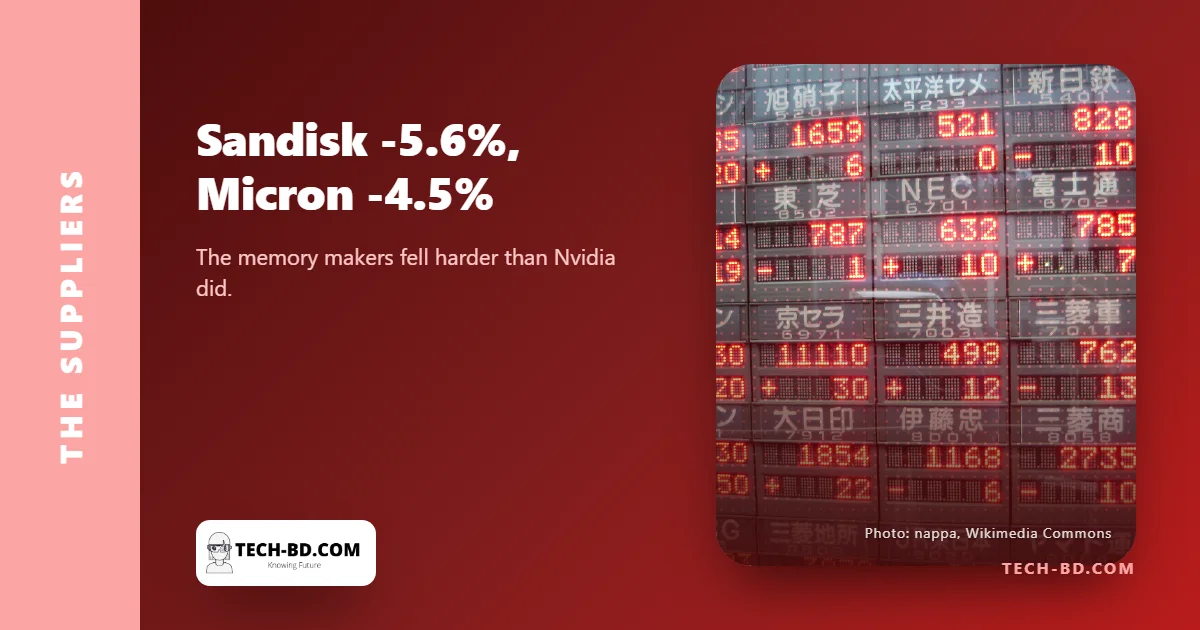
Nvidia slid 3.9%. The memory chipmakers fell harder: Sandisk down 5.6% and Micron down 4.5%, which is the usual pattern — the suppliers to the boom move more violently than the boom itself.
Anthropic had its own day
Anthropic dropped almost 10% before recovering to finish up just over 1% — an outlier among AI stocks. On Tuesday it had closed below its IPO price of $83 a share for the first time.
Volatility after a debut is expected, and a newly listed company trading below its offer price within weeks is common enough not to mean much on its own. It does mean the investors who bought at the IPO are underwater.
Why the relief did not last
Traders have been worried for weeks about whether the enormous sums being spent on the AI build-out will produce returns. That worry was briefly suspended on Monday, when Nvidia's board reinstated Jensen Huang and both the stock and the wider market surged.
The relief faded by Tuesday. Two other things pushed in the same direction: fresh data showing the US economy still running hot, which has traders betting on interest rate rises, and new tariff proposals from President Trump.
Reading it from here
A one-day round trip is not a verdict. But the shape of it is informative: the market no longer treats Nvidia's leadership as the question. Swapping the chief executive back fixed the thing that was fixable, and the market went straight back to the thing that is not — whether the capital expenditure pays off.
For readers here, the transmission is indirect but real. A sustained AI sell-off slows the data-centre spending that drives demand for offshore engineering work, and a dollar strengthened by rate rises raises the cost of imported hardware. Neither happens in a day.
Why memory chips fall hardest
The pattern with Sandisk and Micron repeats in every cycle, and it is worth understanding because it is a leading indicator rather than noise.
Memory is a commodity sold into whatever is being built. When data-centre orders are rising, memory makers sell everything they can produce at good prices; when orders are questioned, buyers delay, inventories build, and prices fall faster than volumes. So the memory makers move further than the chip designer in both directions.
Which means their share prices are a rough read on what buyers expect to order next quarter — information that arrives before the orders themselves do. A 5% fall in memory on a day when Nvidia fell 3.9% is the market saying the build-out slows from here.