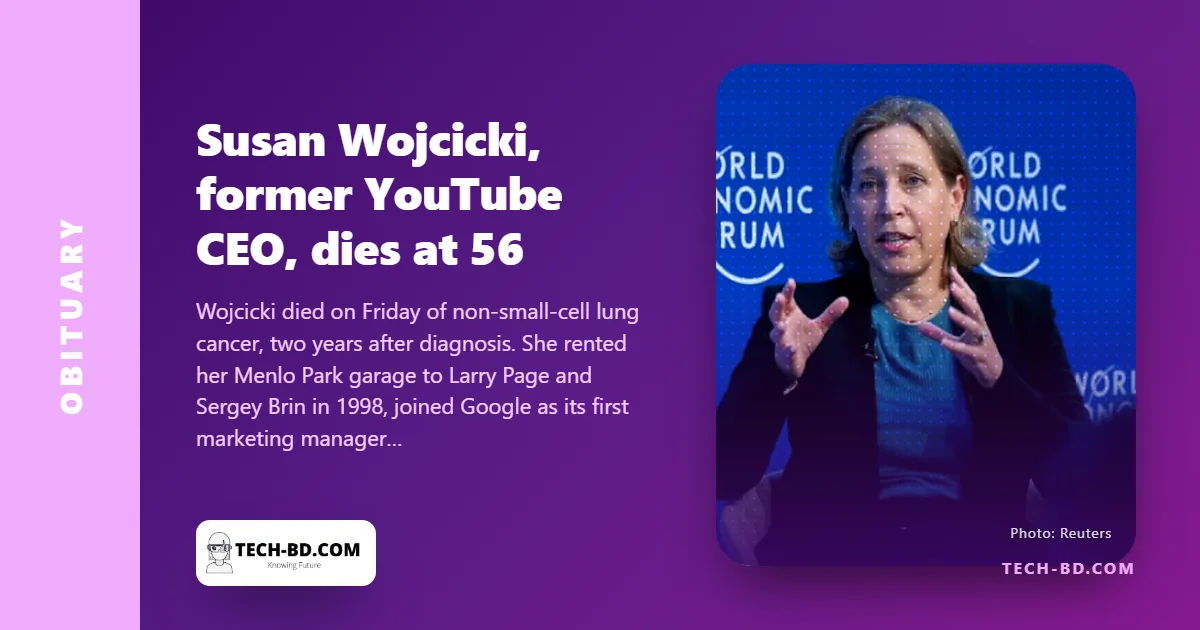
Susan Wojcicki, who ran YouTube for nine years and was present at Google before it had an office, died on Friday 9 August. She was 56. Her husband, Dennis Troper, wrote on Facebook that she had lived two years with non-small-cell lung cancer: “my best friend and partner in life, a brilliant mind, a loving mother, and a dear friend to many.” They had five children.
The garage
The story every Google history tells is true. In 1998 Wojcicki, then 30 and working in marketing at Intel, rented the garage of her house on Santa Margarita Avenue in Menlo Park to two Stanford students, Larry Page and Sergey Brin, for $1,700 a month to help pay the mortgage. Google was incorporated there. The following year she joined the company as its first marketing manager — employee number 16 — and, as she liked to point out, the first to take maternity leave.
What she built
Her list is long and mostly invisible to users. She proposed the Google Doodles, the altered logos on the home page, and worked with the designer Ruth Kedar on the original logo. She was involved in building Google Image Search. In 2003, as a product manager, she led the launch of AdSense, the system that puts Google’s adverts on other people’s websites — the product this site, like millions of others, runs on — and later oversaw the far larger AdWords. In 2006 she argued for buying a video start-up that Google Video was losing to; the board paid $1.65 billion for YouTube, a price mocked at the time and now regarded as the best acquisition in the industry’s history. In 2007 she led the $3.1 billion purchase of DoubleClick, which became the backbone of Google’s display-advertising business.
YouTube
She became YouTube’s chief executive in February 2014 and left in February 2023, handing over to Neal Mohan. In those nine years the site went from a place for viral clips to the largest media business on earth: two billion monthly users, more than $29 billion a year in advertising, a subscription service, YouTube TV, Shorts, and a creator economy that pays out billions. Her tenure also carried the hardest problems of the era — extremism, misinformation, child safety, the 2017 “adpocalypse” when advertisers fled, and endless argument with creators over demonetisation — and she took the criticism from all sides with a calm that colleagues remarked on. Time named her the most powerful woman on the internet in 2015.
The tributes
Sundar Pichai, Alphabet’s chief executive, wrote that she was “as core to the history of Google as anyone” and “an incredible person, leader and friend who has had a tremendous impact on the world.” Her death came eighteen months after her 19-year-old son, Marco Troper, died at university in February.
A note from this side of the world
Wojcicki studied history and literature at Harvard (1990), economics at UC Santa Cruz (MS, 1993) and business at UCLA (MBA, 1998); she did not write code. The two products she is most associated with — AdSense and YouTube — are, between them, the way most independent publishers and creators in Bangladesh earn anything from the internet at all. That was not her intention in 2003, but it is her legacy.
Source: Business Insider, via Prothom Alo.