Personal and identity records belonging to Uber drivers in the United States have been exposed, including information relating to driving licences.
The most important part of this incident is probably not how much data left. It is how it was reached.
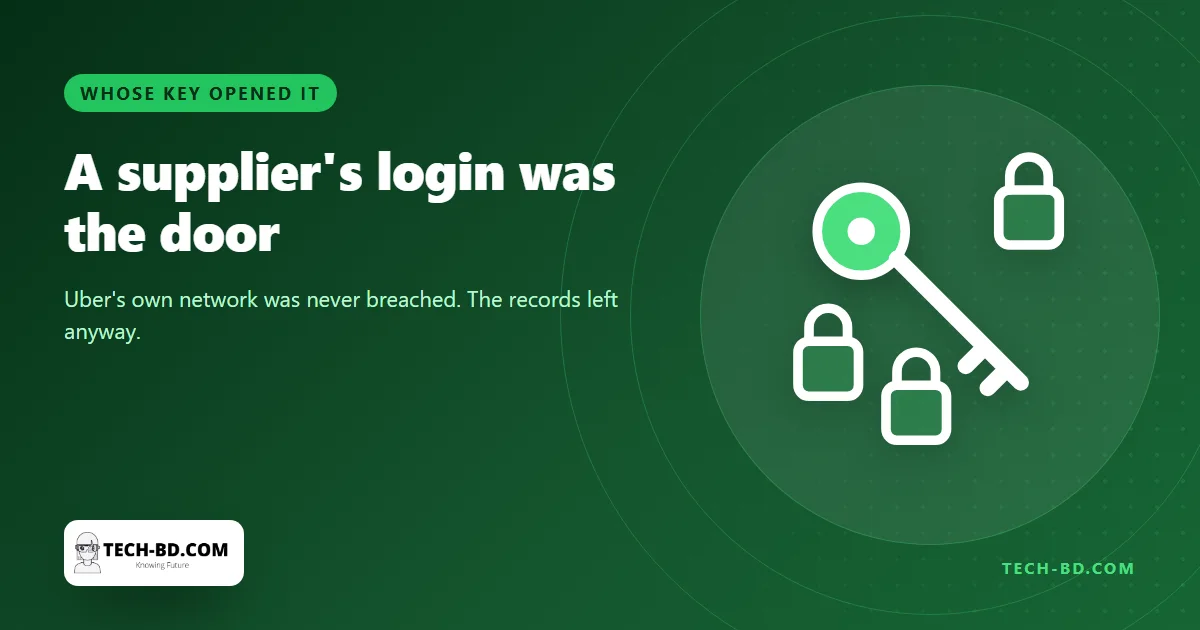
Uber's own network was not breached
Nothing published so far shows direct intrusion into Uber's systems.
The incident began with compromised access credentials belonging to Fireworks AI, a technology supplier to Uber. Those credentials were then used to reach Uber-related data held at the vendor.
This is what makes it more significant than a routine breach notice. An organisation can have strong security of its own, and still lose records — because if a trusted third party's credentials can open the door to sensitive data, those credentials are effectively part of that organisation's security perimeter whether anyone planned it that way or not.
The timeline
7 October 2026 — the date recorded as the breach date on California's data breach register.
9 October — Fireworks AI informed Uber that an unauthorised party had obtained its internal credentials and used them to access Uber's account held at the supplier.
Uber then disconnected the relevant data connection and opened an investigation.
13 October — investigators confirmed that the compromised credentials had been used to access some Uber data, including personal information belonging to the individuals concerned.
Read in order, the gap at the start is the one that matters. The access happened on the 7th and the company that owned the credentials noticed on the 9th. Everything Uber did was fast; it simply could not begin until somebody else's monitoring caught the problem.
What the affected drivers are being told
Those affected in the US can use the federal government's identitytheft.gov service, which walks people through the steps after identity records are exposed.
Licence data is worth treating more seriously than an email address. An email can be changed; a licence number is a long-lived identifier that sits behind identity checks at other companies, which is exactly what makes it useful to whoever took it.
The actual lesson, which applies to far smaller organisations
The Uber incident is a concrete example of how the security perimeter of a modern organisation has moved.
In an environment built on cloud services, APIs and AI tooling, security is no longer bounded by your own servers, your own network and your own database. Third-party vendors, API keys, tokens, service accounts and connected systems are all part of that perimeter too.
Which is why a set of practices that are often treated as separate boxes to tick are really one thing:
Least privilege — a key should open only what that integration genuinely needs, so a stolen one yields as little as possible.
Credential rotation — keys that change regularly limit how long a theft stays useful.
Secrets management — tokens kept somewhere designed for them, not in code, config files or chat messages.
Identity monitoring — watching for a credential being used in a way, or from a place, that does not fit.
Third-party risk management — knowing which suppliers hold a key to your data, and what that key reaches.
In an interconnected system these are not five independent safeguards. They are five parts of one structure, and the Uber case shows which part fails first.
The question to ask about your own setup
The useful version of this story, for anyone running a business of any size, is not "is our data safe".
It is: who holds the master key, and how many doors does one key open?
Most organisations have granted an integration — an analytics tool, a payments provider, an AI service, a marketing platform — broader access than it needs, once, during setup, and never revisited it. That access is still live, it is still a door, and it is held by someone whose monitoring you do not control.