Two in the morning. Someone who has never learned to program describes an app in plain language, and by sunrise it exists. Their friends are impressed. This is now an ordinary story.
It is called vibe coding — getting code written by describing what you want. The researcher Andrej Karpathy coined the term in February 2025, and Collins Dictionary named it word of the year for 2025.
The door to building software is genuinely open to everyone now. That is good news, and it deserves to be said before the warnings. But an open door does not cancel the duty to fit a lock.
Two measurements
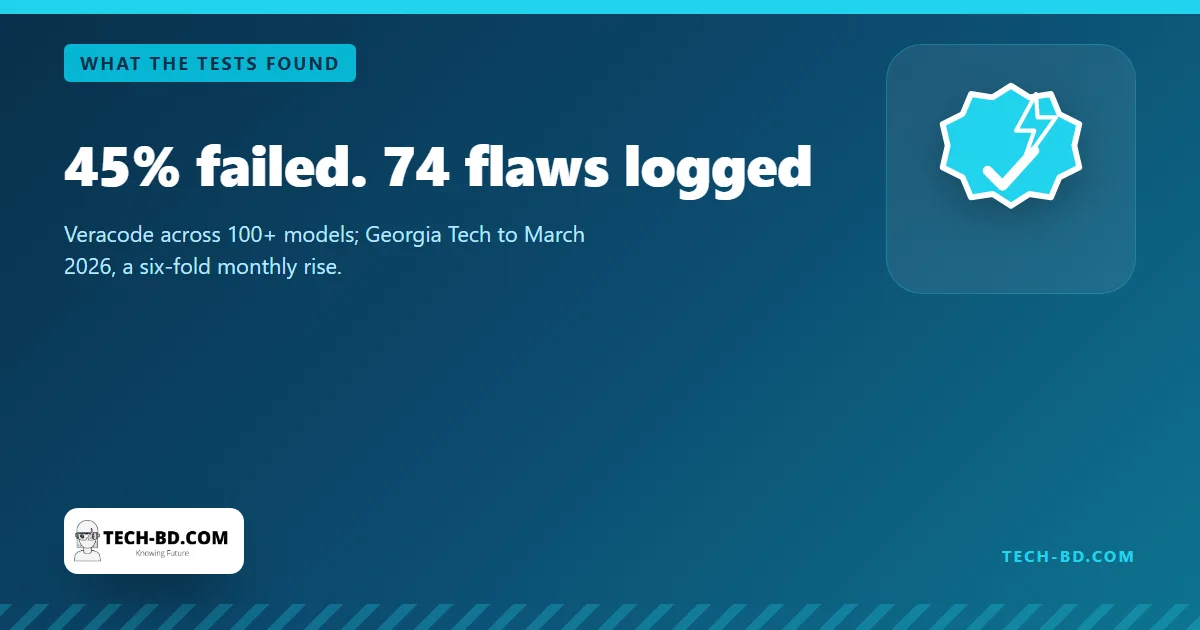
An April 2026 research note from the Cloud Security Alliance cites a Veracode test in which code written by more than 100 AI models was put through security checks. 45% of it failed.
Georgia Tech's Vibe Security Radar had documented 74 security flaws linked to AI-written code by March 2026. The monthly count rose roughly six-fold between January and March.
Be careful what those numbers mean. Forty-five per cent failing a security test does not mean nearly half of all generated code is exploitable in production — test suites deliberately probe for weaknesses. What the figure does establish is that security is not something the models supply by default.
Why this happens
A model writes what you asked for. If you asked for a working login page, you get a working login page. You did not ask for rate limiting, or for the password to be hashed properly, or for the session cookie to be marked secure — so those are a coin toss.
A human beginner has the same blind spots. The difference is speed. A beginner takes three weeks to build the insecure thing, and usually learns something in week two. Vibe coding delivers it before the blind spot has a chance to surface.
The analogy in the original piece is exact: the house is beautiful, and nobody fitted a lock to the door.
Three rules worth following
Never put passwords or secret keys inside the code. This is the most common and most expensive mistake, because code gets pushed to repositories, shared in screenshots and pasted into chats. A key in a file is a key in public.
Before publishing anything that holds other people's personal data, have someone experienced look at it. Your own data is your risk to take. Other people's is not.
Start small and start with no data. Build the thing that does not store anything first. Do not make your first project the public one.
What to add to the prompt
If you are going to build this way, the practical fix is to ask for the missing half explicitly rather than hoping for it.
Ask the model to list what it did not secure. Ask where user input reaches the database and whether it is parameterised. Ask what happens when the same request arrives a thousand times in a minute. Ask it to move every secret into environment variables and show you the file that must never be committed.
None of that requires knowing how to write the code. It requires knowing which questions have expensive answers.
The part that did not change
Writing code got easy. Taking responsibility for it did not, and it has not moved anywhere — a model cannot be accountable for a data leak, and no one has worked out who is when a non-programmer ships an app that loses a thousand phone numbers.
Until that is settled, it is the person who pressed publish.