Update, October 2026 — The question in this 2021 headline has been largely answered. Investigators traced the route out of the country and the amounts, though tracing is not the same as recovering. Where the money went is below the original article.
Controversial e-commerce platform Evaly has defrauded customers of crores of taka, but it has now only Tk30 lakh in several bank accounts. And, its assets - two SUVs, some vehicles and a piece of land at Savar - amount to only Tk7-8 crore.
So, the question arises as to where all the money went?
Investigators are now searching for the money the e-commerce company took from the customers in advance.

Md Asaduzzaman, deputy commissioner at Dhaka Metropolitan Police's Gulshan Division, told The Business Standard that they have already appealed to the court, seeking information on bank accounts and assets of the Evaly's managing director and chief executive director Mohammad Rassel and chairperson Shamima Nasrin.
With the HC approval, police will get details from the Bangladesh Bank, the Registrar of Joint Stock Companies and Firms, city corporations and other agencies, he added.
Assistant Sub-Inspector Wahidul Islam, the investigating officer of the case, said, "We interrogated the couple to know the whereabouts of the money, but they could give us any obvious answer."
"That is why we have sought their bank details," he also said.
"During the primary interrogation, Rassel told us that Evaly spent a lot of money on advertisements and promotions. A portion went on discounts," a reliable source told Tech BD.

"Such expenses apart, a huge amount of money has still remained untraced. Then, where has the money gone? We are looking into this seriously," he added.
"Several crores went to some influential persons that Rassel could not utter their names during the interrogation," the source said.
"It was Shamima who orchestrated all the plans, including a stupendous discount policy, and Rassel just followed her ideas to become a giant in the Bangladesh e-commerce industry," the source added.
In the meantime, Home Minister Asaduzzaman Khan Kamal yesterday told reporters at secretariat that stern actions will be taken against Evaly and other e-commerce platforms if they fail to keep their commitments to customers.
The home minister also warned people of not making any transactions without knowing about the business.
"I mean tempting offers…for example, a car that costs Tk100 is being offered at Tk50. Before investing, make sure you know how much risk you have and what kind of [money or product] you will get and whether there is any chance of being deceived. If you are not sure, you should refrain from investing in such companies," said the minister.
Meanwhile, Saad M Rahman, a Evaly customer, came to Gulshan Police Station on Sunday morning to file a case against Evaly's CEO, chairperson and some of its ambassadors.
But, after waiting there for four hours, the youth from Nawabganj could not file the case. He alleged that Inspector (operation) Shahiduzzmaan misbehaved with him.
Later, as suggested by the cop, he went to the Dhanmondi Police Station, but could not sue them despite several hours of struggle as the police station asked him to come after one week.
"We are now only receiving cases involving big amounts of merchants," said a police official at the Dhanmondi police station.
On May 30, Saad told Tech BD that he ordered a motorcycle for a discounted price of Tk318,000.
"Was it my crime to order a motorcycle on a discount, why did the government allow them to run the business? Now, the police do not receive my case," he added.
Like Saad, many customers are coming to Gulshan police station, seeking actions to get products or refunds.
Two days into the arrest of Rassel and Shamima in a case filed by a customer, a supplier on Saturday night lodged a case against the couple and 25 more officials of the controversial e-commerce platform.
Ihsanul Ferdous, additional deputy commissioner of Dhanmondi Zone, told Tech BD that they have already shown Rassel and his wife arrested in the case and will seek a seven-day remand for interrogating them under the case.
"A supplier named Kamrul Islam Chakdar filed the case with Dhanmondi police station on Saturday night bringing allegation of embezzling Tk36 lakh," said Abdullah Al Masum, assistant commissioner of Dhanmondi Zone on Sunday morning.
In the case, he mentioned the names of 12 officials and another 15 to 20 unnamed people have also been accused.
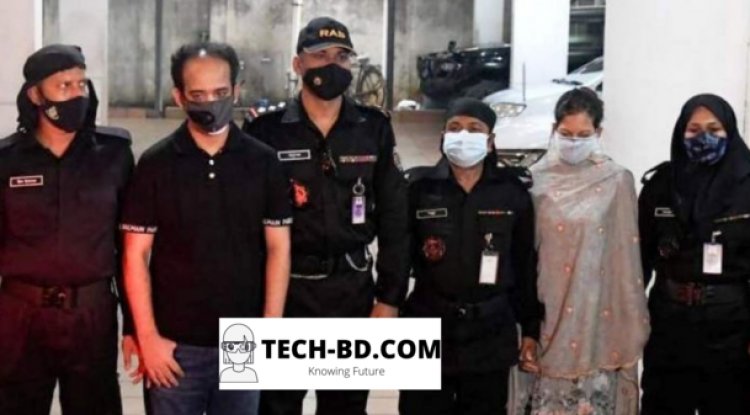
On September 16, an embezzlement case was filed against Rassel and his wife Shamima with the Gulshan police station. A few hours later, the RAB raided their house in Mohammadpur and arrested the couple.
Evaly's controversial business strategy has come to the fore following a central bank inspection report on the e-commerce firm.
Where the money went
Three destinations account for most of it, and they are worth separating because they have very different prospects for recovery.
Earlier customers. The largest share was never stolen in the ordinary sense — it was spent delivering orders placed before yours. A platform selling a motorcycle below cost and funding it from the next thousand deposits is transferring money between customers. That portion is gone in the sense that it is in other people's garages.
Discounts. The gap between what a product cost and what the customer paid was absorbed as a marketing expense. This is money that was burned to acquire users and does not exist anywhere.
Abroad, through hundi. The Criminal Investigation Department concluded that funds were moved out of the country through the informal transfer system. Across eight e-commerce cases the CID put the laundered total at around Tk7.05 billion.
Why hundi makes the last portion unrecoverable
The 2021 reporting could not yet explain this, and it is the most important piece.
A bank transfer leaves a record at both ends and passes through correspondent banks that can be ordered to freeze it. Hundi leaves none of that. Money is handed to an operator in Dhaka; an associate abroad pays out the equivalent from a separate pool; the two settle between themselves later, often by netting against trade invoices. No money crosses a border, so there is no transaction for a regulator to follow, no account to freeze and no foreign bank with a licence at risk.
That is why establishing where the money went and getting it back are separate problems, and why only the first has been achieved.
The number that framed everything
The central bank's inspection put the shortfall plainly: Tk403.80 crore owed out, Tk65.17 crore of current assets to meet it. That single comparison answers the headline more completely than any individual trail, because it shows the money was never simultaneously present. Roughly six taka were owed for every one available — a position from which even a scrupulously honest operator could not have paid everyone.
For customers the practical outcome has been poor. Even after the commerce ministry asked Bangladesh Bank to begin refunds, no agency turned out to hold a usable list of the firms under suit, and the process stalled there.