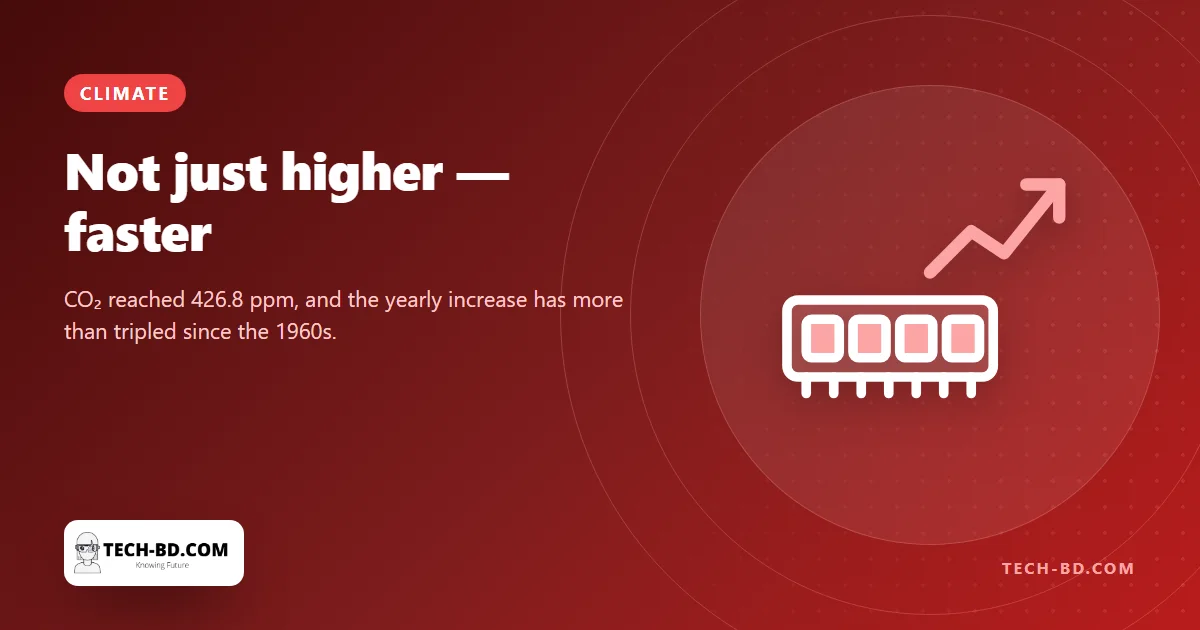
The concentration of carbon dioxide in the atmosphere has reached its highest ever level, the World Meteorological Organization says.
By the end of 2025, atmospheric carbon had reached its highest point on record. The current concentration is 426.8 parts per million — 153% of the pre-industrial level.
The number that matters is not the level
It is the rate, and this is the part worth reading twice.
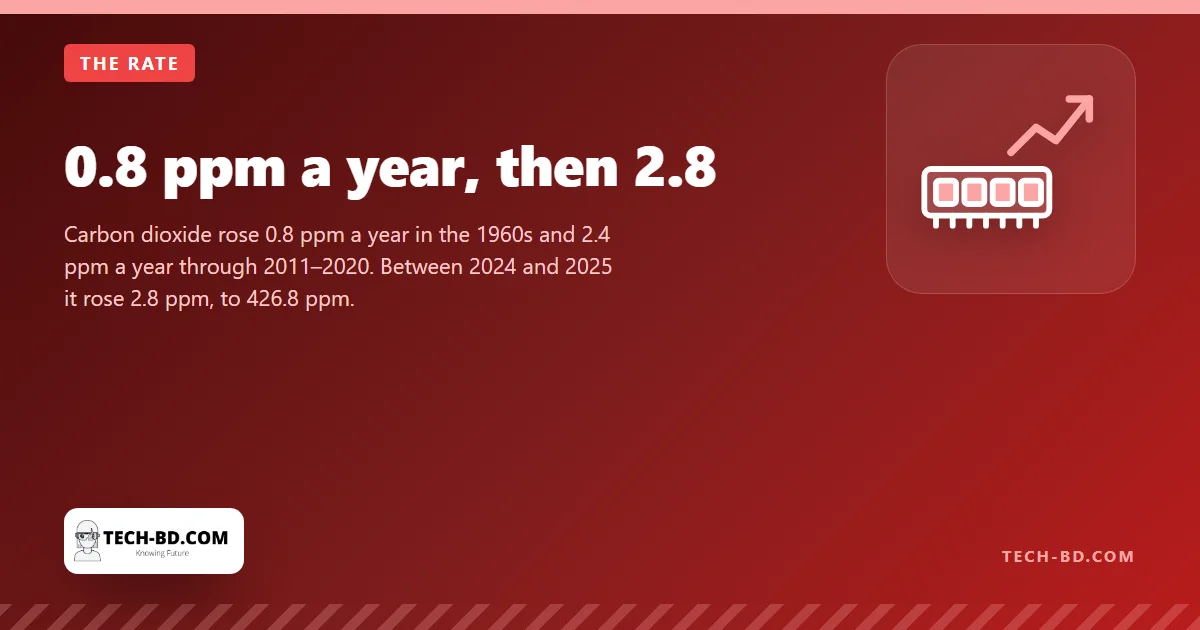
In the 1960s, carbon dioxide rose by 0.8 ppm a year. Across the decade from 2011 to 2020 the rate had risen to 2.4 ppm a year. Between 2024 and 2025 the average concentration rose by 2.8 ppm.
So the quantity is not merely increasing. The speed of the increase is itself increasing, and has more than tripled within a single human lifetime.
WMO Deputy Secretary-General Ko Barrett put it bluntly: another year means another new record. Greenhouse gases are trapping unprecedented heat in the atmosphere, producing severe extreme weather and increasing the risk to economies and societies.
Barrett also made the point that is easiest to miss. Carbon dioxide is long-lived. It will affect the climate not merely in the coming years but over coming decades and even centuries. Despite commitments to renewable energy and net zero targets, she said, the actual picture is entirely different.
It is not only carbon dioxide
Between 1990 and 2025, the warming effect on the climate increased by 56%. Of that increase, 81% came from carbon dioxide alone.
Methane and nitrous oxide also set records. Methane, responsible for 16% of the warming effect in the atmosphere, has reached a concentration of 1,948 parts per billion — 267% of its pre-industrial level in 1750.
One hopeful signal, and why it did not hold
WMO scientific adviser Oksana Tarasova said that after the strong El Niño events of 2023 and 2024, forest fires decreased in 2025 and there were indications that soil was recovering some of its capacity to hold carbon.
That is genuinely good news about the natural carbon sinks, and it is the kind of finding that gets reported as a turning point. It was not one. Tarasova said that because of fossil fuel use, and the influence of a newly strong El Niño in 2026, concentrations will rise further.
This is the shape of the problem in miniature: the land and oceans had a better year, and the total still went up, because what they absorb is small against what is emitted.
Why this is in the technology section
Because the biggest single driver of new electricity demand in the countries doing most of the emitting is now computing infrastructure, and the connection is not rhetorical.
The large technology companies have upwards of $700bn of AI chip and data-centre spending planned for this year alone. Britain’s chancellor offered developers permission to build their own onsite generation to get round grid delays, which is a straightforward admission that the grid cannot supply what is being built. Scotland has 23 hyperscale projects queued behind a power supply that will not stretch to them.
None of that caused 426.8 ppm — the figure is the accumulated product of a century and a half of fossil fuel use. But the decisions being taken right now about where that power comes from are what the next decade of this chart will record.
For Bangladesh the reading is direct rather than abstract. A country of river deltas and coastal districts does not get to treat sea level and extreme weather as other people’s variables, and the WMO is describing an acceleration rather than a plateau.