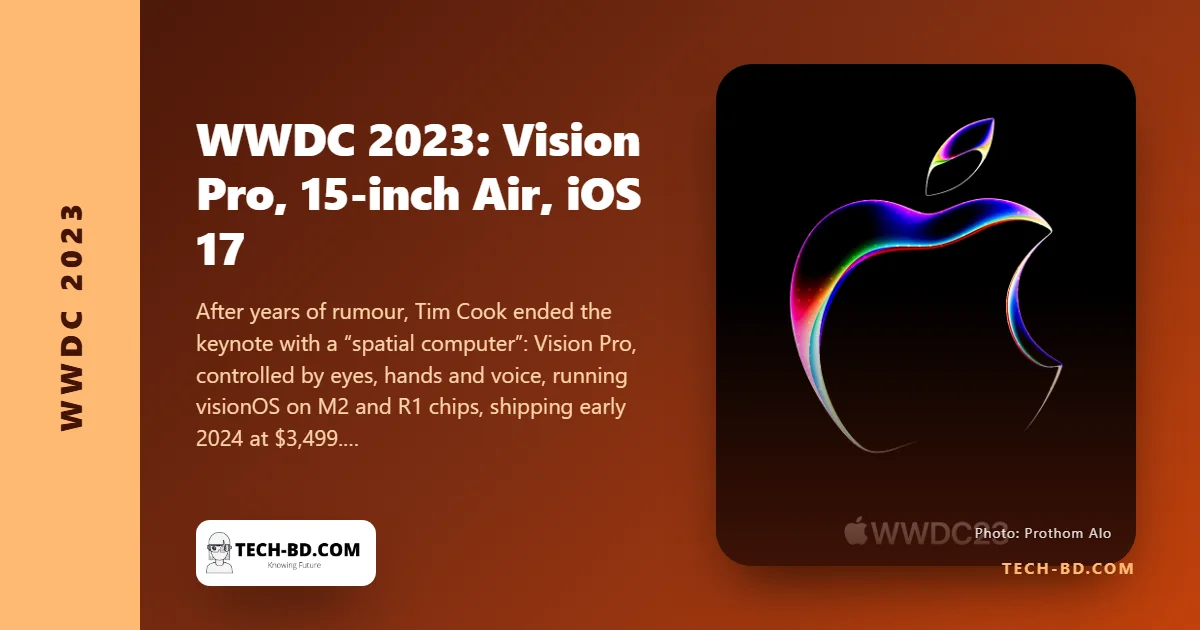
Apple’s developer conference opened on Monday at Apple Park with Tim Cook on stage, and for the first time in nine years the company announced a new category of product. The analysts had been right: it is a headset. Apple refuses to call it that — the phrase is “spatial computer” — and it is called Vision Pro.
Vision Pro
A ski-goggle-shaped device with two micro-OLED screens totalling 23 million pixels, an M2 chip for computing and a new R1 chip for processing the twelve cameras, five sensors and six microphones that watch the world and the wearer. There is no controller: you look at a button to select it, tap your fingers together to click, and speak to type. Apps from the iPhone and iPad float in the room; a Mac’s screen can be pulled into the air; FaceTime shows a scanned “Persona” of your face because the real one is behind glass. A dial blends the real room with a virtual one. It runs visionOS, with Safari, Photos, Music, FaceTime and games at launch. It costs $3,499, ships in the United States in early 2024, and Apple did not say when anywhere else.
Everything before it
- 15-inch MacBook Air — the large Air users have asked for, 11.5 mm thin, M2, 18 hours of battery, four colours, $1,299. Available next week.
- Mac Studio and Mac Pro with the new M2 Ultra; the Mac Pro, the last Intel Mac, finally moves to Apple silicon, from $6,999.
- iOS 17 — StandBy turns a charging iPhone on its side into a bedside clock and smart display; Check In tells a contact when you reach home and alerts them if you do not; NameDrop shares contact details by touching two iPhones; voice messages are transcribed; the Phone app gets personalised contact posters and live voicemail transcription.
- iPadOS 17 — a customisable lock screen, interactive widgets, and collaborative PDF editing.
- Journal, a new end-to-end-encrypted diary app for iPhone, later this year.
- macOS Sonoma (widgets on the desktop, Safari profiles), watchOS 10 (a redesign around full-screen widgets), tvOS 17 (FaceTime on the TV), SharePlay in Apple Music.
The conference runs until 9 June; the software ships in September.
From Dhaka
$3,499 is about Tk3.8 lakh before duty, or roughly Tk5 lakh once a grey importer has landed it — the price of a small car’s down payment, for a device that is US-only next year and needs an Apple ID with a US payment method to buy apps. It will appear in Bashundhara City’s Apple corners as a curiosity in 2024, and the developers who matter for it are in Cupertino, not here. The announcements that reach Bangladesh are the ordinary ones: the 15-inch Air, which will sell, and iOS 17’s Check In, which is the feature every parent of a university student in this city will switch on the day it arrives.