Fifth-generation networks are not finished rolling out anywhere, including here. So why is anyone talking about 6G? Because building, testing and agreeing an international standard for a generation of mobile technology takes years, and the preparation has to start long before the first customer sees it.
What 6G is
6G is the sixth generation of mobile communications technology. The International Telecommunication Union, the United Nations agency that coordinates this work, calls it IMT-2030. It is not ready for commercial use: the technical characteristics and the international standard are still being settled, with work aimed at 2030.
The naming is worth pausing on. IMT-2030 is a target, not a product. What eventually ships under the label “6G” will be whatever equipment makers build against that standard once it is agreed — which is why confident claims about what 6G will do should be read as ambition rather than specification.
When it arrives
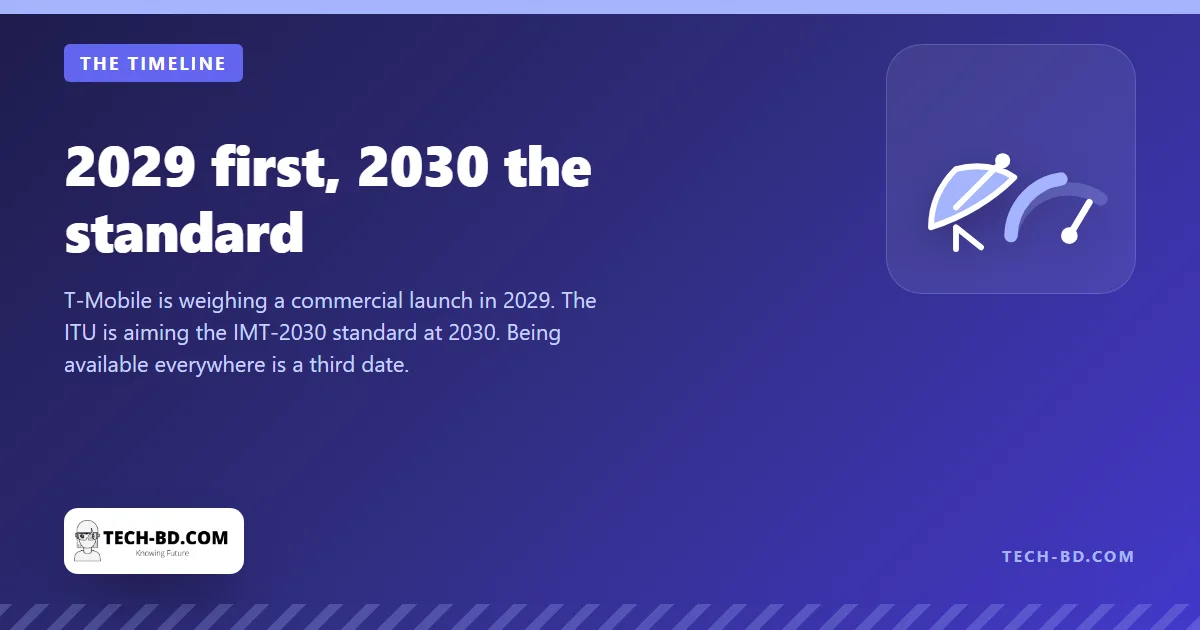
Companies have begun preparing. The American operator T-Mobile is considering launching commercial 6G from 2029. But a technology launching commercially and a technology being widely available are two different things. 4G and 5G both spread country by country, in stages, over years — and 6G is likely to do the same.
The part that is not about speed
The usual way to describe a new generation is a bigger number for download speed. 6G is expected to be different in kind rather than only in degree. The work envisages networks whose radio signals do more than carry data: the same signal, bouncing off its surroundings, can be read to detect the presence of people or vehicles nearby. The network becomes a sensor as well as a pipe.
That is genuinely new, and it is also where the policy questions start. A network that can tell how many people are in a room, or that a vehicle has stopped on a particular stretch of road, is collecting something that no previous generation collected. Whether that counts as personal data, who may query it and on what authority, are questions the standard does not answer — and the countries that write the rules late will be the ones that inherit whatever the equipment happens to do.
What this means for Bangladesh
The temptation is to treat 6G as a race Bangladesh must enter. The more useful framing is that each generation has arrived here as capability long before it arrived as coverage, and the gap has never been the headline speed.
5G spectrum was auctioned here in 2022 and the service still reaches a small fraction of users. Meanwhile 4G coverage is uneven enough that people in remote villages work from a phone tied to a bamboo pole to hold a signal. A sixth generation changes nothing about that arithmetic. What would change it is spectrum priced so operators can afford rural sites, fibre backhaul reaching upazila level, and electricity steady enough to keep a tower up.
There is one thing worth doing early, and it costs nothing: deciding the sensing rules before the equipment arrives. BTRC has until roughly 2030 to write what a network may and may not infer about the people near it. Countries that leave that until the kit is installed tend to find the question already settled by whoever installed it.