In a remote village of Ulipur upazila in Kurigram, a mobile phone spends the working day tied to the top of a bamboo pole. It is not an experiment. It is Fazle Elahi’s office network, and it has been for years.
What the pandemic took
Elahi finished a postgraduate degree at Jahangirnagar University and took a job at a private IT firm. The pandemic ended it. With nothing in his pocket and nothing to show his family, he took work in Dhaka as a security guard at Manarat International University at night, and spent his days delivering letters and doing data entry at a courier company in Eskaton.
“I had to get by with great difficulty. I would get exhausted,” he told Prothom Alo. “But I would think of my family, steady myself and keep working.” When conditions worsened he gave it all up and went home to Kurigram, to the sound of rain on a tin roof and no idea what came next.
The Tk 1,950 that started it
A Facebook advert led him to a Facebook Ads course. The fee was Tk 1,950, and he did not have it. Through freelancing communities and government training projects he had met an older woman he addressed as apu. Swallowing his embarrassment, he explained the problem. She paid, on one condition: whatever he was taught, he would teach her a little of it too.
The bamboo pole
Inside a tin-roofed house there was effectively no mobile signal. Broadband was out of the question and laptop Wi-Fi meant nothing without it. All he had was a phone hotspot — so he put the phone outside the window, or tied it to the top of a bamboo pole, and connected the laptop indoors. Class videos, assignments and attempt after attempt on Fiverr and Upwork all ran through that link.
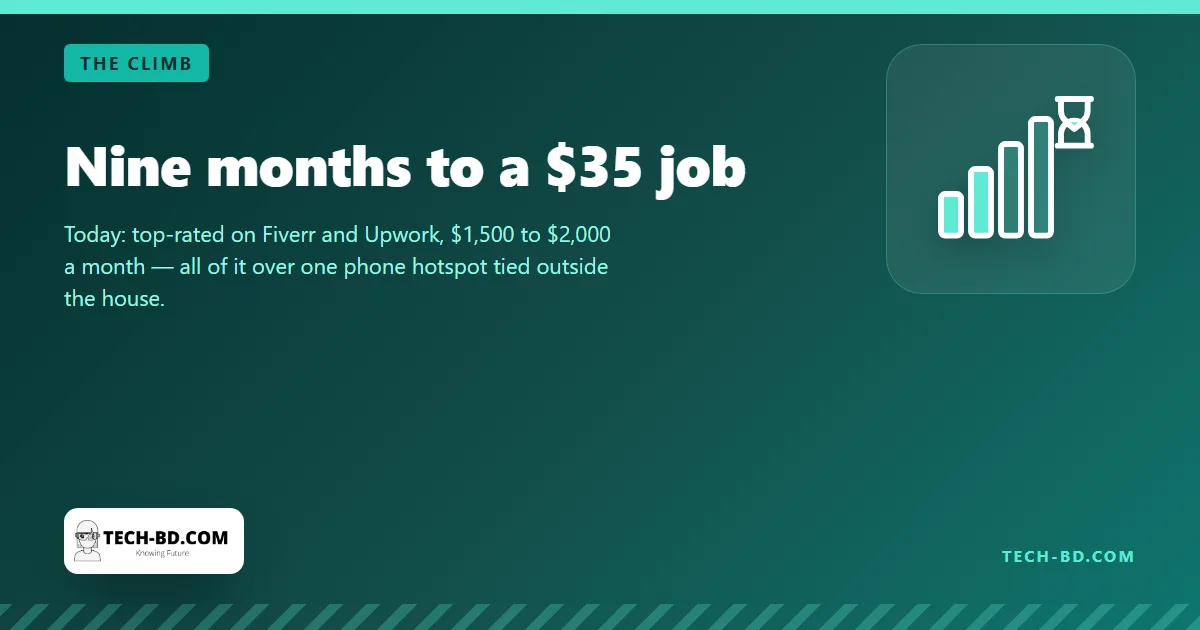
It took nine months to land the first job. It paid $35. Everything since has gone through the same hotspot.
What the neighbours said
The village did not know what to make of a young man tapping at a laptop all day. “What does he do at home all day? When is he going to Dhaka? Even a garments job would bring in some money,” he recalls hearing. His mother worried. He kept going.
Where it stands now
Elahi is a top-rated seller on both Fiverr and Upwork, working on Google Ads, web analytics and Facebook conversions for marketplaces and agencies. He earns $1,500 to $2,000 a month — more than Tk 2 lakh — from that village. He mentors younger freelancers at an institute and puts some of what he earns into small development work around his area.
The part worth arguing about
It is easy to file this as an inspiring story and move on. The more useful reading is that his success was achieved in spite of infrastructure, not because of it. Bangladesh exports freelance labour measured in hundreds of millions of dollars a year, and a meaningful share of that work is done on mobile data in places where a tin roof is enough to break the connection. Coverage maps count a village as served if a signal reaches it at all; they do not ask whether it reaches inside the house.
That gap is precisely what satellite services claim to address, and it is why Banglalink switching on Starlink direct-to-cell matters more in Ulipur than in Dhaka — though on the current specification it carries messages, not a workday of uploads. Until something does, the bamboo pole stands.
Related: Nokrek IT, ten years of training freelancers from a Madhupur courtyard.