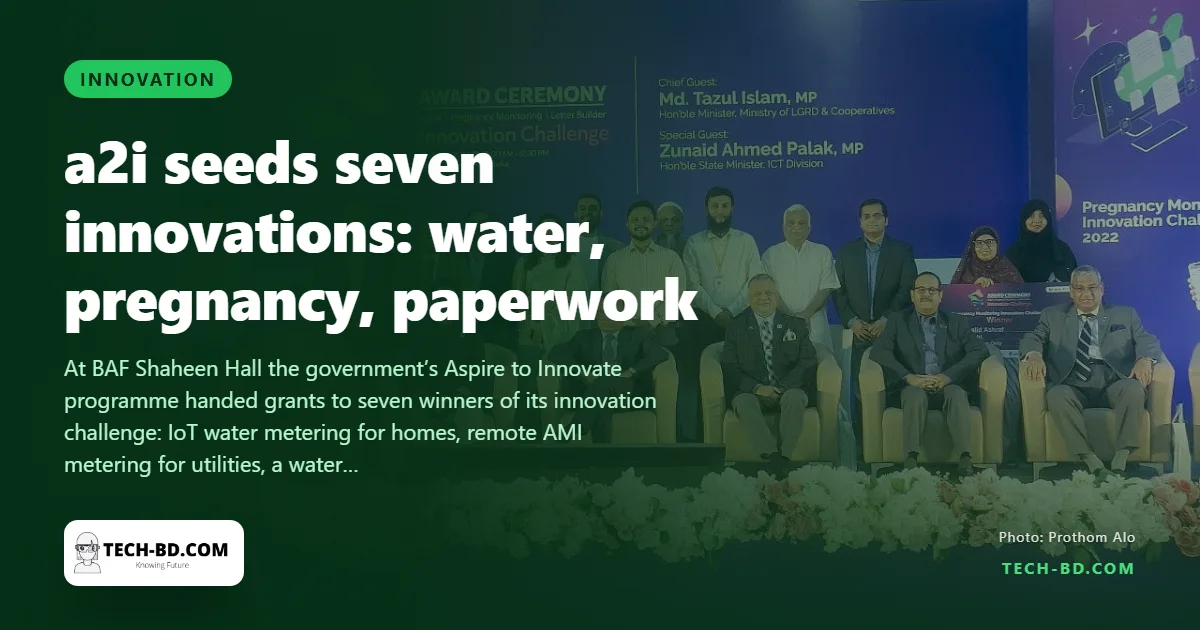
Seven Bangladeshi innovators have been given between Tk18.5 lakh and Tk90 lakh each to build their ideas, at a ceremony held on Thursday at BAF Shaheen Hall in Dhaka by a2i, the government’s Aspire to Innovate programme. The money is seed funding — enough to build a working version — rather than a prize, and the seven were chosen from an innovation challenge run with the agencies that will eventually use what they build.
The winners
- Ashikur Rahman — IoT-based smart metering and sub-metering for homes, tracking water quality and consumption and using AI and analytics to nudge households to waste less. Tk18.5 lakh.
- Ahmed Nasif Hossain — smart water monitoring through Advanced Metering Infrastructure, letting utilities read customers’ usage remotely and distribute supply accurately. Tk20 lakh.
- Md Khaled Hasan Morshedul Bari — a dashboard for the textile and leather industries showing water use, treatment, reuse and waste on demand. Tk28.32 lakh.
- AHM Rezwanul Islam — digital meters and a “water tool analytics” platform for factories: remote monitoring, prepaid and postpaid billing, usage analysis. Tk25 lakh.
- Khalid Ashraf — a system linking public and private health providers, dashboards and data islands for continuous pregnancy monitoring, with two-way contact between doctor and patient. Tk90 lakh, the largest award.
- Mehedi Hasan — a digital platform that tracks vital signs in pregnancy through a smartwatch and alerts a health provider. Tk60 lakh.
- Hasib Uddin — a web-based dynamic letter builder for government offices, with reusable templates that connect to Nothi, the national portal and MyGov. Tk33.2 lakh.
Why water, four times
Dhaka WASA, whose managing director Taqsem A Khan was on the stage, loses a large share of the water it produces to leaks and unmetered use, and the country’s garment and tannery clusters draw groundwater at rates that are sinking the water table under Savar and Gazipur. Metering is the unglamorous fix for both, and the four water projects are, in effect, WASA and the Department of Environment commissioning tools they intend to deploy. The pregnancy projects follow the same logic: the Directorate General of Health Services, whose director general attended, wants continuous monitoring to cut maternal deaths, which remain around 160 per 100,000 births.
What the ministers said
LGRD minister Md Tazul Islam said innovation must be prioritised to reach the Smart Bangladesh vision by 2041, listing transport, education, electricity and water as the areas needing it. ICT state minister Zunaid Ahmed Palak said the government is encouraging innovation through public-private-academic partnership and will support each innovator through every stage to commercial success; he also said drones for urban planning, environmental monitoring, water quality and delivery would be built in Bangladesh. Also present: a2i project director Dewan Muhammad Humayun Kabir, Bangabandhu Aviation and Aerospace University vice-chancellor Air Vice Marshal ASM Fakhrul Islam, DGHS director general Dr ABM Khurshid Alam, Department of Environment director general Dr Abdul Hamid, and a2i policy adviser Anir Chowdhury.
The test
Seed money is the easy part. The record of government innovation grants in Bangladesh is of prototypes that work at the demonstration and are never procured. The seven will be judged not on Thursday’s cheques but on whether, in two years, a WASA meter reader has been replaced by one of them.