"AI is making medicines" is a headline that invites an obvious question: has the job of discovering drugs moved to the machines?
The short answer is that the research is real, the money is enormous, and the finish line is further away than the advertising suggests.
What is genuinely happening
The serious work starts with AlphaFold, the system from Google DeepMind that predicts how proteins fold into their three-dimensional shapes. That was a real scientific achievement, and it matters because a protein's shape largely determines what can bind to it.
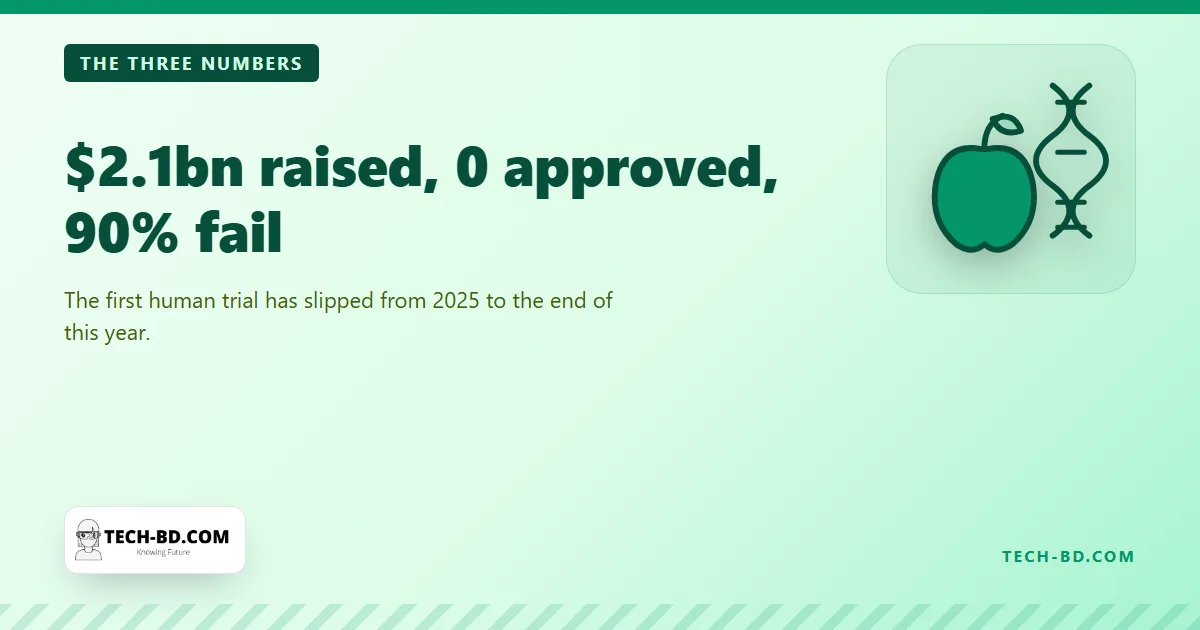
DeepMind's drug-design arm, Isomorphic Labs, is now applying that technology to designing medicines. In May the company raised $2.1bn.
So this is not vapour. It is a well-funded attempt by a group with a genuine track record.
And here is the gap
Reuters has reported that Isomorphic's first human trial is now expected around the end of this year. The earlier target was 2025.
According to a Business Insider report on 31 October, no AI-designed drug has yet received approval from the US drug regulator.
And the base rate is brutal: roughly 90% of drug candidates fail in trials.
Put those three facts together and the picture is clear. The first serious AI-designed candidate has not yet been tested in a person, and nine out of ten candidates that reach testing do not survive it.
Why finding a molecule is the easy part
This is the step the headlines skip. Predicting a protein's structure, and proposing a molecule that should fit it, is a computational problem — and it is the part AI is genuinely good at.
What a medicine additionally has to do is survive a human body, and that is not a computational problem. It has to reach the right tissue, last long enough to work, not be destroyed too quickly by the liver, not damage anything on the way, and not interact badly with whatever else the patient is taking. Then the effect has to be large enough to measure against people who received nothing.
Clinical trials exist to test those things in sequence: first whether a dose is safe at all, then whether it does anything, then whether it does more than existing treatment across a large group. Each stage removes candidates, and that is the stage where the 90% goes.
A tool that shortens the first step is valuable. It does not shorten the rest, because the rest is measured in human time.
How to read the claims you will actually meet
You are far more likely to encounter "AI-discovered" on a product label or an advertisement than in a journal. Three checks are worth making.
Ask which trial phase it is in. A candidate in early safety testing and an approved medicine are not the same category of thing, and a product on sale as a cure should have finished, not started.
Note that no AI-designed drug is approved. Because of that single fact, anything currently for sale claiming to be an AI-designed medicine is describing itself inaccurately. "AI was used somewhere in our research" and "this is an AI-designed drug" are very different statements, and the first is often stretched into the second.
Treat "miracle cure" language as the warning, not the selling point. Before buying any medicine, ask a doctor or a pharmacist. That advice is dull and it remains the single most useful filter available.
The honest summary
AI is not a magician in drug discovery, and it is not a useless toy either. It is a fast research assistant — one that can propose and narrow options far quicker than a team could alone.
The decisions, and the responsibility for them, should stay with people. For anyone reading an advertisement rather than a paper, the practical version is simpler: the technology is promising, nothing has crossed the line yet, and anything claiming otherwise on a shelf is selling something.