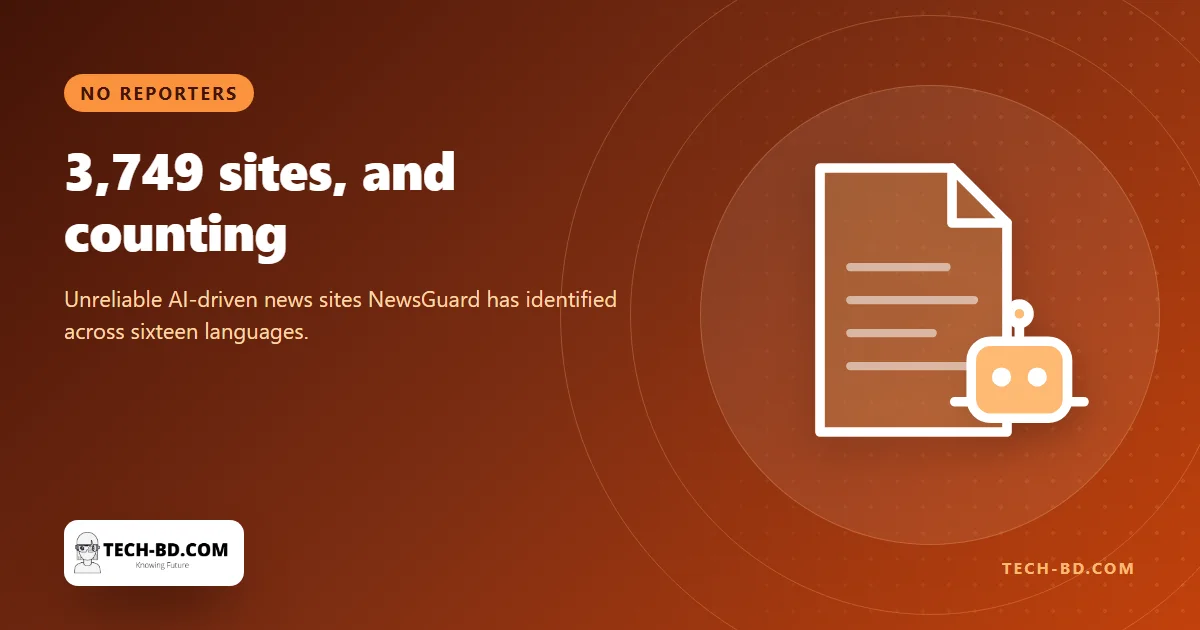
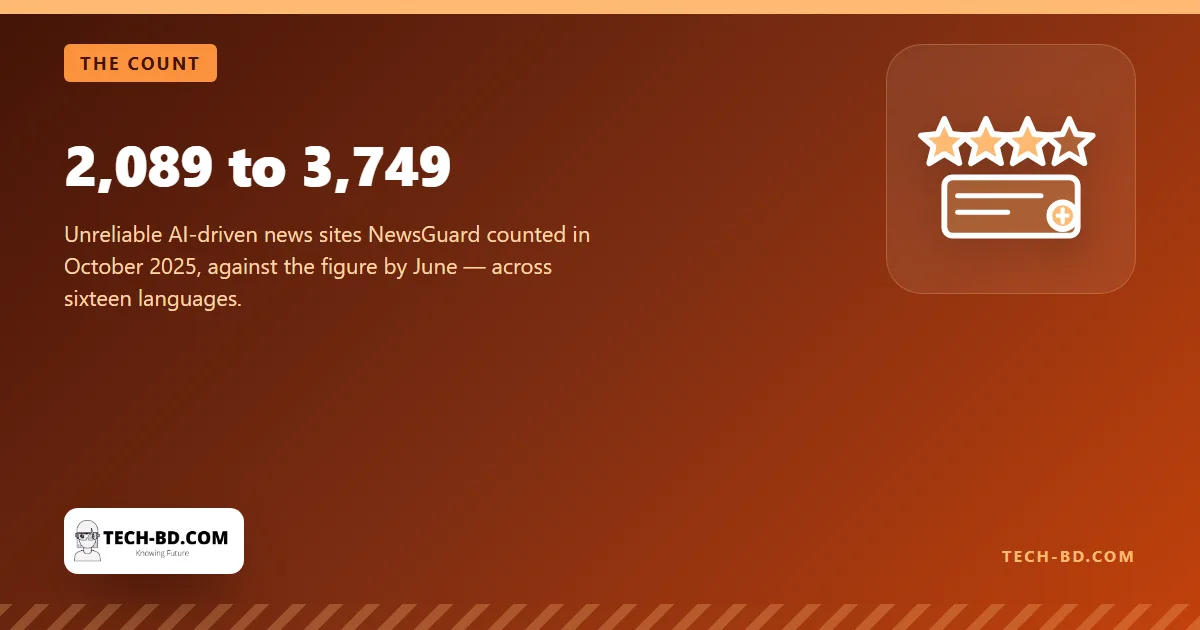
A growing share of what looks like news online is produced by sites that employ no journalists at all. The monitoring organisation NewsGuard had counted 3,749 unreliable AI-driven news sites across sixteen languages by June, up from 2,089 in October 2025.
That is an increase of about eighty per cent in roughly eight months, in one count, in sixteen languages. The report was written up by Remijius Remy.
What these sites actually are
They carry names that sound like news organisations, mastheads, categories, and a steady flow of stories. What they do not have is anyone reporting. Text is generated in volume, often rewritten from real coverage elsewhere, and published without anyone checking whether it is true.
The business model is advertising. A site that costs almost nothing to run and publishes hundreds of pages a day can earn from automated ad placement, and at that cost per page the accuracy of any individual story is simply not a commercial consideration.
The number is a floor, not a total
This is the part worth being careful about. NewsGuard counts sites it has identified, in languages it monitors. Sixteen languages is a small fraction of the languages the internet publishes in.
Bangla is not among them. That absence tells you nothing about whether Bangla-language AI news sites exist — only that nobody in this count is looking. Given that the technique requires no local knowledge, no staff and no premises, the safer assumption is that the practice follows the advertising market into every language with one.
Three things a reader can check
None of these is conclusive on its own, and together they catch most of it.
Look for a person. Real news organisations name their reporters and editors, and those names lead somewhere — other work, a professional profile, a contactable address. A site whose articles are credited to a generic staff name, or to writers who exist nowhere else, is a strong signal.
Check whether the text is anyone's own. Paste a distinctive sentence into a search engine. If the same wording appears across several unrelated sites, you are reading a rewrite of a rewrite, and the original is what you want.
Follow the story to its source. Genuine reporting says where it got something — a named official, a court filing, a published paper, its own interview. Writing that attributes everything to "reports" and "experts" without naming one has no source to follow, usually because there was not one.
Why this is getting harder rather than easier
The old advice was to look for bad grammar and clumsy translation. That advice is now useless: the text reads fine. What has not improved is sourcing, and that is why the three checks above are about provenance rather than style.
The practical risk for readers here is not being fooled by a single invented story. It is that search results and social feeds fill with plausible, unattributed versions of real events, and the original reporting gets harder to reach — which costs you accuracy even when nothing you read was outright false.