When the first day of the apple harvest arrived in Washington State last year, the fruit was ripe and the pickers were ready. The weather had other ideas.
The problem
"It was like 38C… it's not safe for people to work in that heat," recalls Joel Carter at Okanagan Specialty Fruits. "We had to stop at 10 o'clock in the morning."
He says AI models that forecast ideal harvest dates, taking weather into account, would be useful. "You need to know more than just when your fruit is going to be ripe. How long do you have to pick it? That's where these models are really helpful."
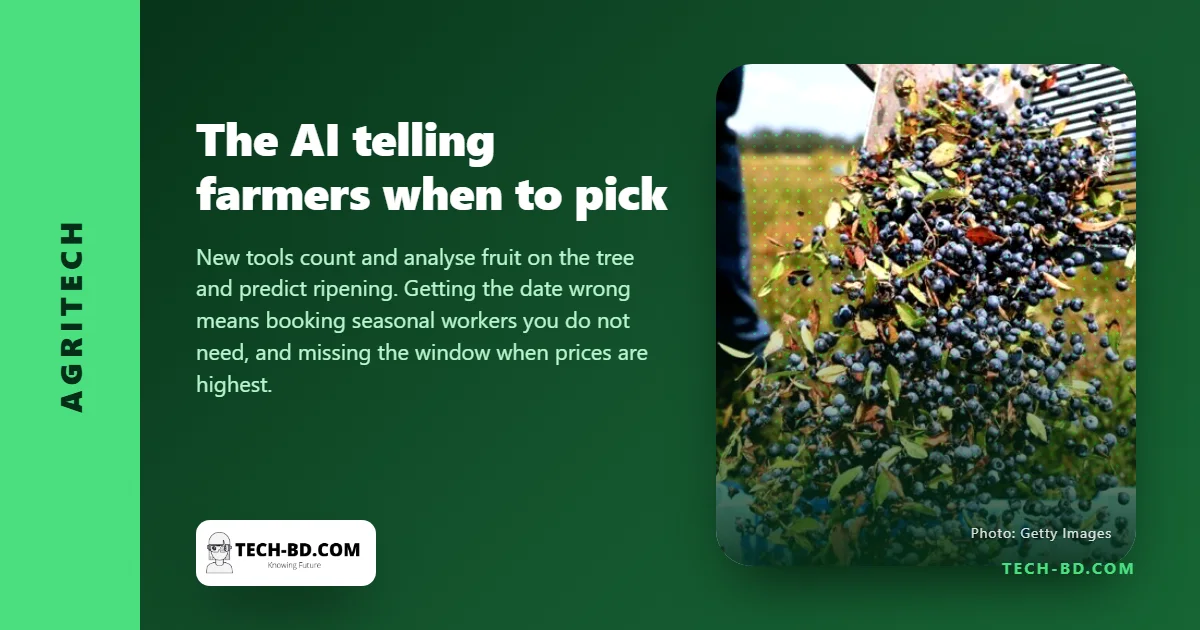
Carter's company has more than 1,250 acres of apple orchards, grown for sliced apple portions sold to hotels and schools. New tools that count and analyse fruit on the tree or vine, and predict when crops will ripen, are emerging.
It matters because prices for fruit — especially high-value berries such as strawberries and blueberries — fluctuate wildly. Get the harvest date wrong and you book seasonal workers when you do not need them, and risk missing the biggest profits.
What it means in Bangladesh
The technology is not the transferable part. The framing is, and it is unusually well suited to Bangladeshi agriculture.
Carter's insight is that the useful question is not "when is it ripe" but "how long is my window". That is precisely the question a Bangladeshi farmer cannot currently answer, and the cost of not answering it is enormous. Post-harvest losses here are estimated at roughly a quarter to a third for fruit and vegetables — not because of ignorance about ripeness, but because the harvest window, the labour, the transport and the market day do not line up.
The heat detail transfers literally. Bangladesh has already closed schools nationwide for heat, and a 38C day stopping work at 10am is not a Washington State problem here; it is April and May. Any harvest-planning model built for this country has to treat working hours as weather-dependent, which the Western tools are only now learning to do.
What would actually help is far simpler than orchard computer vision. The binding constraints in Bangladesh are a cold chain that barely exists outside a few corridors, market price information that reaches the farmer after the trader has it, and transport booked on the day rather than in advance. A model predicting ripeness to the day is worth very little if the truck is the variable.
That said, the cheap version is available now and nobody is deploying it: a weather-based harvest-window forecast, delivered by SMS, for the handful of crops where timing drives price — mango in Chapainawabganj, litchi in Dinajpur, potato in Munshiganj. The data exists at the Bangladesh Meteorological Department. The missing piece is the translation into a farm instruction.