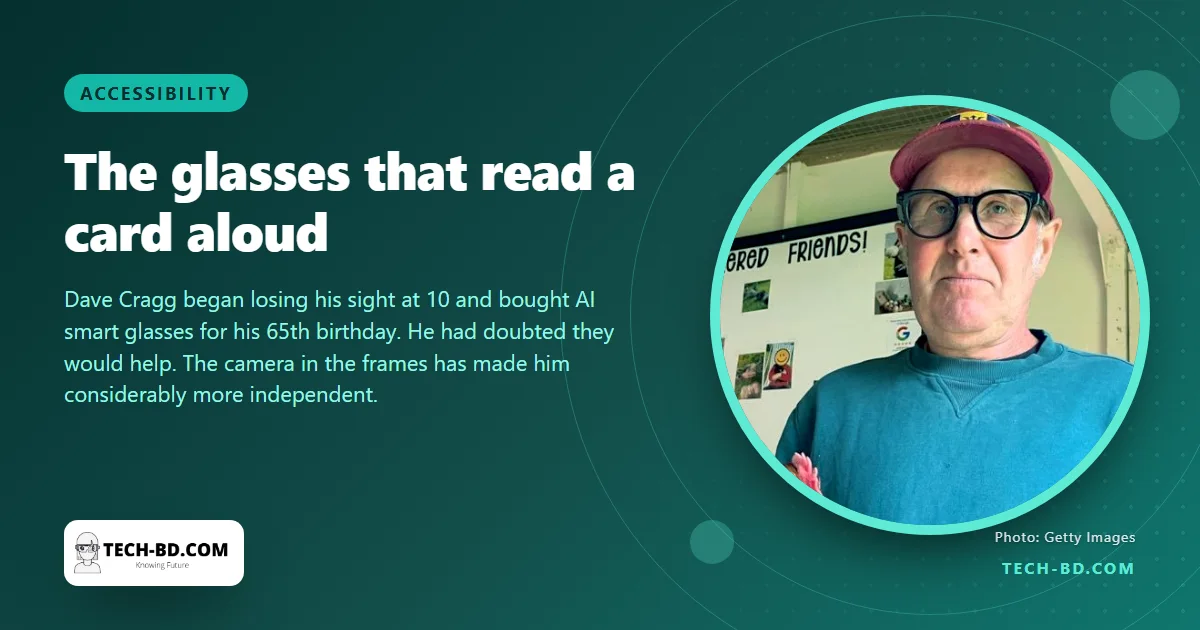
For the family of visually impaired chicken farmer Dave Cragg, his decision to buy AI-powered smart glasses for his 65th birthday delivered a moment they had not expected.
What changed
"It was the first birthday — and I am 33 — [that] I have ever seen my dad be able to read a birthday card," said his eldest daughter Philippa Wilcox.
Cragg, from Wybunbury in Cheshire, began losing his sight aged 10 and now has very limited peripheral vision. He had initially doubted what benefit the glasses would bring.
The camera in the frames links to apps on his phone, and has enabled him to become "a lot more independent" than he was. The devices have also proven controversial, amid concerns about covert recording.
What it means in Bangladesh
Bangladesh has in the region of 750,000 blind people and several million with significant visual impairment, by the common estimates. Assistive technology reaches almost none of them.
What makes this story worth more than a warm feeling is that the capability involved — a camera reading text aloud, describing a scene, identifying an object — no longer requires a special device. It is a feature of a smartphone. Free apps already do the core of it, and several handle English well.
The gap is Bangla. Text recognition in Bangla script is materially worse than in Latin script across every major platform, because the training data is thinner and the conjunct characters are harder. A blind Bangladeshi can point a phone at an English sign and be told what it says; point it at a Bangla prescription, a utility bill or a government form and the result degrades badly. That is a solvable engineering problem and nobody with resources is solving it.
It is also the clearest case for public funding of a Bangla language dataset. The usual argument for one is economic — better translation, better search. The stronger argument is this: optical character recognition that works in Bangla converts an ordinary phone into the device Cragg bought, for a population that cannot afford a specialist product.
The covert-recording concern is real and should not be waved away, but it applies to the camera every person already carries. The difference with glasses is that the recording is not visible to the person being recorded. That is a genuine privacy question, and it has no satisfactory answer yet in any country.