Two AI features have changed daily life for people with visual and hearing impairments more than most of the technology that gets written about. One describes an image aloud. The other turns speech into text as it is spoken.
The first lets someone who cannot see a photograph know what is in it — a red rickshaw, a smiling child — including photographs sent by relatives who never thought to describe them. The second, live captions, gives deaf and hard-of-hearing people a running text of a conversation as it happens.
What the survey found
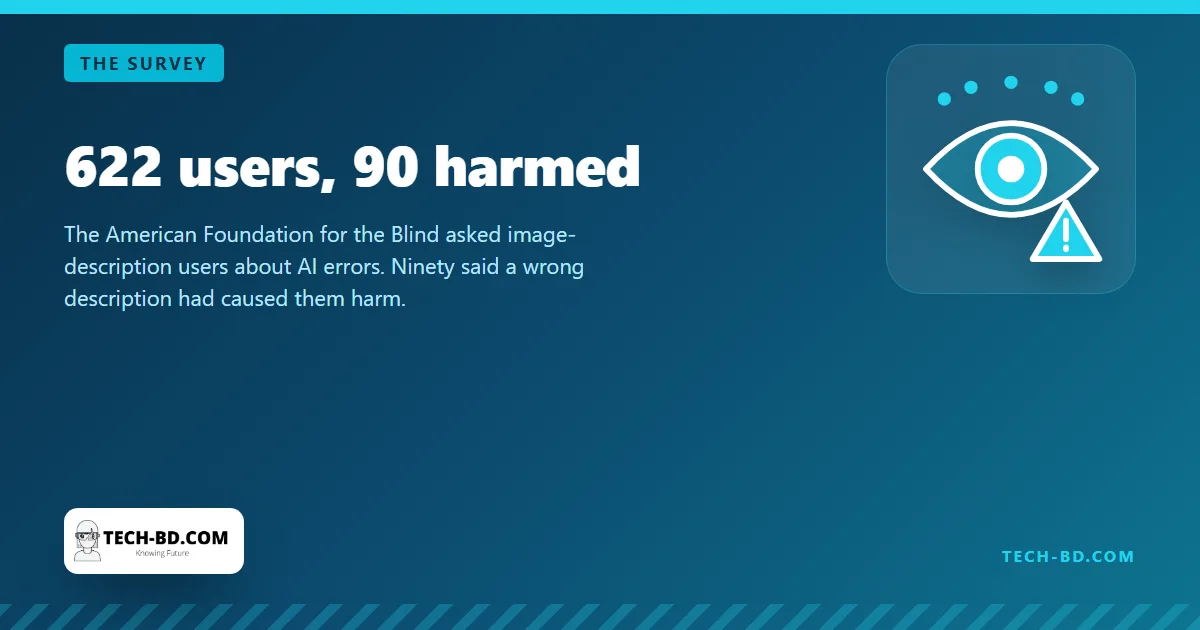
A report by the American Foundation for the Blind, published in August 2026, surveyed 622 users of image description. 74% of them were people with disabilities. 90 users said they had suffered harm because of AI errors.
The finding underneath that number is the important one: blind and visually impaired users are harmed more by these errors than other users are. The reason is structural rather than technical. If you can see the photograph, a wrong description is an annoyance you catch instantly. If you cannot, the description is the photograph.
Why confidence is the failure
AI image description does not usually fail by refusing to answer. It fails by producing a detailed, fluent, entirely wrong description in exactly the same tone it uses when it is right. There is no audible difference between a correct answer and an invented one, which removes the signal a user would normally rely on to know when to double-check.
There is a related limit worth stating plainly: image description is not navigation. Relying on a described scene while walking outdoors is dangerous, because the description is a snapshot interpreted by a system with no understanding of what is moving, how fast, or how far away it is.
What the report advises
Three things. Double-check information where an error is costly — medicine labels and currency notes are the examples that come up most. Family and friends should treat support as part of the tool rather than assuming the app has replaced them. And users should press for better Bangla-language support.
That last point deserves more weight than it usually gets. Most of these systems were built and tested in English. A description engine that is reliable in English and shaky in Bangla produces exactly the failure the survey describes — confident output, no audible warning — for the users least able to catch it.
The question underneath
The article that reports this ends on a question worth repeating: is AI for disabled people a kindness, or part of their rights? The distinction is not rhetorical. If it is a kindness, accuracy in Bangla is a feature request that waits its turn behind larger markets. If it is access, it is an obligation, and the error rate is not an inconvenience but a barrier.
What a careful user can do now
Where the stakes are high, ask the same question twice in different words and see whether the two descriptions agree; a fabricated detail rarely survives rephrasing. Where a number matters — a dose, a note, a date on a label — treat the description as a prompt to verify rather than an answer. And where a second person is available, a two-second human check still outperforms every system in the survey.
None of that is a substitute for the tools working properly in Bangla. It is what manages the gap until they do.