AI now writes a share of the blog posts, essays, emails, columns and research papers being published, and it writes them fluently enough that the question of who is accountable for the result has stopped being theoretical.
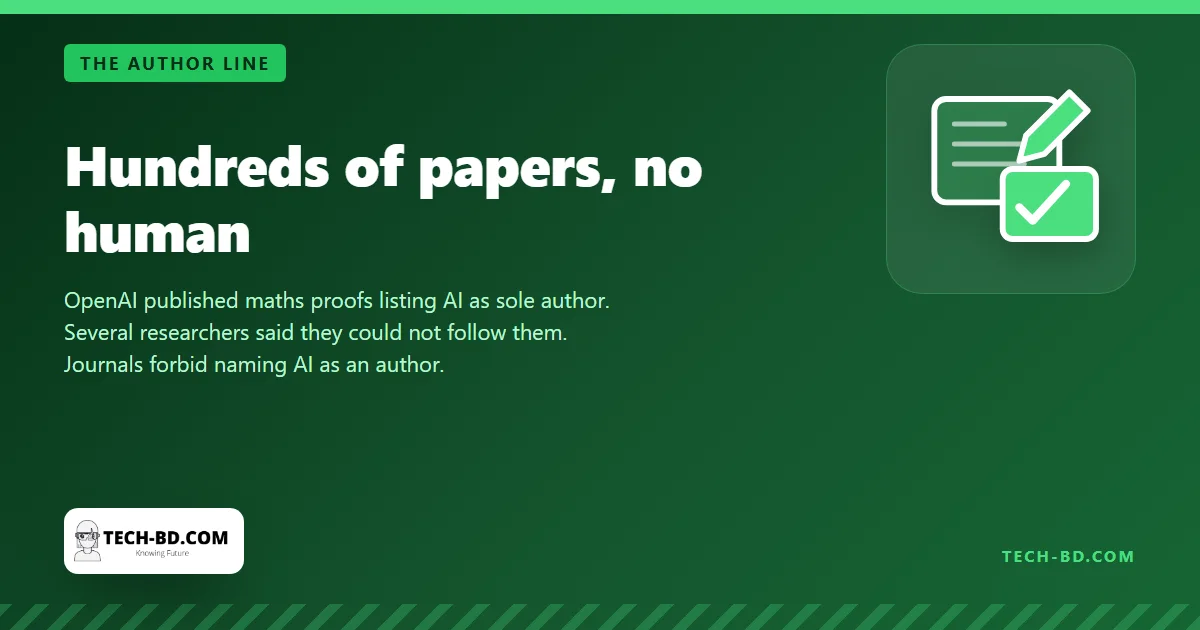
Last month OpenAI published hundreds of research papers on long-standing mathematical problems and listed AI as the sole author, with no human names attached. Several researchers and mathematicians said they could not understand many of the proofs.
Why that combination is the problem
Bioethicist David Resnik, of the US National Institute of Environmental Health Sciences, put the objection simply: if humans do not understand the work, they cannot ethically take responsibility for it.
That matters because responsibility is exactly what authorship means in academic publishing. Under the guidance of the International Committee of Medical Journal Editors, an author must be able to answer for the planning of the research, the analysis of the data, and the checking of the writing. Journals and preprint servers therefore prohibit listing AI as an author outright — not as a judgement about quality, but because a model cannot carry an obligation.
The proposed fixes
Bioethicist Brian Arp, of the National University of Singapore, argues the definition of authorship may simply have to change, and suggests at least one human acting as a certifying author who verifies the final results.
Resnik’s position is stricter: a paper should not be published at all if humans cannot understand what the AI did, and scientists should be supervising the work step by step rather than reviewing it at the end.
Véronique Kiermer, chief scientific officer at PLOS, adds a practical caution in the other direction. Disclosure of AI use is right in principle, but requiring it for minor spelling or language edits is meaningless — a rule that treats a grammar check and an autonomous proof as the same act will be ignored.
OpenAI itself does not claim academic credit for the papers, and has asked scientists to review and understand the AI-generated research.
Why this reaches further than mathematics
Proofs are the hardest case to argue about and the easiest to check, because a proof is either valid or it is not. The same question becomes far messier in fields where results are probabilistic and errors are not self-revealing — clinical research being the obvious one, which is why the medical editors’ rules are the ones being quoted.
For researchers and postgraduate students here, the operative rule has not changed and is worth stating plainly: AI cannot be an author, its use should be disclosed, and the person whose name is on the paper is answerable for every line of it. A certifying author, if that idea is adopted, would not dilute that — it would make it explicit.
Where the rules will actually bite
Disclosure policies are easy to write and hard to enforce, because nothing in a finished manuscript reveals how it was produced. The enforceable version of this is not a declaration at submission but a requirement at review: that an author can be asked to explain any step of the work and answer for it. That test does not need to detect AI at all. It simply fails anyone who cannot account for what they have signed.
It is also the test that the mathematics papers would fail, which is why they have forced the question into the open rather than settling it.