The winning entry of a prestigious scientific photography competition is being re-evaluated after criticism from other scientists that it was made with AI.
The entry
Nikon's annual Small World In Motion contest accepts photos and video taken using powerful microscopes, and has run for 15 years.
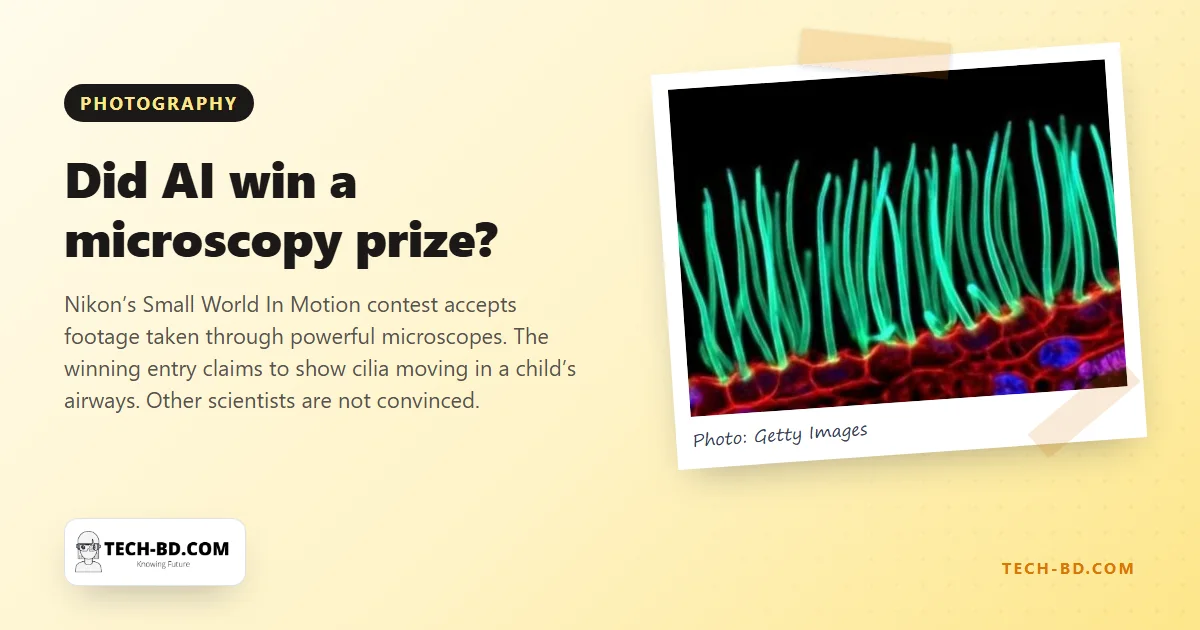
The winner was a short video submitted by Dr Ning Xu, a researcher at Tsinghua University in China, which claims to be footage of tiny hair-like structures called cilia moving inside the airways of a child with a rare disease.
Xu did not respond to the BBC's request for comment, but has posted online denying he broke the competition rules.
What it means in Bangladesh
Strip out the microscope and this is a question every institution is about to face: how do you verify that an image is a record of something rather than a depiction of it?
Scientific photography is where the problem bites first, because the image is the evidence. But the same question is already live in places Bangladesh cares about more. A land dispute settled partly on photographs. An insurance claim. A news photograph of a protest. A medical image sent for a second opinion. In each case the picture is doing evidentiary work that it can no longer automatically do.
The response that will not work is detection. AI-image detectors are unreliable, they get worse as the generators improve, and a confident wrong answer is more damaging than no answer. Anyone selling a Bangladeshi institution a tool that "detects AI images" is selling something that does not reliably work.
The response that does work is provenance: not asking whether an image looks generated, but requiring the chain that produced it. For a competition that means raw files, instrument metadata and the capture session. For a court it means where the photograph came from and who can testify to taking it. For a newsroom it means the same discipline that has always applied and is now unavoidable.
This matters particularly here because Bangladesh's information environment already runs heavily on screenshots and forwarded images with no origin. The country did not need generative AI to have a verification problem — it has had one for years. What has changed is that the cheapest category of fabricated evidence is now the most convincing one.