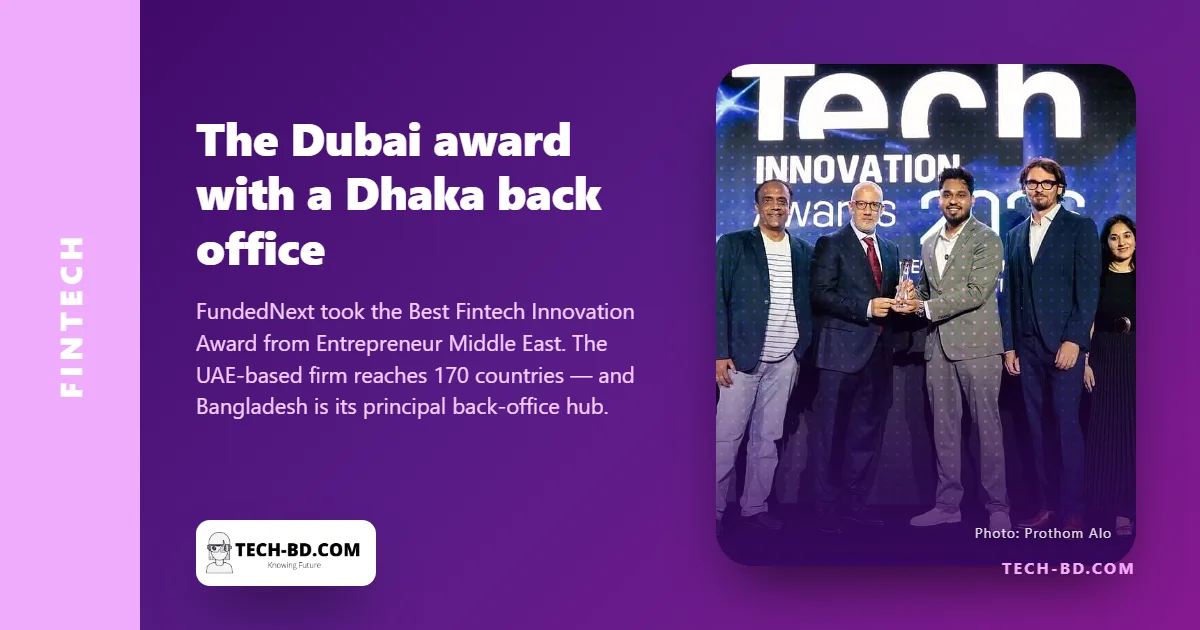
UAE-based FundedNext has received the Best Fintech Innovation Award, given by Entrepreneur Middle East — the Dubai-based regional franchise of the US magazine Entrepreneur, which covers business, technology and innovation across the region.
The award
Chief executive Syed Abdullah Zayed accepted the honour at a ceremony at Dubai's Al Habtoor Palace on 17 September, alongside chief product and growth officer Dana Massey and chief legal officer Anaclaudia Filadoro.
"There are many skilled traders around the world who cannot put their strategies to work for want of the right capital," Zayed told Prothom Alo. "FundedNext was born to close that financial gap."
Launched in 2022, FundedNext is the flagship product of Next Ventures. Its services now reach more than 170 countries. Next Ventures also owns a regulated brokerage, FNMarkets. The headquarters is in the UAE, with operational hubs in Malaysia, Cyprus and Sri Lanka — and Bangladesh acting as the principal back-office hub.
What it means in Bangladesh
That last detail is the story, and it is the one a press release buries.
This is the shape a great deal of Bangladeshi technology work actually takes: the company is registered abroad, the brand is foreign, the revenue is booked in another currency, and the people doing the work are here. It is not outsourcing in the old sense — these are not contractors taking briefs. It is a Bangladeshi operational core inside a foreign corporate shell.
There are good reasons founders structure it this way, and they are worth stating without judgement: access to international payment rails, a regulatory environment that global clients recognise, and the ability to hold and move foreign currency without the friction Bangladeshi exchange controls impose. For a business whose customers pay in dollars from a hundred countries, Dhaka incorporation is a genuine handicap.
The cost to Bangladesh is equally plain. The work happens here; the value is recognised elsewhere. The award says Dubai. The tax base is not here, the intellectual property is not here, and if the company is ever sold, the proceeds are not here either.
What would change that is unglamorous and well understood: making it practical to receive international payments into a Bangladeshi entity, and to hold foreign currency without a per-transaction argument. Until then, every success of this kind will keep being a foreign success with a Bangladeshi engine — and the country will keep reading about its own work in somebody else's trophy cabinet.
The other Bangladeshi firm on an international stage this week is in the two students who won SpaceX's challenge at MIT.