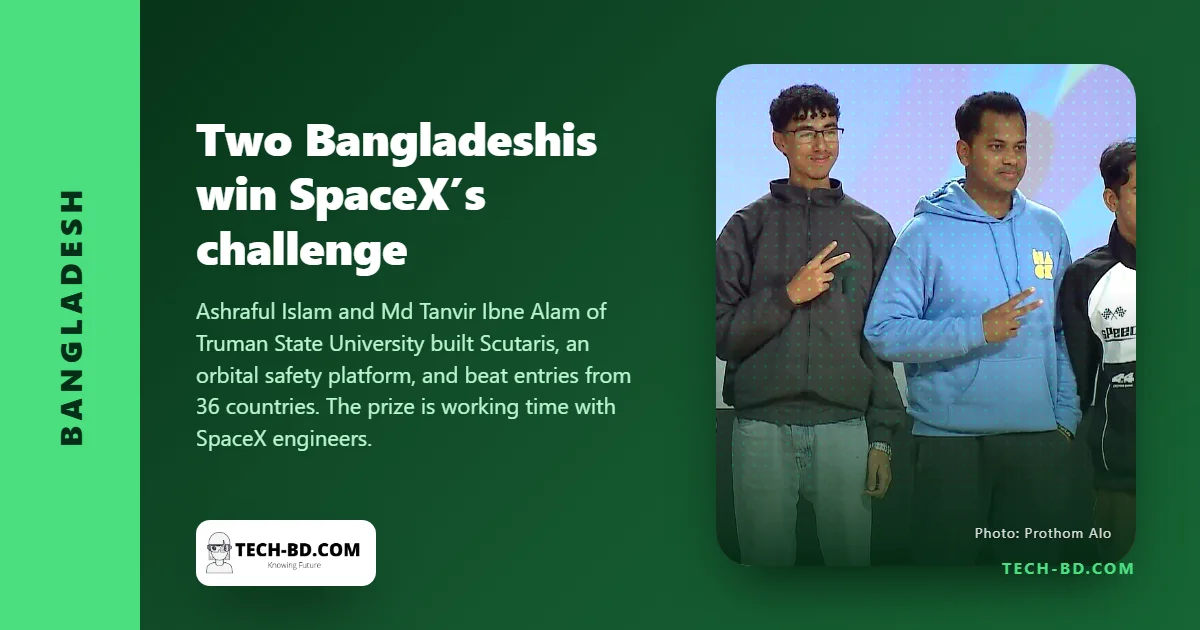
Two Bangladeshi students at Truman State University in the United States — Ashraful Islam and Md Tanvir Ibne Alam — have won the SpaceXAI challenge at HackMIT 2026, held at the Massachusetts Institute of Technology.
What they built
Their project, Scutaris, was picked as one of the two best entries. The prize is the chance to work alongside SpaceX engineers.
Islam describes it as an AI-driven orbital safety platform. It identifies possible collision risks between satellites and space debris orbiting Earth, and surfaces the significant ones in plain terms. It runs on more than 9,000 real orbital records pulled from CelesTrak. A user asks a question in ordinary language; Elasticsearch finds the most relevant risks; SpaceXAI's Grok then analyses each in five stages, sets out what could be done, checks the safety implications and produces a visual report. Satellite positions, orbits, closest-approach distances and risk levels are shown on a three-dimensional Earth.
HackMIT ran on 19 and 20 September with more than 1,100 students from 36 countries. SpaceX, Google, Meta, Microsoft, OpenAI and Nvidia all set challenges. "We chose the one from SpaceXAI," said Alam. Their brief was to use Cursor as the IDE, Grok Imagine for images, Grok Bot for planning, and real space data.
Islam has researched detecting microplastics in water using a low-cost microscope and AI; Alam was selected for Truman's Emerging Innovator Research Programme and works on eclipsing binary stars using NASA Kepler and TESS data.
What it means in Bangladesh
The easy version of this story is national pride, and it is earned. The more useful version is about what the win actually demonstrates.
Scutaris was not built on privileged access to space hardware. It was built on public data — CelesTrak publishes orbital elements for anyone — combined with ordinary search tooling and a commercial model, in two days. That is a template, and it is available to a student in Dhaka tonight. The scarce inputs were not money or equipment. They were knowing the dataset existed and having the nerve to enter.
The second point is uncomfortable and worth saying plainly. Both winners are studying in Missouri. Bangladesh produces this calibre of student routinely; what it does not reliably produce is the environment in which a weekend project gets judged by SpaceX engineers. Hackathons here are common enough, but few carry a real industry brief, a live demo judged by practitioners, and a prize that is access rather than cash.
That is a fixable gap and a cheap one. A hackathon's value is in the quality of the challenge and who reads the result. Bangladeshi universities that want this outcome should be spending their effort on getting serious companies to set the problem and sit on the panel, not on the venue.
Another Bangladeshi team went out on the same kind of stage this month — see the eight students taking fire-fighting robots to South Korea.