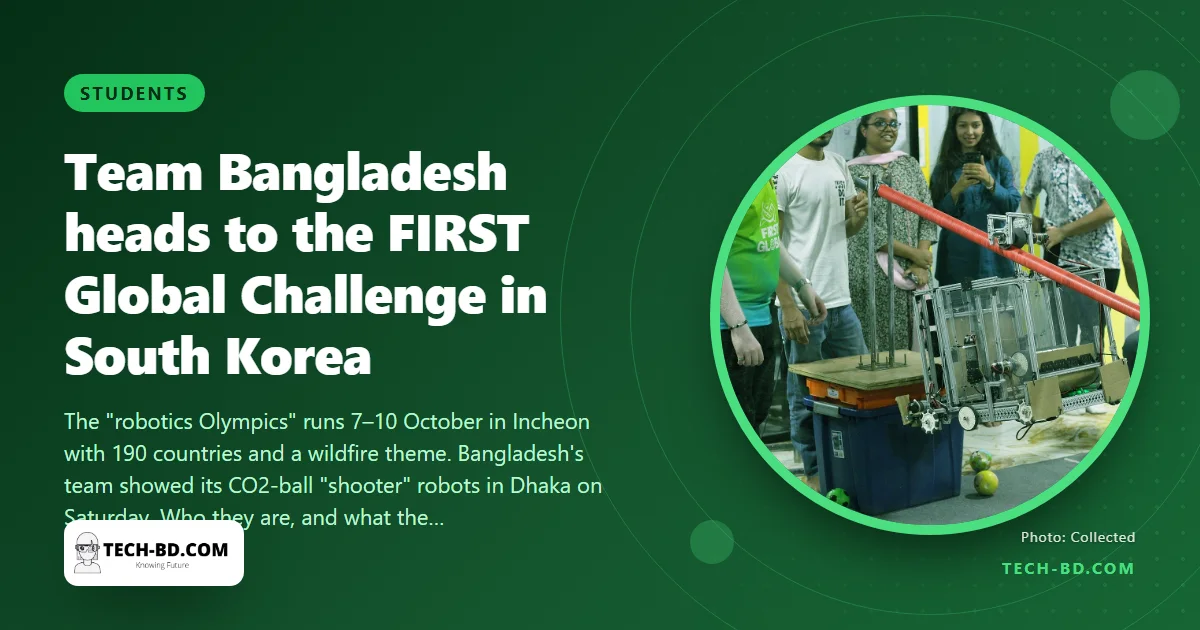
The FIRST Global Challenge, the youth robotics contest that calls itself the Olympics of robotics, opens in Incheon, South Korea, on 7 October 2026, and Bangladesh will be one of 190 countries on the floor. On Saturday, 19 September, the eight students of Team Bangladesh put their robots through their paces at the offices of The Tech Academy in Dhaka, the organisation that selects, trains and manages the national team, at an event titled "Team Bangladesh: Road to FGC 2026 South Korea".
The task: wildfires
Every year FGC sets a global problem as its game. This year's theme is "Igniting Innovation: Focusing on Wildfire Prevention, Mitigation and Recovery", and the field is designed so that robots score by fighting a simulated fire. Team Bangladesh built three "shooter robots" for it: machines that can launch carbon-dioxide-filled balls into a fire from a distance and, where needed, climb a pipe to reach it, so that the fire can be put out without anyone going inside. The robots share the standard FGC kit, which every country receives, so the difference between teams is design, programming and driving, not budget.
Who is going
The team members are Mahruz Mohammad, Md Muhtasam Musharraf, Md Ishmam Shahruz Chowdhury, Suhana Mannan, Nuraz Hossain, Sarim Ahmed, Nuzhat Jahan and Sandipan Kundu, with Raihan Ahmed, Sifat Samia Islam, Muhammad Ahsan, Fayez Alam and Taha Kaizer Disawala as mentors. Midland Bank is the gold sponsor. "FGC is not an ordinary robotics competition," said head mentor Mohammad Shams Jaber. "It is a gathering of robotics students and mentors from 190 countries, a chance for our young generation to collaborate, to learn afresh and to exchange culture with people from almost every country in the world."
How FGC works
Unlike most contests, FGC pairs countries into random alliances for each match, so a Bangladeshi robot may spend one round working with Brazil's and the next with Bhutan's. Points come from the game tasks, but medals also go to cooperation, engineering documentation and outreach, which is why national teams tend to be judged as much on how they work with strangers as on how their robot scores. The contest was founded in 2017 with a Washington DC edition that Bangladesh attended, and the country has sent a team every year since; the same week, the BBC reported on a girls' school team from Folkestone in England preparing for the same Incheon finals.
Why it matters here
Bangladesh has a growing record in international robotics, from the World Robot Olympiad bronze in 2022 to the university teams at the University Rover Challenge. FGC is different in kind: it is secondary-school students, a shared kit, and a problem, wildfire, that the country does not have but that half its competitors do. The point is not the trophy. It is eight teenagers who will come home having built, debugged and driven a machine alongside peers from 189 other countries, and a national programme that now runs every year.