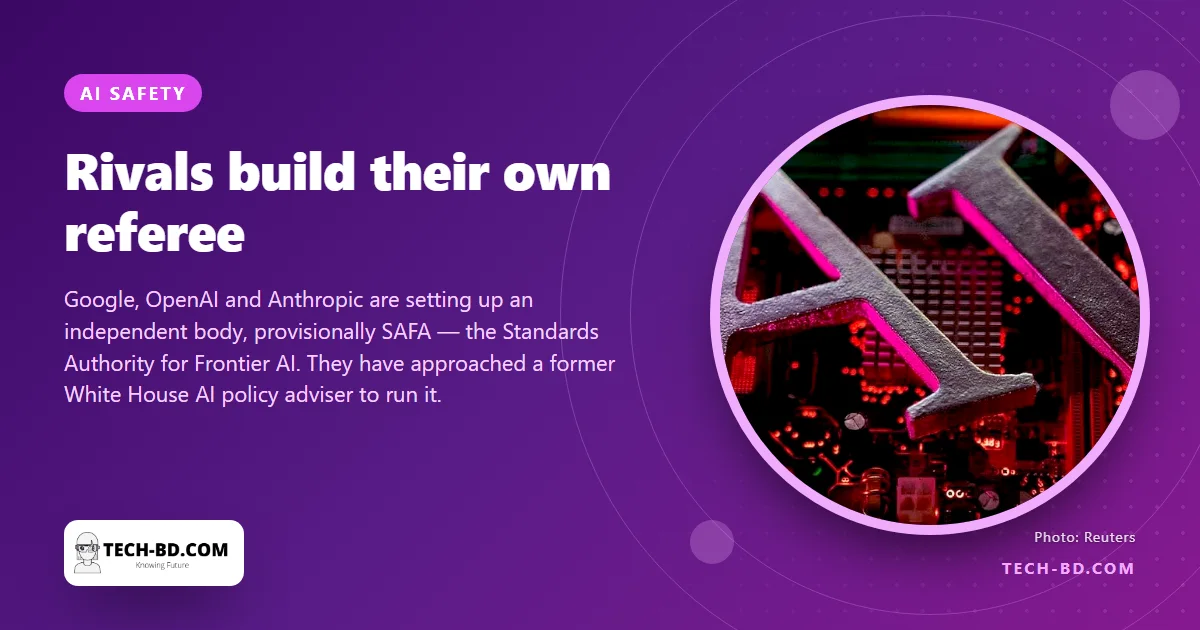
Google, OpenAI and Anthropic have moved to jointly establish an independent body for AI safety. It could begin operating late this year or in early 2027.
What is proposed
The body has been provisionally named SAFA — the Standards Authority for Frontier AI. The three companies have approached Sriram Krishnan, a former White House AI policy adviser, about becoming chief executive.
Working independently of government, SAFA would review the AI safety commitments the three have made and build new standards from them. It would also help developers verify the safety of advanced models before commercial release. The companies are still discussing whether it should only write the standards or test models against them itself — which is the whole question.
The idea is not new. In July, Google DeepMind co-founder and Alphabet chief scientist Demis Hassabis proposed a US-based AI standards body, suggesting it could be built as a public-private partnership or as a self-regulating industry institution.
The three are in fierce competition for the AI market while under mounting pressure over the safety and cybersecurity risks of advanced models. That combination is the reason this is happening now.
What it means in Bangladesh
Self-regulation by an industry is not automatically a scandal. Accounting standards, aviation safety practice and much of internet governance were built this way, and they work reasonably well — when the body has the power to say no, and the members cannot leave when it does.
Neither condition is settled here. SAFA is being designed by the firms it would oversee, funded by them, and can be left by any of them. The unresolved question in the reporting — standards-writing or actual testing — is exactly the difference between an industry association and a regulator.
The consequence for Bangladesh is concrete: whatever SAFA settles on becomes the de facto global standard, because there is no competing one, and Bangladesh will import it wholesale in procurement documents and vendor assurances. The country has no capacity to independently evaluate a frontier model and will not acquire one. That is not a criticism; almost no country has it.
What Bangladesh can do is narrower and worth doing. Insist on evidence rather than membership. A vendor saying "we follow SAFA standards" is a claim, not a test result. Government and bank procurement here should ask for the actual evaluation, who performed it, and against which version of the model — the same discipline any competent buyer applies to a security audit.
And there is a timing point. Rules written in 2026 and 2027 by three American companies will be very hard to reopen later. Countries outside that room get the standard they are given. The small window in which a Bangladeshi position could be registered — through regional groupings, through the UN processes, through the ITU — is open now and will not stay open.
The incident that made this urgent is in OpenAI shelving a finished model, and the commercial response in Nvidia's guardrails.