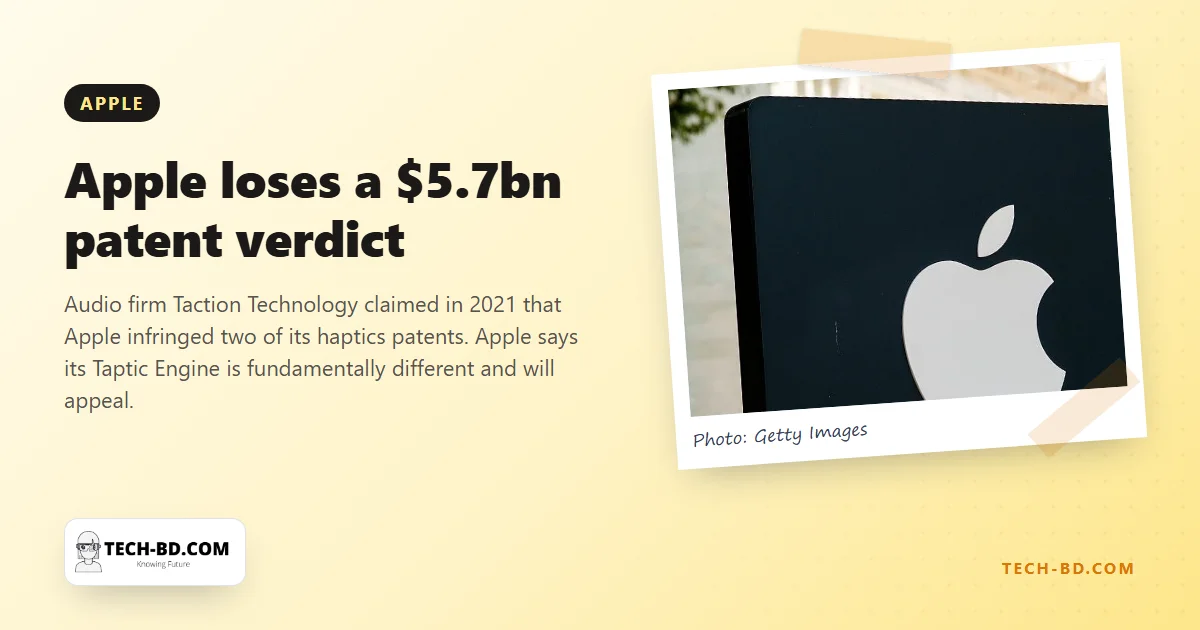
Apple has been ordered to pay $5.7bn (£4.3bn) in damages after a US jury found it had used another firm's technology without permission.
The claim
Audio firm Taction Technology claimed in 2021 that Apple had infringed two of its patents for haptics systems — the technology that produces vibrations for actions such as receiving a message or pressing a button. It is built into devices including the iPhone and Apple Watch.
Apple said it had not used Taction's vibration technology and will appeal. "While we thank the jury for their consideration, we strongly disagree with today's verdict and the damages awarded, which are entirely unsupported by the facts," the company said. "Apple's Taptic Engine is fundamentally different from Taction's technology, which Taction's own testing of Apple's products confirmed during trial."
Haptics let people interact with a device by simulating touch through vibration — the small, precise pulse that makes a virtual button feel like it was pressed.
What it means in Bangladesh
The headline number invites the wrong reading. $5.7bn is large in absolute terms and small against Apple's cash position; the sum will almost certainly shrink or vanish on appeal, as jury awards of this size usually do. What survives is the underlying point, and it is one Bangladeshi technology firms are moving towards whether they intend to or not.
The thing being fought over here is not a product. It is the method of making a component behave a particular way — a patent on how a vibration is generated, not on the phone it sits in. A Bangladeshi manufacturer assembling consumer electronics, or a hardware startup designing a device, inherits that exposure the moment it sells into a jurisdiction that enforces patents.
Three things follow. Bangladesh's own patent regime is little used by local firms and slow, which means a Bangladeshi invention is usually unprotected anywhere that matters — protection is territorial, so filing here does nothing in the US or EU. Second, freedom-to-operate checks, standard practice for exporters in most of Asia, are almost unknown among small Bangladeshi hardware firms; the cheapest moment to discover you are infringing is before tooling, not after a customs seizure.
Third and most practical: if you manufacture to a foreign buyer's design, get the indemnity in writing. When the design is theirs and the infringement claim lands, the question of who pays is decided by the contract, not by whose idea it was. A court that issues an injunction will not be interested in the distinction.
The same principle, argued over a sandal rather than a vibration motor, is in the Dutch court that priced a copy.