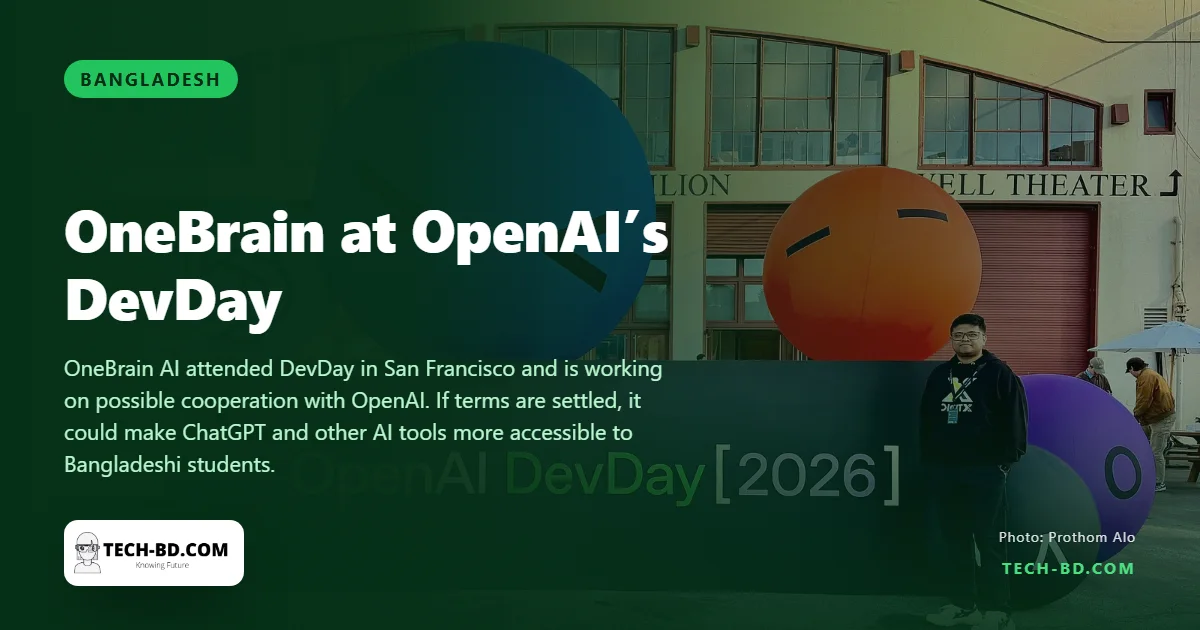
Bangladesh-based AI platform OneBrain AI took part in OpenAI DevDay 2026 in San Francisco — the second year in a row. The discussions covered recent AI developments, new technology, and ways to widen the use of AI in Bangladesh.
What is being discussed
OneBrain is working with OpenAI on possible cooperation to make AI more accessible to students. If an agreement and its terms are finalised, it could create an opportunity to make ChatGPT and other AI tools more readily available to Bangladeshi students.
The company has worked on student-facing AI programmes before. In 2025 it ran a OneBrain Campus Ambassador AI programme across more than a hundred public and private universities in the country, encouraging students towards AI use, new innovation and preparing for technology-led careers.
Founder and chief executive Amit Das said taking part for a second consecutive year was an important experience, and that the company continues to work with the OpenAI team on the potential of new AI technology for Bangladesh and on reaching more people with it.
What it means in Bangladesh
The honest reading first: nothing has been signed. "Working on possible cooperation" and "if terms are finalised" are the load-bearing phrases, and they describe a conversation rather than a deal. That is worth saying plainly because announcements like this are often read here as if the outcome had already arrived.
What would matter, if it happened, is specific and measurable. The constraint on AI use by Bangladeshi students is not curiosity or capability — it is that the useful tier costs around twenty dollars a month, which is a meaningful fraction of a student's monthly budget and is payable only with a card that most do not have. Either half of that problem being solved would change actual behaviour.
The second constraint is language, and it is less often mentioned. A Bangladeshi student working in Bangla gets a measurably worse answer than one working in English, on every major model. Widening access without addressing that widens access to a worse product.
There is also a question worth asking of any such programme. Free access to a commercial AI tool for a hundred universities is, from the vendor's side, a customer acquisition programme — which is not a criticism, but it does mean the terms deserve reading. What happens to the student work submitted to it, whether it is used for training, and what the price is in year three are the parts that determine whether this is an educational initiative or a distribution channel.
The students demonstrating what the access is for are in the eight students taking fire-fighting robots to South Korea.