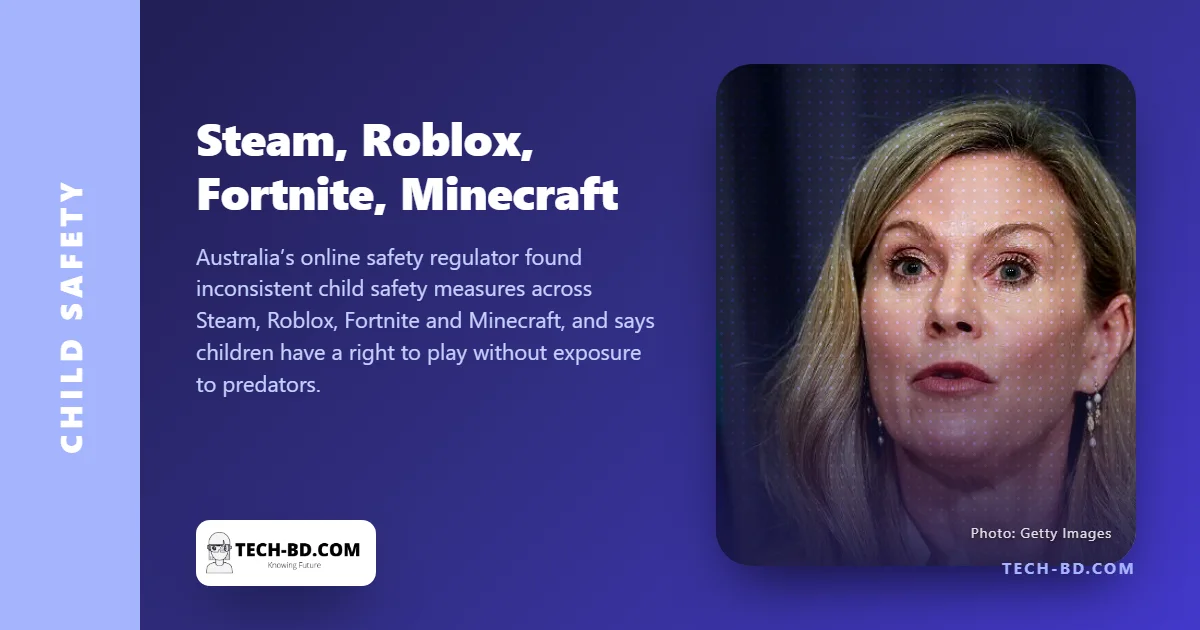
Australia's online safety regulator has found "significant gaps" in how popular gaming platforms protect children online.
The finding
A new report found inconsistent approaches in how Steam, Roblox, Fortnite and Minecraft implement child safety measures — at a time when research shows nine out of ten Australian children aged 8 to 17 have played online games.
"Australian children have a right to play online without being exposed to predators, sexual extortionists, violent extremist content or other harmful material," said eSafety Commissioner Julie Inman Grant.
Roblox said it "prioritises the safety of our Australian community, especially the youngest users". The other platforms were contacted for comment.
What it means in Bangladesh
Every platform in that list is played heavily in Bangladesh, and none of them has ever been assessed by a Bangladeshi regulator. That is the practical reality, and it is worth being clear-eyed about what follows from it.
Bangladesh benefits from Australian regulation whether or not it participates, because platform safety changes are usually implemented globally rather than per country. An eSafety finding that forces Roblox to change a default setting changes it for a child in Mirpur too. That is genuine, and it is also the whole problem: the protection Bangladeshi children get is a side effect of somebody else's enforcement, and it stops exactly where that enforcement's priorities stop.
Two gaps follow directly. The first is language. Content moderation, grooming detection and reporting flows are built first for English and a handful of major languages. A predator operating in Bangla is working in a space where automated detection is materially weaker, and where a report may be reviewed by someone who cannot read the exchange.
The second is age assurance. Every safeguard in these systems depends on the platform knowing the user is a child. Age gates that ask for a birthdate are defeated by every child who can count backwards, and the stronger alternatives rely on identity documents most Bangladeshi children do not have.
The useful advice for parents here is narrower and more boring than a policy argument. On every one of these platforms the settings that matter are who can message your child and who can join their session — both default to more open than most parents assume, and both can be changed in a few minutes. That is a bigger immediate protection than anything a Bangladeshi regulator is likely to deliver this decade.
The parallel move on messaging is in WhatsApp's new parental controls.