
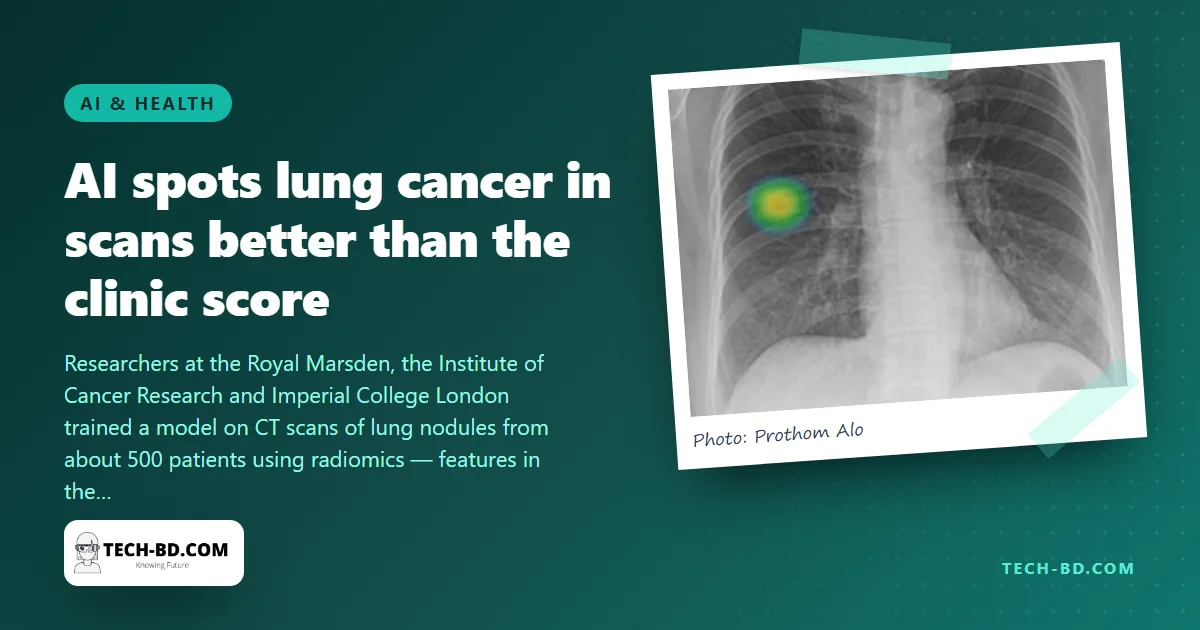
A CT scan of the chest often shows a nodule — a small shadow in the lung that may be a scar, an infection, or an early cancer. Deciding which is the job of a radiologist and a scoring system, and both get it wrong often enough that patients are either biopsied unnecessarily or told to come back in a year and lose the year. A team at London’s Royal Marsden hospital, the Institute of Cancer Research and Imperial College London has now published a model that does the job measurably better.
What they did
The LIBRA study took CT scans of lung nodules from about 500 patients and used radiomics — the extraction of hundreds of measurable features from an image, textures and gradients and shapes that the eye does not register — to train an algorithm to tell cancerous nodules from benign ones. Its performance was measured as AUC, the area under the curve, where 1.0 is a perfect classifier and 0.5 is a coin toss. The model scored 0.87. The Brock score, the calculator clinicians use today, scored 0.67 on the same cases. That is not an incremental gain; it is the difference between a test that is useful and one that is barely better than guessing. “We hope it will increase early detection of cancer and help make treatment successful,” said Dr Benjamin Hunter, a clinical oncology registrar at the Royal Marsden. Dr Richard Lee, the study’s chief investigator, said the aim was to “push the boundaries” of detection with AI.
What it is not
It is not a diagnosis, and not yet a product. The model was trained and tested on one hospital system’s scans; the next step is validation on scans from other machines and other populations, where models of this kind often lose accuracy. An AUC of 0.87 still means false alarms and missed cases. And it answers one narrow question — is this nodule likely to be cancer — not the many others a clinician asks. The same week brought a related result from Toronto, where researchers with the company Insilico Medicine used an AI drug-discovery platform to design a candidate molecule against liver cancer in 30 days; that, too, is a beginning, not a treatment.
The Bangladesh case
Lung cancer is the country’s commonest cancer in men and is diagnosed, in most cases, at stage three or four, when little can be done. The reason is not a shortage of CT scanners — Dhaka’s private hospitals have plenty — but a shortage of radiologists, a few hundred for 170 million people, and the absence of screening. A validated model that reads scans reliably is precisely the technology that helps a country with machines and no specialists, provided it is built for the scanners and patients actually here. The LIBRA model is not that yet. The path from it to a district hospital in Rangpur runs through local validation, regulatory approval and a scanner with a network connection — none impossible, none started.
Sources: Daily Mail, The Guardian, via Prothom Alo.