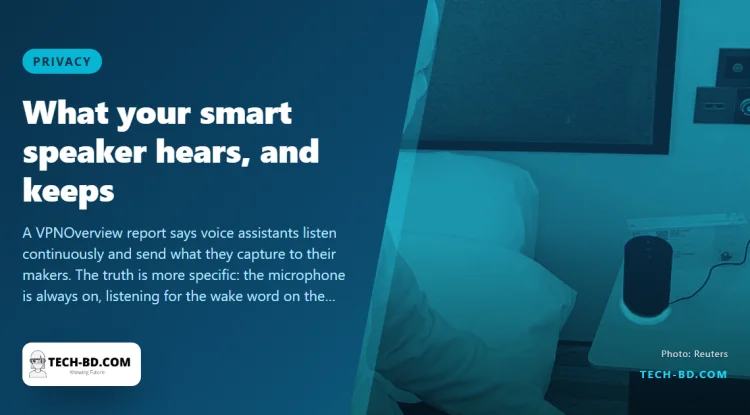
Seven in the evening. A nine-year-old asks the speaker in the corner of the room whether it will rain tonight. The speaker answers nicely, and even asks whether he will be taking an umbrella. The child laughs — and his mother thinks: so the thing is listening all the time, then.
That is the smart speaker, the household assistant that listens. It is worth being precise about what has changed, because the honest answer to the mother’s question is different from what it was two years ago.
What changed
Earlier speakers understood only fixed commands. Now that generative AI has been added, devices like Google’s Gemini-powered home speaker — on the market since last June — and Amazon’s Alexa Plus can handle several tasks at once in natural speech: turning on lights, setting reminders, arranging a calendar.
Not all of these features are available in Bangladesh yet.
Where the risk sits
An AI that is in the house all the time means your conversations may be captured. Advanced features also generally require a monthly subscription.
The companies’ answer is that a ring of light shows when the speaker is listening, and that there is a button to switch the microphone off.
Three habits
1. Mute the microphone during sensitive conversations. The physical switch is the only control that does not depend on trusting the software.
2. Clear the recording history regularly. Both Google and Amazon keep one, and both let you delete it. Treat it like a browser history rather than something that manages itself.
3. Never say a PIN or a bank detail out loud. Not to the speaker, and not in the room with it.
The part the light does not cover
The light ring tells you when the device has decided it is listening. It does not tell you when it decided wrongly — the misfire on a word that sounded like the wake word, which is the case where a fragment of a conversation gets recorded that nobody intended.
This is why the recording history matters more than the indicator. The history is the only place you can see what the device actually captured, as opposed to what it signalled at the time. Checking it once is an education; deleting it regularly is the habit.
You have the right to know whether the ears are open even when the door is closed. Convenience and privacy are both possible — on the condition that the button is in your hand.
Why the answer changed
With the older devices, the honest answer to "does it hear everything?" was close to no. The speaker listened locally for one wake word and sent nothing until it heard it. Almost all of what passed through the room never left it.
With a generative assistant the balance shifts, because the device is built to handle a conversation rather than a command. More of what you say is worth sending, more context is retained between turns, and the useful features are the ones that depend on that. The device is not doing something sinister; it is doing the thing that was advertised.
The household question
Worth settling before the speaker arrives rather than after: who in the house can use it, and what is the room it sits in used for?
A speaker in a living room is a different proposition from one in a bedroom or a home office where work calls happen. The nine-year-old in the opening is the easy case — the harder one is the adult who takes a client call in the same room and forgets what else is in it.
None of this argues against owning one. It argues for deciding where it goes while you still have the box in your hand.