
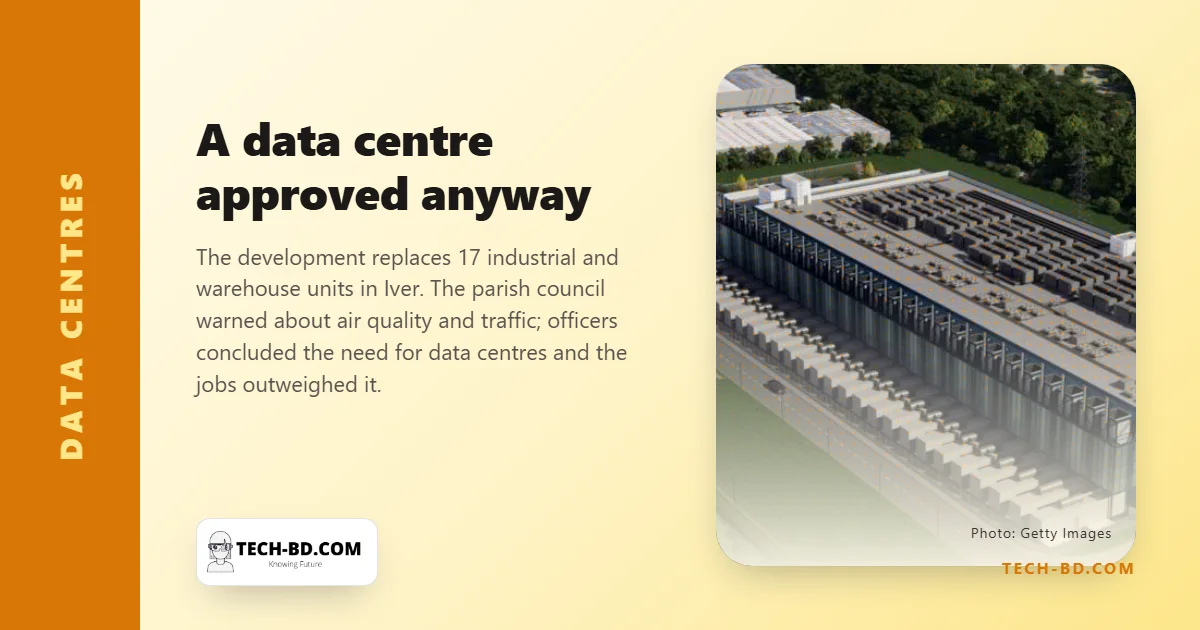
Amazon has been given the go-ahead to build a large data centre beside the M25, despite concerns about its environmental impact.
The decision
The development will replace 17 industrial and warehouse units on the Ridgeway Distribution Centre in Iver, Buckinghamshire.
The Ivers Parish Council said the building would have a negative impact on air quality and traffic. Buckinghamshire Council approved the plans on Monday.
Officers concluded that the need for data centres, the employment benefits, and an expected reduction in vehicle movements outweighed other considerations.
What it means in Bangladesh
That third reason is the one to notice, because it is the honest one. A data centre replacing seventeen warehouses generates far fewer lorry journeys than what it replaces. On traffic, the objection was simply wrong — and the planning officers said so.
The first reason is the one that should be examined wherever this argument is used, including here. "The need for data centres" is doing a great deal of work in that sentence. Need by whom, for what, and would refusing this site have prevented it or merely moved it? Those questions are rarely asked, and the answer is usually that the capacity gets built somewhere with weaker objections.
Bangladesh is at the start of the same conversation. Data centres are being built at Kaliakoir and by banks and telecoms, and the pitch is identical: jobs, digital sovereignty, national need. What the pitch tends to leave out is the generator room. A facility here has to promise power it can guarantee, and guaranteeing it still means diesel standing by — so part of what gets signed is a long bet on the landed price of a barrel.
The employment claim deserves particular scrutiny here. Data centres are capital-intensive and staff-light; a facility of this kind typically employs dozens, not hundreds, once built. That is not an argument against building them. It is an argument against justifying them primarily on jobs, which is how they are consistently sold in Bangladesh.
The useful thing to import is the process rather than the outcome. A parish council could object, the objection was recorded, officers published reasoning that addressed each point, and the decision can be read and argued with. Bangladesh's planning decisions on industrial siting are rarely documented to that standard — and the absence of a published reason is what makes every such decision look arbitrary, whether or not it is.