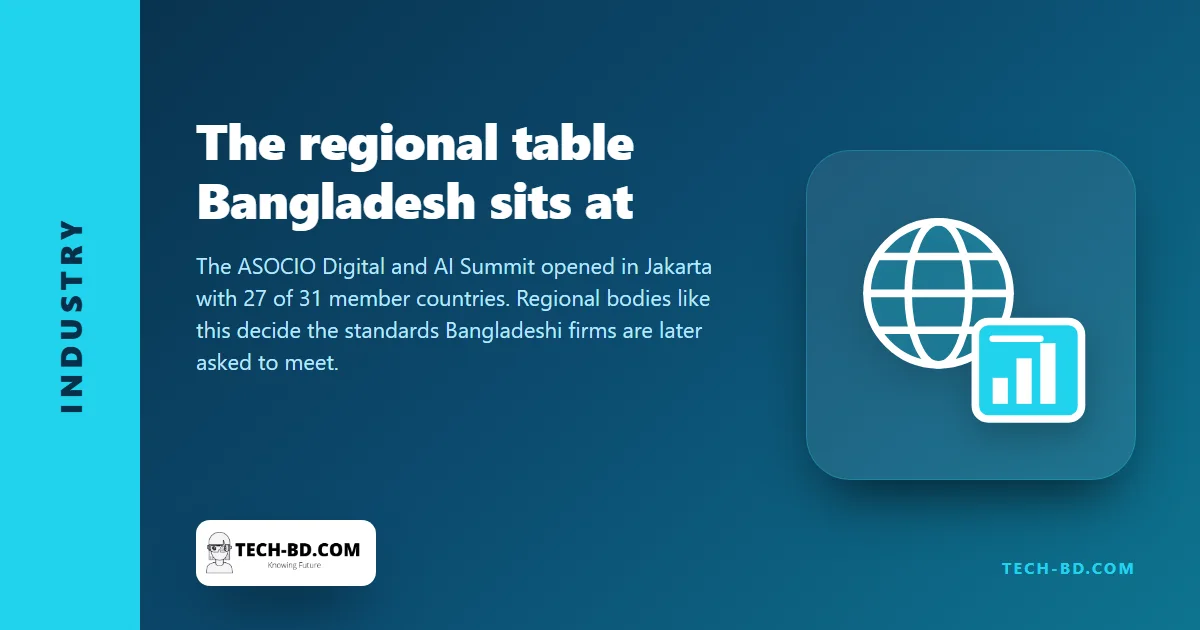
The three-day ASOCIO Digital and AI Summit 2026 opened on Monday at the Swissotel Jakarta PIK Avenue in the Indonesian capital. ASOCIO — the Asian-Oceanian Computing Industry Organisation — has 31 member countries, and 27 are taking part. It runs to Wednesday.
The programme is the usual summit mixture and the usual summit mixture is the point: ASOCIO's board and general meetings, an international conference on digital technology and AI, strategic discussions on digital transformation and the digital economy, sessions on AI governance and responsible AI, sessions on cybersecurity and digital infrastructure, an exhibition, the ASOCIO Awards, and meetings on regional cooperation, startup growth and investment.
ASOCIO chairman Stan Singh-Jit of Malaysia told Prothom Alo that in a fast-changing digital world, cybersecurity has become the foundation of economic stability, digital trust and sustainable innovation — and that as organisations and governments across Asia-Oceania adopt AI, cloud and connected digital ecosystems, strengthening cybersecurity capability matters more than ever. Indonesia's deputy tourism minister Ni Luh Puspa welcomed delegates.
What a body like this actually does
It is easy to read a summit agenda as nothing happening slowly. That underrates what regional industry organisations decide, and the decisions are the kind that reach a Dhaka software firm years later as a requirement rather than a discussion.
Three things get settled in rooms like this. Mutual recognition — whether a certification earned in one member country is accepted in another, which determines whether a Bangladeshi engineer's qualification travels. Common procurement language — the clauses that member governments and large buyers start putting in tenders, on data residency, security audits and now AI governance. And the regional position that gets carried into larger negotiations, where small markets are represented collectively or not at all.
None of that is signed at a summit. All of it starts there.
Why the AI governance sessions are the ones to watch
Most reporting on AI rules follows Washington and Brussels. For a Bangladeshi exporter, the Asia-Oceania position may matter more, because this is the region its customers are in.
A firm in Dhaka selling to Singapore, Malaysia, Japan or Australia will be asked to meet the buyer's AI and data requirements, not America's. If those requirements converge across the region, a single compliance effort opens 27 markets. If they diverge, each market costs its own audit, and the smallest exporters are the ones who cannot afford twenty-seven of anything.
That is the practical stake in a word like "harmonisation", and it is what makes a seat at the table cost less than it returns.
The question for the Bangladeshi delegation
Bangladesh's industry body is a member, and the question to ask is not whether attending is useful. It is what comes back.
A delegation returns with three possible things: photographs, contacts, or a document. Only the third compounds. If the summit produces a position on AI governance or a certification framework, the measure of a useful trip is whether that text reaches local member firms in a form they can act on — translated where needed, with a note saying which clauses will show up in next year's tenders.
That is a low bar and it is frequently missed, here and elsewhere. It is also the only part a member country fully controls.
What a smaller member can get out of it
There is a version of this that works for the smallest firms, and it is not a trade mission. A regional body has one thing a national one does not: a list of counterparts in 30 other markets who have already solved a problem you are hitting now.
A Dhaka firm trying to answer a Japanese client's data residency clause, or a Singaporean bank's security questionnaire, is rarely the first in the region to face that exact document. The organisation that can tell you who answered it last year is worth more than the one that issues the award.
On the industry body's recent work at home, see the Bitopia freelancing allegations. On where the sector says it wants to go, see the BPO summit and the advice to move up the value chain.