In 1997 an assistant professor from North South University went to a conference in Singapore and came back with a leaflet. He had met C J Hwang, a Taiwanese-American professor, who handed him a flyer for something called the ACM International Collegiate Programming Contest. Back in Dhaka he passed it to a colleague in the computer science department, Professor Abul L Haq. Twenty-five years later, that piece of paper is the reason the World Finals of the most prestigious programming contest on earth will be held in Dhaka this November.
18 November 1997
Haq took the leaflet seriously. Within months he had organised the first ICPC Asia Regional, Dhaka site, held at North South University on 18 November 1997. Eighteen teams from eleven universities took part. At the time only two other Asian cities, Taipei and Shanghai, hosted a regional; Dhaka was the third, years before Delhi, Kanpur or Jakarta. The rules were the ones still used today: three students, one computer, five hours, a set of algorithmic problems, and a scoreboard that rewards the team that solves the most, fastest.
What 25 years produced
The Dhaka regional became an annual fixture and the funnel through which BUET, Dhaka University, Shahjalal University, and later private universities, reached the World Finals. BUET's teams became regulars in the finals and have finished among the top thirty in the world. More important than any placing, the contest built a culture: the programming clubs and camps, the online judges, the Bangladeshi problem-setters now working for the ICPC itself, and a generation of engineers at Google, Microsoft and Dhaka's own software firms who first learned to think under a clock in a university computer lab in November.
2022: the finals come home
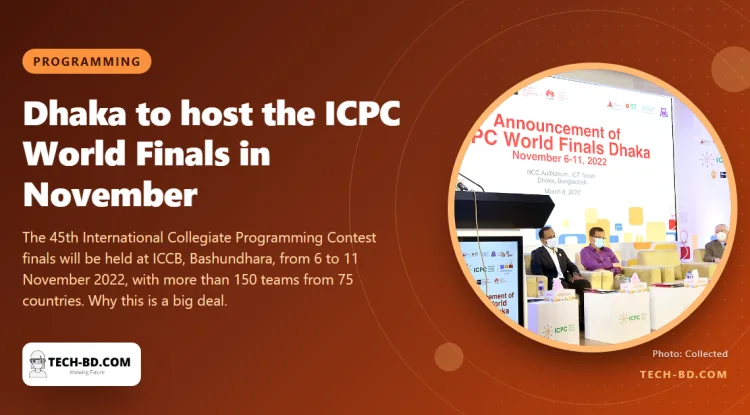
The 45th ICPC World Finals will be held in Dhaka in November 2022, hosted by the ICT Division with the University of Asia Pacific as academic host, the first time the finals have come to South Asia. The same year the Dhaka regional turns 25 and holds its 24th edition; its winners will go to the following year's finals, where more than 150 teams compete.
The leaflet, incidentally, described a contest that had already been running since 1970. Bangladesh joined late and caught up fast. That is roughly the story of the country's software industry too.