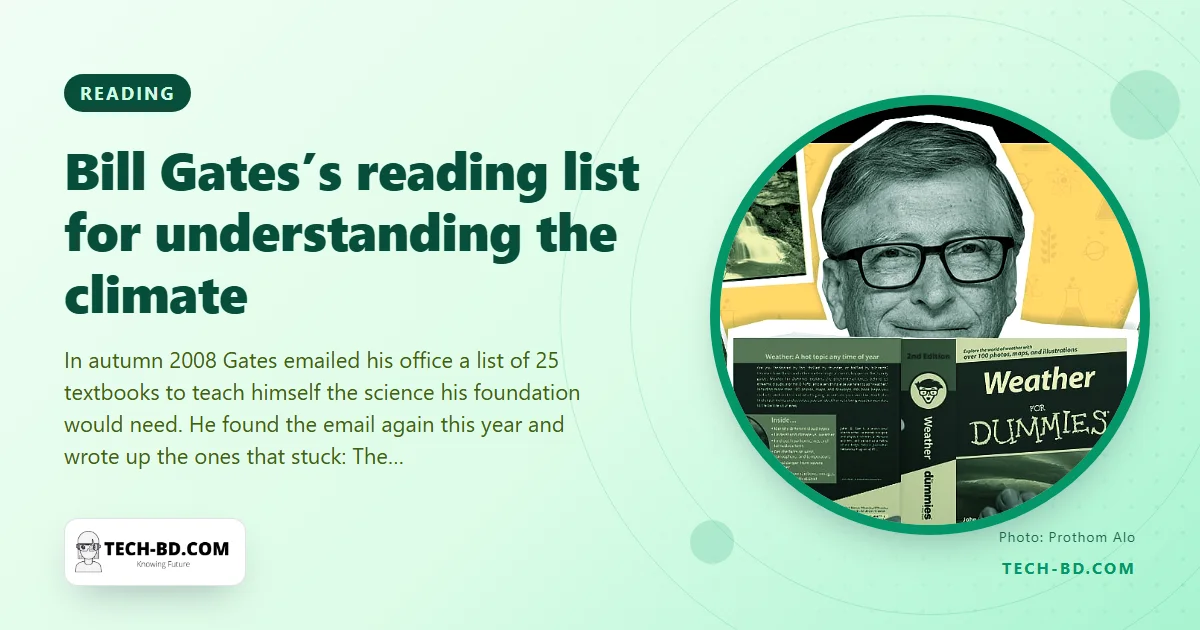
In the autumn of 2008 Bill Gates stopped running Microsoft and started working full time at his foundation, whose work — health, education, and increasingly climate — needed a grounding in sciences he had never studied. He did what he does: he sent his office an email listing 25 books to order. This month, fourteen years later, he found the email again and wrote on his blog, GatesNotes, about the ones on weather and geology that he still recommends.
The four books
The Atmosphere, by Frederick Lutgens and Edward Tarbuck, first published in 1979 and now in its fourteenth edition, is a college textbook, but Gates says anyone who wants to understand how the planet’s climate works can read it: rainfall, air pressure, storms, pollution, explained with the colour diagrams that make textbooks expensive and useful. Physical Geology, by James Monroe, Reed Wicander and Richard Hazlett, does the same for plate tectonics, volcanoes, glaciers and the geological record of past climates. Planet Earth, by John Renton of West Virginia University, made his list for two reasons: the book itself, and the author, whose video lecture course Nature of Earth: An Introduction to Geology Gates watched afterwards and describes as the work of a man who makes rocks interesting. And Weather for Dummies, which was on the 2008 order and which, he writes, is exactly what it says: a clear introduction that no adult should be embarrassed to be seen with.
The rest of the shelf
The same post mentions Elizabeth Kolbert’s Under a White Sky on human intervention in nature, Eula Biss’s On Immunity, Siddhartha Mukherjee’s The Gene and his new The Song of the Cell, Nancy Stepan’s Eradication on the history of disease campaigns, and, as always with Gates, the energy writer Vaclav Smil.
Why this matters here
Bangladesh is a country made entirely of the subjects on this list. It is a delta of river sediment (Physical Geology), its year is set by the monsoon (The Atmosphere), and its future is the sea level and the cyclone track (both). Yet earth science is barely taught in schools beyond a chapter of geography, and the public conversation about climate — the most important conversation this country will have — is conducted mostly in slogans. The textbooks Gates names are old, cheap in used editions and, in the case of Renton’s lectures, free on YouTube. A student in Khulna who works through them will understand the ground under her house better than most of the officials planning to protect it.
Source: GatesNotes, via Prothom Alo.