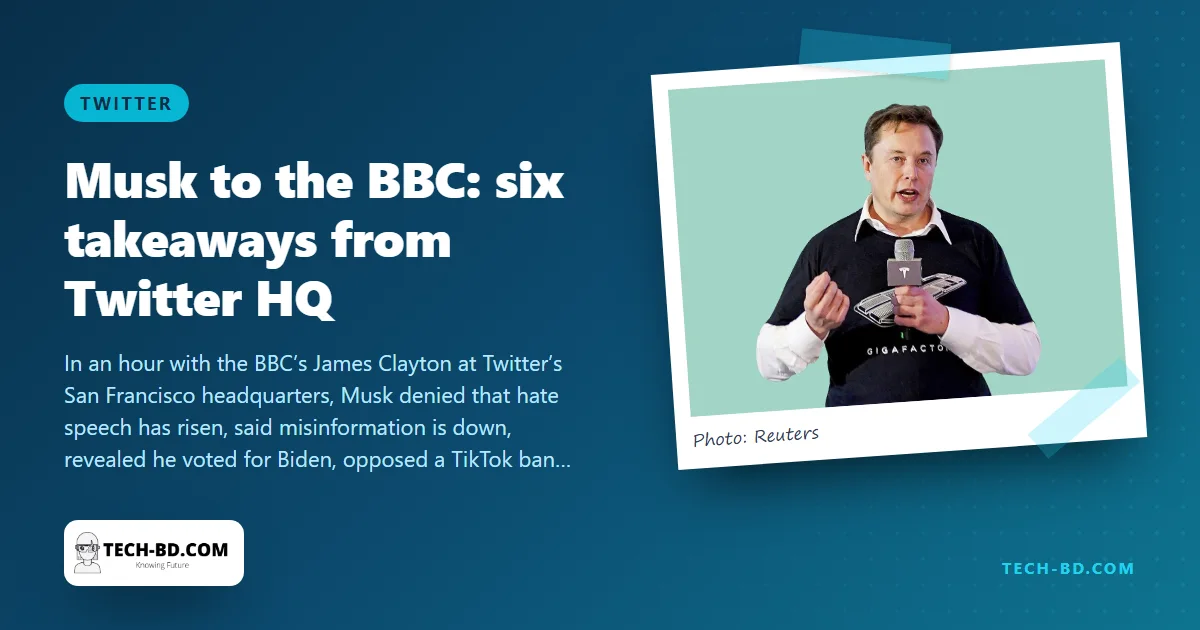
Elon Musk gives few interviews, and this one was arranged at a few hours’ notice: the BBC’s technology correspondent James Clayton was invited to Twitter’s San Francisco headquarters late on Tuesday and sat for nearly an hour with the company’s owner, live-streamed on Twitter itself. It came days after Twitter labelled the BBC “government-funded media”, which the broadcaster disputes. Six things emerged.
1. He would not buy it again
Asked whether he would sell Twitter for the $44 billion he paid last October, Musk said he would decline the offer — and then that he would not pay it again either. The company, he said, was loss-making and months from insolvency when he took it; it has since cut its staff from about 8,000 to about 1,500, and is now “roughly breaking even”, with most advertisers back. He described the past six months as “quite painful”.
2. Hate speech: “give me one example”
Former staff have told the BBC that after the lay-offs Twitter can no longer adequately police trolling, state-backed disinformation and child sexual exploitation; the company deleted 400,000 accounts in March. Musk rejected the claim that hate speech has risen, and when Clayton could not cite a specific post he had seen, pressed him on it — the exchange that went viral. His position: nobody outside had access to the data before he arrived either, and his own reading of his feed shows less hate and less misinformation than before.
3. He voted for Biden
Musk said he voted for Joe Biden in 2020 — while defending his reinstatement of Donald Trump’s account, banned in 2021 for incitement, on free-speech grounds.
4. Don’t ban TikTok, even though it would help him
He does not use TikTok, which the US is considering banning and several governments have removed from official phones. “I’m generally against banning things,” he said — and added, with unusual candour, that a ban would benefit Twitter because people would spend more time there.
5. The BBC label
He conceded the “government-funded” tag was wrong for a broadcaster paid for by a licence fee, and promised to change it to “publicly funded”. The new label appeared within hours of the interview ending.
6. The style
He said his dog is now Twitter’s CEO, that he sleeps at the office, and that he has no regrets about tweets that cost him sleep. The interview did nothing to settle whether Twitter is safer or more dangerous than before; it did show a man running the platform by instinct and argument rather than by the moderation apparatus that used to run it. For users in Bangladesh, where Twitter is small but is where journalists, diplomats and the diaspora argue in public, that is the fact to hold on to: the rules are now one person’s opinion, stated live.
Source: BBC, via Prothom Alo.