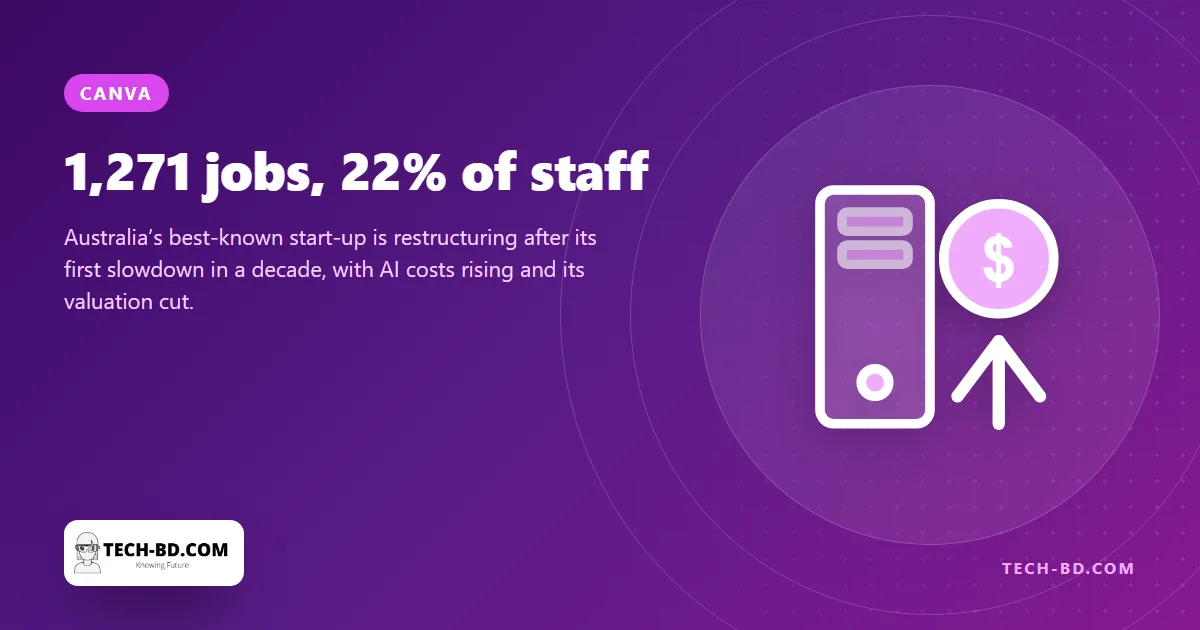
Canva, the Australian design platform and one of the country’s best-known start-ups, is restructuring in a way that affects 22% of its workforce. Co-founder and chief executive Melanie Perkins told staff that 1,271 people will either lose their jobs, be asked to relocate, or have their roles changed.
She described it as “without doubt the hardest moment in our thirteen-year history”, and the note did not soften the arithmetic: “Sadly, it will also mean saying goodbye to teammates and friends who have helped build Canva into what it is today.”
The number behind the number
The sentence that explains the rest is this one, from Perkins: it had been “our hardest year yet, and as we shared earlier this year, our growth has slowed for the first time in a decade”.
A decade of uninterrupted growth is what the company’s valuation was built on. When that stops, the valuation follows. Two of Canva’s backers, Blackbird Ventures and Airtree, are reported to have marked it down from about A$60bn at the end of last year — roughly $41.8bn, or £31.1bn — to about A$49bn. Canva is also reported to have cut its own internal valuation.
Why AI is on both sides of the ledger
The pressure on Canva is unusual because artificial intelligence appears as both the threat and the cost.
On one side, the company’s core promise — that someone with no design training can produce a professional-looking graphic — is exactly what a general-purpose image model now offers for nothing. Canva built its business on templates; the competition increasingly needs no template at all.
On the other, answering that threat is expensive. Canva’s internal valuation cut has been attributed to soaring AI expenses tied to rolling out new products. The company must spend heavily on the very technology that is eroding the moat, which is a difficult position to be in and an easy one to describe.
“New technology is transforming what people can create, how they create it, and what they expect from the products they use,” Perkins wrote on Wednesday.
Not only redundancies
It is worth being precise about the 1,271, because the figure covers three different outcomes and only one of them is job loss. Some people are being asked to move; others are having their roles rewritten.
Canva has staff in 37 countries, and the restructuring pulls work inward. Sydney is to become the “primary home” for more of the company’s product teams, and from next year hybrid staff will be expected in an office two to three days a week.
That is a quiet reversal. Canva grew internationally and distributed; consolidating product teams into centralised hubs is a bet that the slowdown is partly a coordination problem.
From a university dropout to 37 countries
Perkins left university at 19 to found her first venture and launched Canva in 2013. The product offers templates and tools for people without technical skill or design background, covering everything from wedding invitations to business pitch decks — a market that barely existed as a category before it.
What this signals beyond Canva
Canva is not a company in trouble in the usual sense. It is profitable in a way many start-ups of its generation never were, and A$49bn is not a collapse. What makes this worth noting is that it is one of the first clear cases of a large, successful software business restructuring specifically because generative AI has changed what its product is worth.
Plenty of firms have cited AI while cutting staff. Fewer have been this direct that the technology is simultaneously the competitor and the bill.