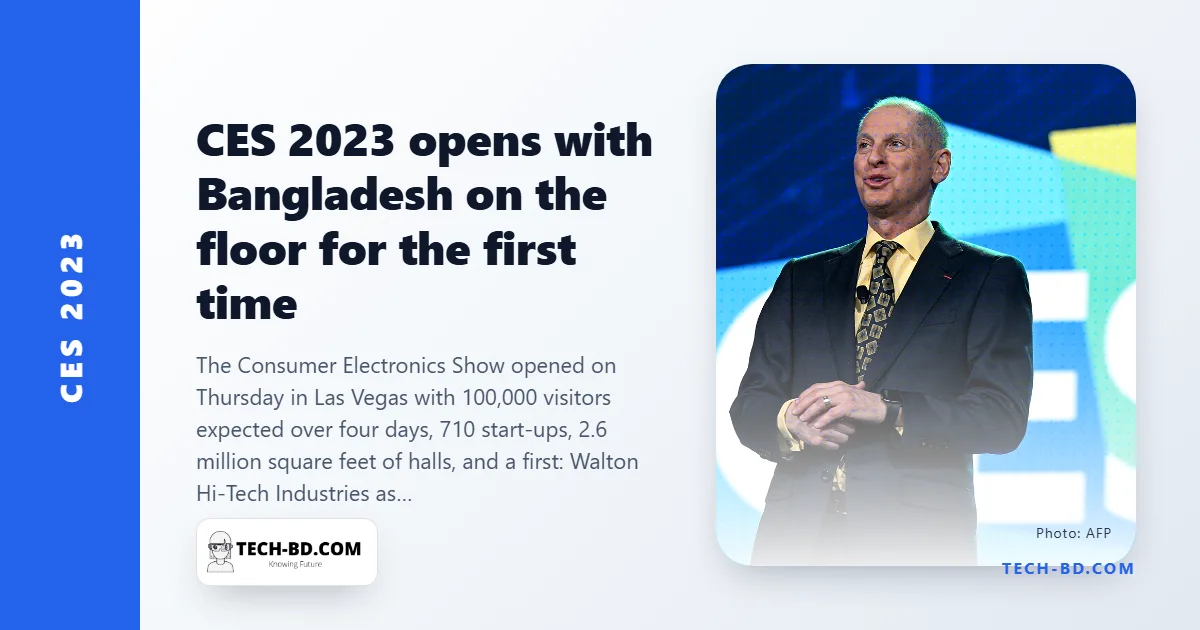
The Consumer Electronics Show opened its doors at 9 am on Thursday at the Las Vegas Convention Center — the first full-scale CES since January 2020. The 2021 show was online and the 2022 one half-empty under Omicron; this year the organisers, the Consumer Technology Association, expect more than 100,000 visitors over four days across 2.6 million square feet, with Google, Samsung, LG and Sony alongside 710 start-ups. Ticket desks are open from the airport to the big hotels, and the whole city is dressed for it. The show runs until 8 January.
A first for Bangladesh
Among the national pavilions and the start-up alley there is, for the first time, a stand from Bangladesh. Walton Hi-Tech Industries, the country’s largest electronics manufacturer, has taken space to show refrigerators, televisions and other products under a “Made in Bangladesh” banner. “We are looking at a fair like CES, and especially the US market, with particular seriousness,” Golam Murshed, Walton’s managing director and chief executive, told Prothom Alo from the stand. “I believe it is possible to build a market in the developed world with Bangladeshi technology. Walton has both the capability and the preparation.” The company is pushing internet-connected fridges and TVs, and he said the first day’s response had been good: “It is the start of a new day for Bangladesh’s electronics and technology manufacturing.”
What people queued for
Day-one crowds went where the pre-show talk had pointed them. Ottonomy showed a food-delivery robot it says will be on the streets of some European cities this year. LG’s 97-inch OLED with no cable but the power lead — video arrives wirelessly from a box across the room — drew the longest line in Central Hall. Elsewhere: Sony and Honda’s Afeela car, a colour-changing BMW, and the first laptops with Intel’s 13th-generation chips.
Why the stand matters more than the products
Walton’s fridges are not going to surprise anyone in Las Vegas. What a CES stand buys is meetings: with US retailers who decide what sits on Best Buy’s shelves, with component suppliers, and with the trade press that has never written the words “Bangladeshi electronics”. Garments took twenty years to make “Made in Bangladesh” a label buyers trusted. Walton is trying to do the same for a refrigerator, and CES is where that starts — with a badge on a stand rather than a sale.